
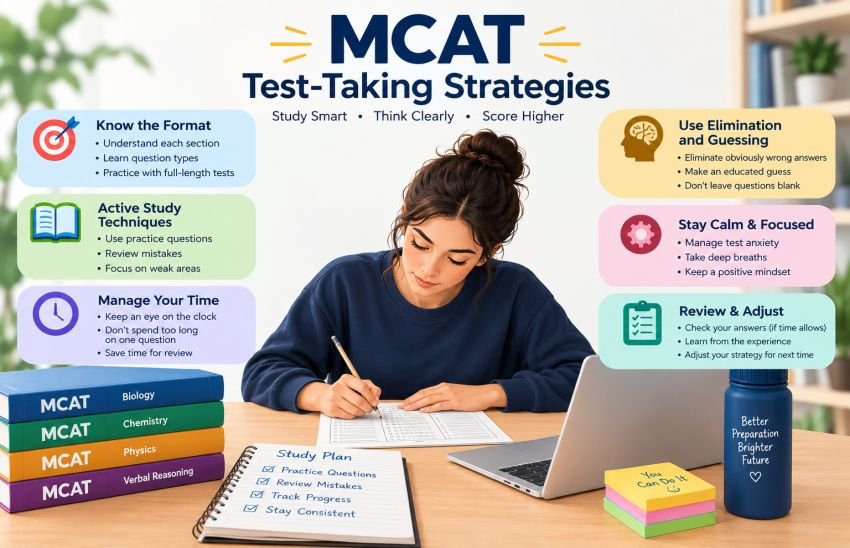
Preparing for the MCAT can feel like trying to solve two different problems at once.
Table of Contents
ToggleFirst, you have to learn a huge amount of material. Biology, biochemistry, chemistry, physics, psychology, and sociology all matter. But knowing the material is only half the challenge.
The second challenge is knowing how to use what you know when the clock is running.
You can understand a concept perfectly during a study session and still miss a question because you misunderstood the passage, rushed through a graph, spent too long on another problem, or chose an answer that was technically true but did not actually answer the question.
That is where effective MCAT test taking strategies become important.
The MCAT is designed to test more than simple recall. In the science sections, you are expected to combine foundational knowledge with scientific inquiry and reasoning. CARS is different: it focuses on comprehending, analyzing, and evaluating information presented in passages.
So, instead of approaching the MCAT as a giant memorization test, think of it as a combination of knowledge, reasoning, reading, decision-making, pacing, and endurance.
This guide covers 15 strategies that can help you approach the exam more effectively, along with current MCAT statistics, practical examples, timing guidance, and mistakes to avoid.
What Are MCAT Test Taking Strategies?
MCAT test taking strategies are the techniques you use to make better decisions while answering questions under the exam’s time constraints.
They include things such as:
- understanding what a question is really asking,
- reading passages strategically,
- identifying important experimental information,
- interpreting graphs and tables,
- eliminating incorrect answers,
- estimating calculations,
- managing your time,
- recognizing when to move on,
- reviewing mistakes,
- staying focused during a long exam.
These skills are different from content knowledge.
For example, you might know exactly what an independent variable is. But on the MCAT, you still have to recognize which variable in an unfamiliar experiment is independent.
Likewise, you may know how to calculate a percentage, but you still need to decide whether an exact calculation is necessary or whether estimation will get you to the correct answer faster.
That distinction is important.
Studying content gives you the tools. Test-taking strategy helps you use those tools efficiently.
Understanding the Current MCAT Format
Before working on strategy, make sure you understand what you are actually preparing for.
The current MCAT contains four multiple-choice sections and 230 questions in total. The AAMC lists 95 minutes for Chemical and Physical Foundations, 90 minutes for CARS, 95 minutes for Biological and Biochemical Foundations, and 95 minutes for Psychological, Social, and Biological Foundations. Total content time is 6 hours and 15 minutes, while total seated time is approximately 7 hours and 30 minutes.
| MCAT Section | Questions | Time |
|---|---|---|
| Chemical & Physical Foundations of Biological Systems | 59 | 95 minutes |
| Critical Analysis & Reasoning Skills (CARS) | 53 | 90 minutes |
| Biological & Biochemical Foundations of Living Systems | 59 | 95 minutes |
| Psychological, Social & Biological Foundations of Behavior | 59 | 95 minutes |
| Total | 230 | 6 hr 15 min content time |
There are also scheduled breaks between sections, and the AAMC lists total seated time at about 7 hours and 30 minutes.
That length alone tells you something important:
You are not only preparing for a knowledge test. You are preparing for a long period of sustained concentration.
Current MCAT Statistics: What Do the Numbers Tell You?
It is useful to understand the current scoring landscape, but avoid treating national averages as personal score requirements.
For percentile ranks in effect from May 1, 2026, through April 30, 2027, the AAMC reports a mean MCAT total score of 500.6 and a standard deviation of 11.2.
Some current percentile benchmarks include:
| Total MCAT Score | Approximate Percentile |
|---|---|
| 500 | 48th |
| 505 | 64th |
| 508 | 74th |
| 510 | 79th |
| 515 | 91st |
| 520 | 97th |
| 525 | 100th |
| 528 | 100th |
Percentiles are useful because they show how a score compares with other test takers. The AAMC explains that a percentile rank represents the percentage of test takers who received the same score or a lower score.
The important takeaway is not that everyone should target a particular number.
Your target score should depend on factors such as your medical school list, academic profile, practice-test performance, and overall application strategy.
15 MCAT Test Taking Strategies That Can Help You Perform Better
1. Identify What the Question Is Really Asking
One of the easiest ways to waste time on the MCAT is to start solving a problem before figuring out what you are being asked to find.
Take a few seconds to identify the task.
Is the question asking you to:
- identify a mechanism?
- interpret a result?
- make a prediction?
- compare two groups?
- apply a scientific concept?
- determine what happened in an experiment?
- identify the author’s argument?
- draw an inference?
These are different tasks and may require different approaches.
Try this habit
Before looking at the answer choices, mentally complete this sentence:
“This question wants me to…”
For example:
“This question wants me to determine why the experimental group changed.”
Now you have a much clearer target.
The AAMC’s sample-question resources emphasize that MCAT science questions require students to apply foundational knowledge and scientific inquiry and reasoning skills rather than simply recall isolated facts.
2. Learn to Recognize Different Question Types
Not every MCAT question should be approached in exactly the same way.
Some questions primarily test content knowledge.
Others require you to extract information from a passage.
Still others combine the two.
Discrete questions
These are relatively independent of the passage.
Your approach can be simple:
Question → concept → answer
Passage-based questions
These require you to work with information presented in the passage.
Your approach becomes:
Passage → relevant evidence → reasoning → answer
Data-based questions
These may require you to interpret:
- graphs,
- tables,
- experimental results,
- diagrams,
- relationships between variables.
Knowing which kind of task you are facing prevents you from using the wrong strategy.
3. Stop Trying to Read as Fast as Possible
Fast reading sounds attractive when you have a long MCAT passage in front of you.
But speed without comprehension often creates another problem: rereading.
You might race through a passage, realize you do not understand it, and then spend even more time going back through the same paragraphs.
A better goal is efficient reading.
As you read, try to understand:
- the main point,
- the purpose of the passage,
- important changes,
- experimental design,
- major conclusions,
- relationships between ideas.
You do not need to memorize every sentence.
Think of the passage as a map.
You want to know where the important information is so that you can return to it when a question requires it.
4. Use a Different Approach for CARS
CARS deserves special attention because it does not work like the science sections.
The AAMC lists 53 questions in 90 minutes, and all CARS questions are passage-based. The section tests three broad reasoning areas: Foundations of Comprehension, Reasoning Within the Text, and Reasoning Beyond the Text.
CARS also does not require specific outside content knowledge in the same way the science sections do.
That means your job is not to become an expert in every subject that appears in a passage.
Instead, focus on the author’s reasoning.
Ask:
What is the author saying?
Then:
Why is the author saying it?
And finally:
How does the rest of the passage support that position?
Don’t answer based on your personal opinion
A CARS answer can sound reasonable to you and still be wrong.
The question is not:
“Do I agree with this?”
It is:
“Does the passage support this?”
That distinction can make a major difference.
5. Treat Science Passages Like Experiments
Science passages become easier when you stop trying to absorb every technical detail at once.
Instead, look for the structure.
Ask yourself:
- What are the researchers trying to find out?
- What did they change?
- What did they measure?
- What did they compare?
- What happened?
- What conclusion can be supported by the results?
You can think of the basic structure as:
Question → Method → Variables → Results → Conclusion
For example, imagine a study comparing two groups of cells.
If one group receives a treatment and another does not, you immediately have useful information:
- treatment = likely independent variable
- measured response = likely dependent variable
- untreated group = potential control
You do not necessarily need to understand every technical term in the passage before you can understand the experiment.
6. Get Comfortable With Graphs and Tables
A graph can look complicated while actually telling you something fairly simple.
Before interpreting it, check:
- What is the x-axis?
- What is the y-axis?
- What are the units?
- Which groups are being compared?
- Is the relationship increasing or decreasing?
- Are there obvious differences?
- What conclusion is directly supported?
One common mistake is looking at the shape of a graph before understanding what its axes represent.
Don’t do that.
Read the axes first.
A graph that initially looks confusing can become much easier once you know exactly what is being measured.
The AAMC’s sample-question guidance specifically notes that MCAT questions may require students to use information presented in tables, charts, and graphs.
7. Use Estimation When Exact Math Isn’t Necessary
The MCAT requires quantitative reasoning, but you should not assume that every calculation needs to be completed to several decimal places.
Suppose the answer choices are:
- 0.02
- 0.2
- 2
- 20
You may not need to perform an elaborate calculation to determine the correct order of magnitude.
Estimation can be useful for:
- scientific notation,
- percentages,
- ratios,
- square roots,
- unit conversions,
- order-of-magnitude comparisons.
A simple example
If you need to estimate √20, you know:
- √16 = 4
- √25 = 5
Therefore, √20 must fall between 4 and 5.
If your answer choices are sufficiently separated, that may be all you need.
The point isn’t to avoid calculation.
It is to recognize when calculation is necessary and when it is not.
8. Make Process of Elimination a Habit
You won’t know every answer immediately.
That’s normal.
When you are uncertain, don’t simply stare at all four choices and hope one suddenly looks familiar.
Start eliminating.
For each answer, ask:
- Does it contradict the passage?
- Is it scientifically incorrect?
- Does it answer a different question?
- Is it too broad?
- Is it too extreme?
- Does it introduce information that isn’t supported?
Even removing one or two bad choices can make a difficult question much more manageable.
Think like this:
Four choices → two plausible choices → compare evidence → best answer
This is much better than treating an uncertain question as a 25% guess.
9. Learn to Spot the “Almost Right” Answer
Some MCAT questions are difficult because an incorrect answer contains something true.
That is exactly what makes it tempting.
Consider this:
A question asks which statement best explains an experimental result.
One answer may describe a fact that is scientifically correct.
But if that fact does not explain the result, it is still wrong.
This creates one of the most important MCAT habits:
Don’t ask only:
“Is this statement true?”
Also ask:
“Does this statement answer the question?”
Other common traps include:
- partially correct answers,
- answers that go beyond the evidence,
- extreme statements,
- answers based on irrelevant outside knowledge.
The best answer is the one that most directly fits the question and the evidence.
10. Know When to Move On
This is one of the most important pacing skills you can develop.
Imagine you encounter a difficult question.
You spend one minute on it.
Then another 30 seconds.
You still aren’t sure.
At this point, continuing to fight the question may be costing you more than the question is worth.
A better strategy can be:
Choose your best answer → flag it → move forward.
You can return later if time permits.
This doesn’t mean you should rush through difficult questions.
It means you should recognize when additional time is no longer producing useful progress.
During practice, experiment with your own “move-on point.”
For some students, the warning sign is 60–75 seconds without a productive path. For others, it may be slightly different.
The important part is having a rule before test day.
11. Protect Your Time From One Bad Question
A difficult question becomes especially dangerous when it affects the questions that come afterward.
Imagine:
One hard question → five minutes lost → rushed passage → careless mistakes
The original question may have cost you one point.
The time problem can cost you several more.
That’s why pacing isn’t simply about moving quickly.
It is about protecting future questions.
If you are stuck, remind yourself:
“I don’t need to solve every question immediately. I need to manage the entire section.”
That mindset can help you make better decisions under pressure.
12. Review Your Mistakes Like a Coach, Not a Judge
A practice score tells you where you are.
Your mistakes tell you how to improve.
After a practice test, don’t just count the number of questions you missed.
Find out why you missed them.
A useful mistake log might look like this:
| Problem | What Happened? | What to Do Next |
|---|---|---|
| Content gap | Didn’t remember concept | Review concept + practice |
| Misread question | Missed what was being asked | Slow down on question stem |
| Graph error | Misread axis | Practice data interpretation |
| Timing | Spent too long on one question | Establish move-on rule |
| Careless error | Knew concept but made mistake | Check reasoning before submitting |
| Trap answer | Picked true but irrelevant choice | Practice elimination |
| Overthinking | Changed correct answer | Require evidence before changing |
This turns a practice exam into a personalized study plan.
The AAMC’s own study-planning guidance recommends using baseline testing to identify knowledge gaps and then using active learning, practice, and reflection to address those weaknesses.
13. Practice Under Realistic Conditions
A practice test should feel like a practice version of the real thing.
If you:
- pause the exam,
- check your phone,
- take unlimited breaks,
- look up answers,
- change the timing,
- work from a comfortable bed,
you are not testing the same skills you will need on exam day.
The AAMC provides official practice exams that replicate the actual exam’s look, feel, functionality, and length. Its free Practice Exam One also provides a scaled score and percentile rank.
Use those resources strategically.
Create a realistic routine
Try to:
- start at a consistent time,
- follow the official timing,
- use the scheduled breaks,
- avoid distractions,
- sit at a desk,
- complete the entire exam,
- review your performance afterward.
You’re training your brain not only to answer MCAT questions but to do so after several hours of sustained concentration.
14. Build Mental Endurance Before Test Day
The MCAT is long.
Even if you understand every section individually, the experience of completing all four sections in one sitting can be challenging.
This is why full-length exams are valuable.
During practice, pay attention to when your concentration starts to decline.
Do you notice:
- slower reading?
- more careless mistakes?
- difficulty understanding graphs?
- frustration with difficult questions?
- more answer changes?
- rushing near the end?
Those observations are useful.
If your performance drops late in the exam, you may need more endurance practice—not necessarily more content review.
15. Have a Plan for Difficult Moments
No matter how well you prepare, you will probably encounter questions that feel difficult.
That’s not automatically a sign that you’re doing poorly.
When that happens:
- Pause.
- Read the question again.
- Identify what it actually asks.
- Use the passage.
- Eliminate what you can.
- Choose the best-supported answer.
- Move forward.
Don’t allow one confusing question to determine the emotional direction of the entire section.
The same applies after a mistake.
Once you’ve submitted an answer, that question is finished.
Your next question deserves your full attention.
A Practical MCAT Timing Guide
The official section times give you a useful starting point for building your pacing strategy.
| Section | Questions | Minutes | Average Time per Question* |
|---|---|---|---|
| Chemical & Physical | 59 | 95 | ~1.61 min |
| CARS | 53 | 90 | ~1.70 min |
| Biological & Biochemical | 59 | 95 | ~1.61 min |
| Psychological, Social & Biological | 59 | 95 | ~1.61 min |
*These are mathematical averages, not instructions to spend exactly that amount on every question. Passage questions can require different amounts of time.
The key is not watching the clock every few seconds.
Instead, develop pacing checkpoints during your practice exams.
For example, you might periodically ask:
“Am I roughly where I should be?”
If yes, continue.
If no, make a deliberate adjustment rather than panicking.
How to Handle CARS Timing
CARS contains 53 questions in 90 minutes.
Because questions are grouped around passages, it can be more useful to think about pacing at the passage level than obsessing over every individual question.
During practice, experiment with how long you need to:
- read the passage,
- understand the argument,
- answer its questions,
- return to the passage when necessary.
The goal is consistency.
If one passage takes considerably longer than expected, don’t let it derail the rest of the section.
How to Handle Science Passage Timing
Science sections contain passage-based sets as well as independent questions. The AAMC currently lists 10 passage-based sets plus 15 independent questions in each of the three science sections.
That means you should practice moving between different question styles.
A useful workflow is:
Read → identify structure → answer → use evidence → move on
Don’t turn every passage into a full textbook chapter.
You are reading it to answer the questions.
Should You Highlight MCAT Passages?
Highlighting can help, but only if it serves a purpose.
If you highlight half the passage, you’ve essentially highlighted nothing.
Instead, consider marking information such as:
- major claims,
- important experimental changes,
- key definitions,
- surprising findings,
- major conclusions.
Your goal should be to make information easier to find later.
If highlighting slows you down, use less of it.
What If You Don’t Know the Answer?
This will happen.
The goal isn’t to eliminate uncertainty completely.
The goal is to make the best decision possible when uncertainty occurs.
Try this sequence:
Step 1: Re-read the question
Make sure you know exactly what it asks.
Step 2: Look for evidence
Return to the relevant part of the passage if necessary.
Step 3: Use your content knowledge
Connect the evidence with what you know.
Step 4: Eliminate
Remove choices that clearly don’t work.
Step 5: Compare the remaining choices
Ask which one is best supported.
Step 6: Decide
Don’t let uncertainty turn into several wasted minutes.
Don’t Change an Answer Without a Reason
Changing an answer isn’t automatically bad.
Sometimes you realize:
“I misunderstood the question.”
That’s a good reason to change it.
But this is different:
“I chose B, but now I’m nervous that B might be wrong.”
Anxiety isn’t evidence.
Before changing an answer, ask:
What specific information changed my mind?
If you have a concrete reason, reconsider.
If you simply feel uncertain, your original reasoning may still be the better guide.
Use the AAMC’s Official Practice Resources
Third-party preparation materials can be useful, but students should become familiar with official AAMC materials because they come from the organization responsible for the exam.
The AAMC currently provides a free 230-question Practice Exam One, a free 230-question Unscored Sample Test, the official content outline, and additional practice products.
The Practice Exam One is particularly useful because it uses previously administered MCAT questions and provides the same look, feel, functionality, scaled score, and percentile rank as an actual exam.
Official resource: AAMC MCAT Free Planning and Study Resources
A 2026 MCAT Prep Update You Should Know
If you’re preparing for a 2027 MCAT, pay attention to the AAMC’s current official-prep changes.
The AAMC says new resources and enhancements for the 2027 testing year are scheduled to become available on September 30, 2026. This includes a new CARS Question Bank containing 575 questions: 166 new questions plus 409 questions from existing CARS products.
The AAMC also says the CARS Diagnostic Tool and CARS Question Packs will no longer be available for purchase after September 14, 2026, although students who already have access can continue using those products until their expiration dates.
Because official preparation products can change, check the AAMC directly when planning your resources rather than relying on an older blog post.
How to Build Your Own MCAT Strategy
There isn’t one perfect MCAT study strategy for everyone.
A student who already has strong content knowledge may need more timed practice.
Another student may understand the exam format but have significant content gaps.
That’s why your first step should be assessment.
The AAMC recommends reviewing the official content outline and taking its free Unscored Sample Test to establish a baseline. The resulting score report can help identify knowledge gaps and areas requiring additional practice.
Think of your preparation as a cycle:
Assess → Study → Practice → Review → Adjust → Repeat
That is much more effective than simply following a calendar that tells you to study a certain subject for a certain number of hours.
Example: Turning a Weakness Into a Strategy
Suppose your practice test shows that you frequently miss experimental questions.
Don’t write:
“I’m bad at science passages.”
That’s too broad.
Look closer.
Perhaps you discover that you regularly confuse independent and dependent variables.
Now you have a specific problem.
Your solution could be:
- Review the difference between the variables.
- Practice identifying them in unfamiliar experiments.
- Complete targeted passage questions.
- Review every mistake.
- Re-test yourself a few days later.
That’s a strategy.
You moved from a vague weakness to a measurable skill.
What to Do During the Final Week
The last week should be about preparation and refinement, not panic.
Focus on:
- reviewing high-yield weaknesses,
- completing targeted practice,
- maintaining CARS practice,
- reviewing your mistake log,
- familiarizing yourself with the testing process,
- protecting your sleep,
- preparing your test-day logistics.
Avoid turning the final days into a marathon of brand-new material.
At that point, the goal is to arrive at the exam with your existing knowledge accessible and your strategy automatic.
MCAT Test Day: Keep It Simple
You don’t need a complicated psychological routine.
You need a reliable process.
Before the exam:
- know where you are going,
- understand the check-in requirements,
- prepare your break food and drinks,
- get adequate rest,
- arrive with enough time,
- know what you can and cannot bring into the testing area.
The AAMC says the exam is approximately 7 hours and 30 minutes of seated time, and test centers provide a noteboard and fine-tipped marker. Personal belongings, including phones, are stored according to test-center procedures.
During the exam:
- Read carefully.
- Manage your time.
- Use the evidence.
- Don’t get trapped by one question.
- Reset between sections.
MCAT Test Taking Strategies: Quick Reference Table
| Strategy | Why It Matters | What to Practice |
|---|---|---|
| Read the question first | Prevents solving the wrong problem | Identify the task |
| Strategic passage reading | Saves rereading time | Main idea + structure |
| CARS reasoning | CARS depends heavily on passage analysis | Author’s argument |
| Experimental analysis | Makes science passages manageable | Variables + controls |
| Graph interpretation | Prevents data-reading mistakes | Axes + trends |
| Estimation | Saves calculation time | Approximation |
| Elimination | Makes uncertain questions easier | Remove unsupported choices |
| Trap recognition | Prevents attractive wrong answers | True vs. relevant |
| Move-on rule | Protects your time | Timed practice |
| Mistake log | Reveals recurring weaknesses | Categorize every error |
| Full-length exams | Builds pacing and endurance | Realistic simulations |
| Break strategy | Helps maintain focus | Practice your routine |
| Mental reset | Prevents one mistake from spreading | Brief breathing/reset |
| Answer discipline | Reduces unnecessary changes | Change only with evidence |
| Official practice | Builds familiarity with AAMC style | AAMC materials |
Common MCAT Test-Taking Mistakes
Even students who have studied extensively can lose points because of strategy problems.
Reading too quickly
You may save seconds while creating minutes of rereading.
Spending too long on one question
The question is not worth sacrificing several later questions.
Ignoring the passage
Sometimes the information you need is right there.
Choosing a true statement
A true statement is not necessarily the answer.
Over-highlighting
Too much highlighting can become another form of distraction.
Ignoring graphs
The graph may contain the evidence needed to answer the question.
Changing answers without evidence
Doubt alone is not a reason to change.
Taking unrealistic practice tests
You need to practice the conditions you’ll actually face.
Reviewing only incorrect answers
Slow and uncertain correct answers can reveal weaknesses too.
Treating every problem as a content problem
Sometimes the issue is timing, reading, reasoning, or decision-making.
Final Thoughts
The MCAT is a demanding exam, but preparation doesn’t have to mean memorizing more and more information indefinitely.
At some point, the question becomes:
Can you use what you know effectively?
That’s where strong MCAT test taking strategies make a difference.
Learn to recognize what a question is asking. Read passages for meaning instead of racing through them. Treat science passages as experiments. Understand graphs before interpreting them. Use elimination when you’re uncertain. Estimate when exact calculations aren’t necessary. And, perhaps most importantly, learn when to stop fighting a question and protect the time you have left.
Your practice exams should also do more than produce a score.
They should tell you something about yourself.
Maybe you have a content gap in biochemistry. Maybe you understand the material but lose time on calculations. Maybe CARS is fine until you encounter a difficult passage. Maybe your accuracy drops during the final section because you’re mentally exhausted.
Those observations are valuable.
Use them.
The most productive MCAT preparation cycle is simple:
Assess → Learn → Practice → Review → Fix → Repeat.
The AAMC itself recommends starting with a baseline assessment, identifying knowledge gaps, using active learning, and deliberately practicing the skills required by the exam.
And remember that your strategy should evolve as you improve. The approach that helps you move from a 500 to a 505 may not be the same approach that helps you move from a 510 to a 515.
You don’t need a perfect strategy on your first day of preparation.
You need a strategy that gets better every time you practice.
That is ultimately what effective MCAT test taking strategies are about: not finding a magic shortcut, but learning how to turn your preparation into the best possible performance when test day arrives.
Frequently Asked Questions
What are the most important MCAT test taking strategies?
The most important strategies are strategic reading, pacing, process of elimination, graph interpretation, experimental reasoning, mistake analysis, realistic practice, and knowing when to move on.
How can I improve my MCAT score without simply studying more hours?
Start by identifying where your points are being lost.
If the problem is content, study content.
If the problem is timing, practice under time limits.
If the problem is reading, work on passage comprehension.
If you repeatedly fall for trap answers, study answer-choice patterns.
More hours aren’t automatically more effective. More targeted practice is often more useful.
How important are full-length MCAT exams?
They are important because they help you practice the combination of knowledge, pacing, concentration, and endurance required for the complete exam.
The AAMC recommends using full-length exams as part of preparation and advises students to take official practice exams under test-day timing conditions.
Should I use official AAMC materials?
Yes. They are especially useful for becoming familiar with the actual exam format and question style.
The AAMC currently offers two free full-length testing experiences: Practice Exam One, which is scored, and the Unscored Sample Test.
How should I review a practice test?
Don’t just look at your score.
Review:
- every incorrect answer,
- every guess,
- unusually slow questions,
- questions you got correct for the wrong reason.
Then classify the mistake and create a specific action to address it.
What should I do if I run out of time?
Don’t panic.
Make your best decision on the current question and move forward. During practice, establish a personal move-on rule so you don’t repeatedly spend several minutes on one problem.
How can I get better at CARS?
Practice consistently and focus on the author’s argument rather than trying to memorize details.
Ask:
- What is the main point?
- What is the author’s position?
- What evidence supports it?
- What can reasonably be inferred?
The AAMC describes CARS as a section focused on comprehension, analysis, evaluation, inference, and applying arguments and ideas to new situations.

Read Dive is a leading technology blog focusing on different domains like Blockchain, AI, Chatbot, Fintech, Health Tech, Software Development and Testing. For guest blogging, please feel free to contact at readdive@gmail.com.