
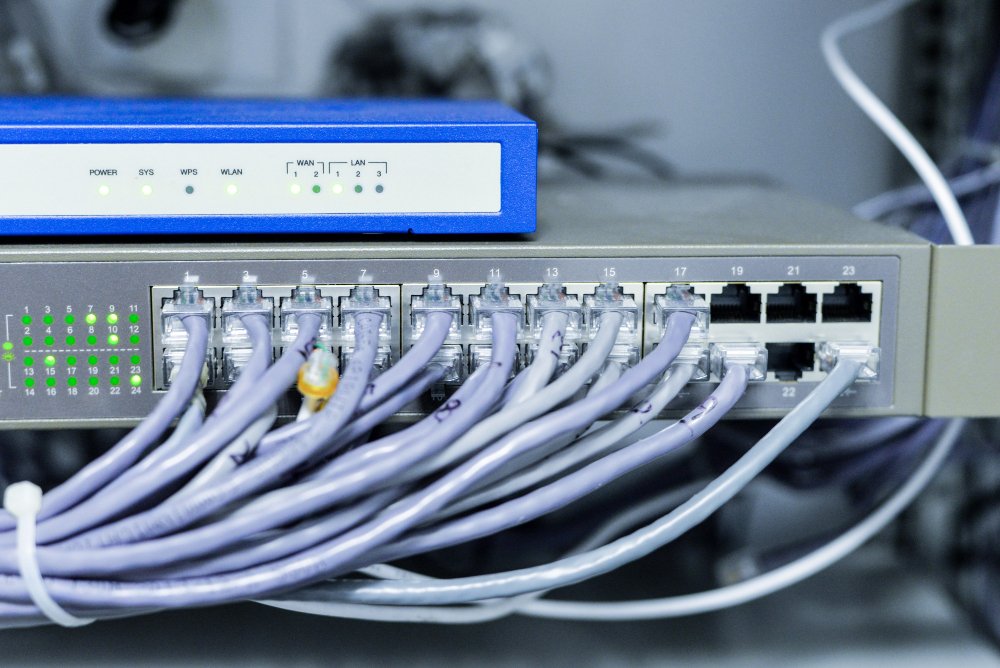
In 2025, the global Power over Ethernet (PoE) switch market is valued at approximately USD 4.4 billion and is expected to grow steadily to around USD 8.5 billion by 2035, reflecting rising adoption across enterprise networks, smart buildings, industrial IoT, and connected infrastructure.
PoE switches have become essential components in modern networks because they deliver both data and electrical power over a single Ethernet cable, simplifying deployments and reducing infrastructure complexity.
From powering IP cameras to Wi-Fi access points and LED lighting systems, PoE switches enable more efficient, flexible, and scalable networks.
Below are essential facts about PoE switches and their benefits.
Understanding PoE Switches
The Power over Ethernet (PoE) switch is a kind of network switch, which provides power to designated devices through Ethernet cables, certified to carry in place their main power supplies. These can then be shifted around, put wherever, and used in cordial areas with no electrical sockets.
PoE switches conform to the standards set by IEEE to ensure a restricted and efficient power supply, hence keeping in with a large selection of powered equipment.
Key PoE Standards and Power Levels
PoE technology is governed by several IEEE standards, each offering different power capabilities:
- IEEE 802.3af (PoE): Up to 15.4 watts per port
- IEEE 802.3at (PoE+): Up to 30 watts per port
- IEEE 802.3bt (PoE++): Up to 60–90 watts per port
These standards support a variety of devices from basic VoIP phones to high performing devices, like PTZ cameras and Wi-Fi 6 access points.
Benefits of Using PoE Switches
PoE switches can considerably reduce installation costs by excluding the necessity for different dedicated wiring. They also enhance flexibility, as a result of which the movement or expansion of devices becomes simpler and swifter with a negligible degree of sustained disruption.
From the management standpoint, PoE switches also enhance reliability with the help of resolute-powered centralized main switches, where the power distribution reduces the legacy design flaw of power production in which powered devices can be individually powered off or power-reset remotely with connectors. This feature is crucial for operations in enterprises and mission-critical environments.
Common Applications of PoE Switches
PoE switches are most often used with surveillance systems, enterprise-scale Wi-Fi setups, access control systems, and smart buildings. Best-fit is the category of environments that privilege tidiness of installation and manufacturability of device management.
PoE switches from the industrial class or for outdoor use enable the support of hardened devices where the provision of traditional power is impractical or even unsafe.
PoE Budgeting and Network Planning
The main issue that needs revealing is about the power configuration of the switches themselves. Each also has an aggregate total power that probably aims to support all the connected devices at any one time. Adequate planning ensures that each device derives sufficient power and, ideally, does not overload the switch.
Through monitoring tools, managed PoE switches enable the management of power consumption data from the network segment to be able to aid in optimizing power usage for performance.
Best Practices for PoE Switch Deployment
In conclusion, it is best for an organization to consider whether the devices need to be matched with the power supply provided by the PoE standards.
Likewise, the evidence at hand about documenting, monitoring the power, and developing firmware can assure a highly stable and future-proof Power over Ethernet (PoE) network.
Setting up a small-network infrastructure for an office or managing a highly sophisticated enterprise implies that one needs to understand the core facts associated with Power over Ethernet (PoE) switches.
Such an understanding will help enhance throughput and develop further the process-efficiency rate, and establish an efficient, reliable, and futuristically robust infrastructure network.

Read Dive is a leading technology blog focusing on different domains like Blockchain, AI, Chatbot, Fintech, Health Tech, Software Development and Testing. For guest blogging, please feel free to contact at readdive@gmail.com.