

As global industries increasingly adopt digital transformation and automation, the demand for technology professionals continues to evolve rapidly. With innovations such as artificial intelligence (AI), cloud computing, cybersecurity, and data analytics reshaping how work gets done, many people are asking: how many tech jobs will be open in 2026? This article examines the projections, current trends, skills demand, regional variations, and challenges in the tech job market as we approach 2026.
Tech Jobs in 2026: Overall Outlook and Projections
The technology labor market experienced strong growth in the past decade, and research suggests that this trend will persist, even if portions of the industry see fluctuations influenced by automation and economic shifts.
According to multiple industry forecasts:
-
Tech employment in the U.S. is projected to grow from about 6.09 million in 2025 to more than 7.03 million by 2035, marking continued expansion in science, computing, and IT roles.
-
The U.S. Bureau of Labor Statistics expects around 317,700 computer and IT job openings annually through the decade — a rate much faster than the national average for all occupations.
This projection includes both newly created positions and openings due to retirements and career movement, meaning hundreds of thousands of tech roles are expected to be open in 2026 alone.
Not All Growth Is Equal
While total tech employment grows, some companies and roles are experiencing hiring slowdowns or realignment. Jobs affected by automation or AI optimization may see fewer openings, especially for generalist or entry-level positions. However, demand remains high in specialized areas like data, security, cloud, and AI development.
Key Growth Trends and In‑Demand Skills

The landscape for tech jobs in 2026 highlights not just the number of roles available, but also where demand is strongest.
AI and Machine Learning
AI integration is now pervasive, with many employers requiring AI-related skills in job descriptions.
-
As of late 2025, 50% of U.S. tech job postings required AI skills, a near‑doubling from the previous year.
Specialized AI roles such as machine learning engineers, generative AI specialists, and AI governance experts are among the fastest‑growing, with some studies projecting AI skills demand to rise over 100% in the coming years.
Cybersecurity and Data Roles
Cybersecurity and data functions continue to be mission‑critical:
-
Forecast models show cybersecurity roles and data analysis positions among the fastest‑expanding functions — with projected growth far exceeding the broad tech job market average.
Organizations struggle with talent shortages; one survey found 87% of tech leaders reported difficulty finding skilled workers, especially at advanced levels.
Cloud and DevOps
Infrastructure roles tied to cloud computing and DevOps remain in significant demand, driven by enterprise digital workloads moving to cloud‑native environments.
-
Cloud computing jobs have grown rapidly and show strong salary and opportunity year‑over‑year.
Regional Trends: Where Are Tech Jobs Concentrated?
Tech job availability varies widely by region, both in the United States and globally.
Key U.S. States and Tech Hubs
-
California — Despite some layoffs in sectors like metaverse and hardware, major tech hubs such as Silicon Valley and the broader Bay Area continue to host large pools of software, AI, and cloud computing jobs.
-
Texas — Rapid infrastructure growth, especially in data centers and cloud services, boosts demand in Dallas‑Fort Worth and Austin.
-
New York — Strong FinTech, data, and cybersecurity ecosystems help sustain a large workforce demand.
-
Florida and Georgia — More companies are choosing business‑friendly environments, increasing tech hiring in these states.
These geographic differences demonstrate that while tech jobs in 2026 will be available nationwide, certain states will offer disproportionately higher volumes of opportunities, particularly in specialized, high‑skill areas.
Projected Openings by Job Category (2026)
Below is a look at which tech roles are expected to have the most openings by 2026:
| Job Category | Projected Growth & Demand |
|---|---|
| Software Developers & Engineers | High demand across industries |
| Data Scientists & Analysts | Very rapid growth, driven by data‑driven decision making |
| Cybersecurity Analysts & Engineers | Strong growth due to rising security threats |
| Cloud & DevOps Specialists | Continued expansion with cloud transformation |
| AI/ML Engineers | Rapidly increasing openings tied to AI adoption |
These trends indicate that while overall job counts matter, skills specialization will be a key determinant of how many roles are actually open and how quickly they are filled in 2026.
Challenges Affecting Tech Job Growth
The forecast for tech jobs in 2026 is positive, but not without challenges. Several labor market dynamics influence how many positions will be available:
Automation and AI Effects
While automation boosts productivity, it can also reduce the demand for certain tasks previously performed manually.
-
Some companies have reported tech layoffs in 2025 and early 2026, influenced by automation and organizational restructuring.
AI has also begun performing a significant proportion of routine tasks, which may impact roles that were once heavily human‑driven, but it simultaneously increases demand for tech professionals who can manage, augment, and secure AI infrastructure.
Skills Shortages
Despite unemployment fluctuations, many companies still cannot fill roles due to a lack of suitable candidates.
-
Over 90% of organizations worldwide are expected to face IT skills gaps by 2026, potentially costing trillions in lost productivity.
This gap may lead to many job openings staying unfilled for longer, especially at higher expertise levels.
Layoffs and Market Corrections
Layoffs in some tech segments — especially hardware and generalized IT services — have reduced job openings in those areas even as demand rises elsewhere.
These factors contribute to a job market where tech roles remain plentiful overall but competitive and evolving in terms of required skills.
Skills and Preparation: What Employers Want in 2026
Understanding how many jobs will be available is only part of the picture. Preparing for these roles — especially in high‑demand areas — is critical:
AI, Machine Learning & Data Literacy
-
Employers increasingly require candidates who not only understand AI but can deploy, optimize, and govern AI systems effectively.
Cybersecurity & Cloud Expertise
-
With more data stored in cloud environments, employers prioritize professionals capable of securing systems, managing identity, and ensuring compliance.
Software Engineering Best Practices
-
Programming remains essential, but the ability to build scalable, maintainable, and secure applications is increasingly valued across industries.
Soft Skills and Problem Solving
-
Technical proficiency alone may not be sufficient; communication, team collaboration, and design thinking continue to be key differentiators.
Graph: Tech Job Growth Projection (2024‑2034)
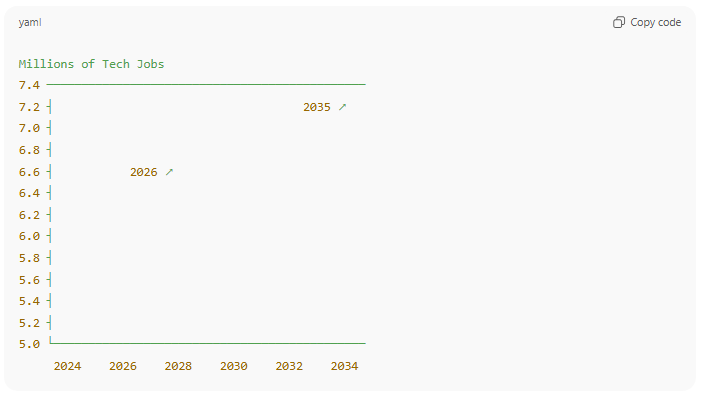
This projection illustrates a steady rise in total tech jobs worldwide, even accounting for market fluctuations and the effects of automation on workforce dynamics.
Conclusion
So, how many tech jobs will be open in 2026? While precise numbers will continue to fluctuate due to economic shifts, automation, and global labor trends, evidence points to hundreds of thousands of openings annually across core technology fields — particularly in cybersecurity, data science, AI, and cloud services.
With employment projected to grow faster than average for all occupations, the global economy will likely see millions of tech roles available in 2026, even as some segments contract or evolve due to automation. The key takeaway for job seekers and professionals is that skills specialization and adaptability will heavily influence how individuals succeed in the 2026 tech labor market.
By embracing emerging technologies, expanding AI fluency, and focusing on growth‑oriented skills, workers can position themselves to take advantage of the many opportunities that the future of technology continues to offer.
FAQs: Tech Jobs in 2026
1. How many tech jobs are expected to be available in 2026?
Estimates suggest hundreds of thousands of tech roles will open annually in the U.S., with millions globally, driven by AI, cloud, and cybersecurity demand.
2. Which tech roles will be most in demand in 2026?
High-demand roles include AI/ML engineers, software developers, data scientists, cybersecurity analysts, and cloud/DevOps specialists.
3. Which states in the U.S. will have the most tech job opportunities?
California, Texas, New York, Florida, and Georgia are projected to have the highest concentration of tech jobs, particularly in major metro tech hubs.
4. What skills will help candidates succeed in 2026 tech jobs?
Specialized technical skills in AI, cybersecurity, cloud computing, data analytics, and software engineering, along with soft skills like communication and problem-solving, will be crucial.

Read Dive is a leading technology blog focusing on different domains like Blockchain, AI, Chatbot, Fintech, Health Tech, Software Development and Testing. For guest blogging, please feel free to contact at readdive@gmail.com.