Businesses no longer buy software the same way they did a few years ago. Instead of contacting multiple vendors, scheduling lengthy product demonstrations, and comparing spreadsheets, companies increasingly rely on online platforms that make software discovery faster and more transparent. These platforms have evolved into trusted destinations where businesses can compare features, read customer reviews, evaluate pricing, and make informed purchasing decisions.
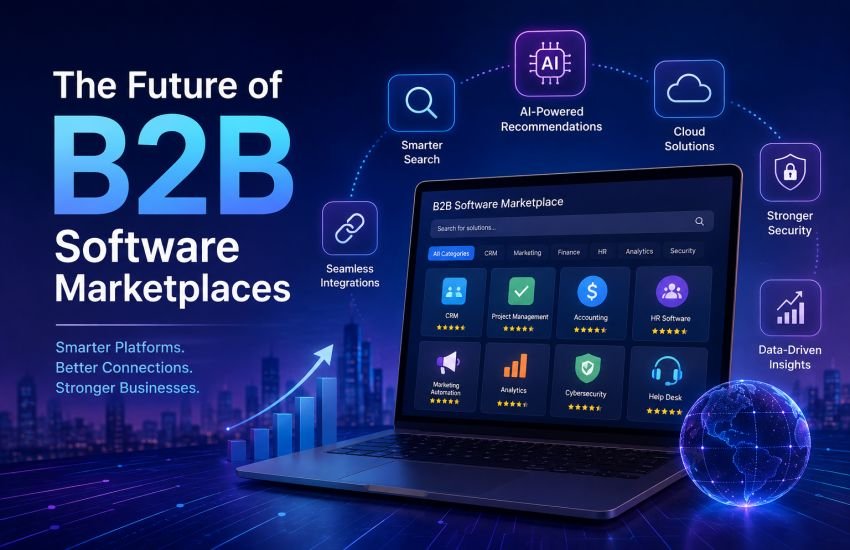
As digital transformation continues across every industry, B2B Software Marketplaces are becoming an essential part of the software buying journey. In 2026 and beyond, these marketplaces are expected to become smarter, more personalized, and more integrated with business operations.
This article explores how B2B software marketplaces are evolving, the technologies shaping their future, and what businesses should expect over the next several years.
What Is a B2B Software Marketplace?
A B2B software marketplace is an online platform where businesses can discover, compare, purchase, or subscribe to software solutions. These marketplaces bring together software vendors and business buyers in one convenient location.
Instead of visiting dozens of individual vendor websites, buyers can compare products based on:
- Features
- Pricing
- Customer reviews
- Industry focus
- Integrations
- Security standards
This centralized approach helps organizations make faster and more confident purchasing decisions.
Why Software Marketplaces Continue to Grow
Several factors are driving the rapid growth of software marketplaces.
Businesses now depend on dozens of digital tools to manage communication, accounting, marketing, customer service, cybersecurity, project management, and human resources. Finding the right software has become increasingly challenging as thousands of new solutions enter the market each year.
Software marketplaces simplify this process by organizing products into searchable categories while offering valuable information that helps buyers evaluate different options.
Remote work, cloud computing, and software subscriptions have also accelerated marketplace adoption because organizations need faster procurement processes than traditional software purchasing methods.
Key Trends Shaping the Future
Artificial Intelligence Will Personalize Recommendations
Artificial intelligence is transforming nearly every digital platform, and software marketplaces are no exception.
Instead of displaying the same software list for every visitor, future marketplaces will analyze business needs and recommend products based on factors such as:
- Company size
- Industry
- Existing software stack
- Budget
- Team size
- Business goals
This personalized experience will reduce research time and improve purchasing confidence.
Smarter Search Capabilities
Keyword searches are becoming less effective as software catalogs continue growing.
Future marketplaces will use semantic search powered by AI to understand user intent instead of matching only exact keywords.
For example, searching for:
“Affordable CRM for remote sales teams”
may instantly display software specifically designed for distributed sales organizations rather than generic CRM products.
Greater Transparency Will Build Trust
Business buyers increasingly expect honest and detailed information before making purchasing decisions.
Future marketplaces will likely include:
- Verified customer reviews
- Independent product comparisons
- Performance benchmarks
- Security certifications
- Customer satisfaction ratings
- Product update history
Greater transparency helps businesses avoid costly software mistakes.
Software Integration Will Become a Priority
Modern companies rarely use just one software application.
A marketing department may rely on:
- CRM software
- Email marketing platforms
- Analytics tools
- Project management software
- Communication platforms
Future marketplaces will place greater emphasis on integrations.
Instead of asking:
“Does this software work?”
buyers will ask:
“Does this software work with everything we already use?”
Marketplace listings will increasingly highlight compatibility with popular business applications.
AI Assistants Will Guide Buyers
One exciting development is the introduction of intelligent buying assistants.
Rather than browsing dozens of software pages manually, businesses may simply describe their needs.
Example:
“We need accounting software for a manufacturing company with 150 employees that integrates with Microsoft 365.”
The marketplace AI could instantly recommend several suitable options while explaining why each one matches the company’s requirements.
This conversational shopping experience will simplify complex purchasing decisions.
Subscription Management Will Improve
Managing multiple software subscriptions has become difficult for growing businesses.
Future marketplaces are expected to include built-in tools for:
- Subscription tracking
- Renewal reminders
- License management
- Cost monitoring
- Usage analytics
This allows organizations to better manage software spending throughout the year.
Data Security Will Become Even More Important
Cybersecurity concerns continue growing worldwide.
Software buyers increasingly want reassurance that vendors meet high security standards before purchasing.
Future marketplace profiles may include:
- Security compliance badges
- Privacy certifications
- Independent security audits
- Data encryption details
- Regulatory compliance information
Providing this information upfront helps buyers evaluate software more confidently.
Comparison Table: Today’s Marketplaces vs Future Marketplaces
| Feature | Today’s Marketplaces | Future Marketplaces (2026+) |
|---|---|---|
| Product Search | Keyword-based | AI-powered personalized search |
| Reviews | Customer reviews | Verified reviews with quality scoring |
| Recommendations | Basic categories | Personalized AI recommendations |
| Software Comparisons | Manual comparison | Automated intelligent comparisons |
| Integrations | Limited information | Complete ecosystem compatibility |
| Subscription Management | Separate tools | Built-in license management |
| Buyer Support | Articles and FAQs | AI purchasing assistants |
Benefits for Businesses
Organizations of every size can benefit from these improvements.
Faster Decision-Making
Instead of spending weeks researching vendors, buyers can narrow their choices within hours using intelligent recommendations and side-by-side comparisons.
Lower Software Costs
Better comparisons make pricing more transparent.
Businesses can evaluate similar products more easily and avoid paying for unnecessary features.
Better Vendor Relationships
Marketplaces encourage vendors to improve customer service because reviews and ratings directly influence future sales.
Higher transparency benefits both buyers and software providers.
Improved Procurement
Procurement teams gain a centralized platform where software research, comparison, purchasing, and subscription management occur in one place.
This streamlines purchasing workflows.
Challenges That Still Need Attention
Despite impressive progress, several challenges remain.
Information Overload
Even with AI assistance, businesses may still face hundreds of software options.
Marketplaces must continue improving filtering and recommendation systems.
Fake Reviews
Customer reviews remain valuable, but fake or misleading reviews can reduce trust.
Future platforms will likely invest more in review verification systems.
Vendor Competition
Thousands of software companies compete for visibility.
Smaller vendors may struggle to gain attention without effective marketplace optimization.
Privacy Concerns
As marketplaces collect more business data to personalize recommendations, protecting customer privacy becomes increasingly important.
Strong data protection policies will remain essential.
Tips for Businesses Using Software Marketplaces
Organizations can maximize value by following a few practical strategies.
Clearly Define Your Requirements
Know exactly what your business needs before comparing products.
This prevents unnecessary purchases.
Compare Multiple Vendors
Avoid selecting the first product you find.
Review several alternatives before making a decision.
Read Verified Reviews
Look for detailed customer experiences rather than relying only on star ratings.
Real-world feedback often reveals strengths and weaknesses that marketing materials overlook.
Evaluate Long-Term Value
The lowest monthly subscription isn’t always the best choice.
Consider:
- Customer support
- Scalability
- Security
- Updates
- Integration options
A slightly higher investment may deliver greater long-term value.
The Role of Artificial Intelligence Beyond 2026
Artificial intelligence is expected to play an even larger role in software marketplaces over the coming years.
Possible future capabilities include:
- Predicting software needs before businesses search
- Automatically identifying duplicate subscriptions
- Monitoring software performance
- Suggesting replacement products
- Forecasting software budgets
- Detecting unused licenses
These innovations could significantly reduce software management costs while improving operational efficiency.
Conclusion
The future of B2B Software Marketplaces looks incredibly promising. As artificial intelligence, automation, and cloud technology continue advancing, these platforms will become far more intelligent than simple software directories. They will help businesses discover solutions faster, compare products more accurately, manage subscriptions efficiently, and make purchasing decisions with greater confidence.
Organizations that embrace these evolving marketplaces will benefit from improved productivity, smarter software investments, and stronger digital transformation strategies. While challenges such as review authenticity and data privacy remain important, the overall direction is clear: software marketplaces are becoming indispensable tools for modern businesses and will continue shaping how organizations buy technology well beyond 2026.
Frequently Asked Questions
1. What is a B2B software marketplace?
A B2B software marketplace is an online platform where businesses can discover, compare, and purchase software solutions from multiple vendors.
2. Why are B2B software marketplaces becoming more popular?
They simplify software research, improve price transparency, provide customer reviews, and help businesses make faster purchasing decisions.
3. How will AI improve software marketplaces?
AI will deliver personalized software recommendations, smarter search results, automated comparisons, and virtual purchasing assistants that simplify software selection.
4. Are software marketplaces suitable for small businesses?
Yes. Small businesses benefit by comparing multiple products, reading reviews, and finding affordable software without spending weeks researching vendors.
5. Can businesses purchase software directly from these marketplaces?
Many marketplaces allow direct purchasing or subscriptions, while others connect buyers with software vendors for demonstrations or quotes.
6. How can businesses verify software quality?
They should review verified customer feedback, compare product features, examine security certifications, and evaluate vendor reputation before making a purchase.
7. What is the biggest trend for software marketplaces after 2026?
Artificial intelligence, personalized recommendations, deeper software integrations, and automated subscription management are expected to define the next generation of software marketplaces.

Read Dive is a leading technology blog focusing on different domains like Blockchain, AI, Chatbot, Fintech, Health Tech, Software Development and Testing. For guest blogging, please feel free to contact at readdive@gmail.com.