Buckle up — nothing’s decelerating. Mid-2026, and companies across nearly every industry are wrestling with a scale of disruption that would’ve read like speculative fiction five years ago. AI, cloud infrastructure, automation, data analytics — none of those are marketing buzzwords anymore. They’re structural. Load-bearing. Any business operator still treating them as optional is losing ground they won’t recover.
Artificial Intelligence and Automation Reshape Daily Operations
It’s already clocked in. AI, that is. Most organizations blew past the “should we adopt this?” debate entirely — they’re deep into the messier question of doing it right. Repetitive tasks that once chewed through human hours? Gone. Data entry, customer service queues, predictive maintenance on factory floors — machine learning absorbed all of it. Inquiries roll in at 3 a.m. Chatbots handle them. Staff wake up to actual problems instead of ticket queues. That shift forced hard thinking about workforce strategy. Emotional intelligence, genuine creativity, critical reasoning — machines approximate these things, but not cleanly. So smart organizations are doubling down on them. Leaner teams. More purposeful ones. The grind gets automated; humans do what machines still can’t.
Remote and Hybrid Work Models Become the Standard
Pandemic improvisation calcified into permanent policy. Most knowledge-based companies now run some blend of remote, hybrid, and in-office arrangements — five days a week at a central office feels almost archaeological. Talent acquisition got unrecognizable. Geography stopped mattering. Software developers in Eastern Europe, customer service teams in Southeast Asia, financial analysts working from wherever they’ve got a solid connection — all fair game now. Real estate footprints shrank; those savings flowed into tech infrastructure and benefits. But flexibility without discipline creates its own mess. Cybersecurity and collaboration tooling aren’t afterthoughts anymore. They’re the foundation everything else rests on.
Cloud Infrastructure Enables Scalability and Flexibility
Cloud computing crossed from “nice to have” into foundational infrastructure years ago. Now it’s just the backbone. Full stop. Expensive on-premise servers? Companies are dumping them — fast — for cloud systems that stretch or contract with actual demand and eat far less capital upfront. A retailer rides out holiday traffic surges without stockpiling servers that’ll just collect dust come February. A scrappy startup triples its user base without ever pouring concrete for a data center. But maybe the sharpest effect is what cloud did for smaller players. Enterprise-grade capability, minus the enterprise-grade bill. That leveling of the field is still playing out — and the ripples aren’t done yet.
Data Analytics Drive Strategic Decision Making
Gut instinct had a decent run. Data ended it. Decisions in 2026 get anchored in hard analysis — customer behavior patterns, emerging market signals, operational bottlenecks that’d never bubble up through casual observation. Analytics platforms catch correlations no human reviewer would spot; the payoff is sharper pricing, earlier churn signals, resources pointed where they’ll actually do something. E-commerce? Classic case. Parse browsing and purchase history, surface recommendations that land with almost unsettling precision, and watch both satisfaction scores and revenue per visit tick upward. This data-first mindset now runs through marketing, supply chain, HR — nearly every function that matters. Organizations mining their data well are outrunning those still guessing. The gap keeps widening.
Cybersecurity Is Now a Boardroom Problem, Not an IT Footnote
Once upon a time, cybersecurity lived in the IT department. Nobody else gave it much thought. That era’s gone. Digital dependency deepened; the threat landscape exploded right alongside it — ransomware locking companies out of their own systems, breaches dumping customer data at scale, regulatory penalties trailing close behind. A serious cyber incident isn’t an operational hiccup anymore. It’s a financial and reputational catastrophe. Boards demand regular security briefings now. Budgets have grown substantially. Response frameworks layer AI-driven threat detection, employee training, and incident response playbooks — because “hope for the best” stopped qualifying as a strategy a long time ago.
Customer Experience Technology Creates New Competitive Advantage
Customers in 2026 aren’t impressed by personalization. They assume it. Mobile apps, social platforms, websites, physical stores — they expect consistent service and seamless continuity across all of it, whichever channel they happen to pick. Companies responded with heavy investment in CRM systems, marketing automation, and omnichannel platforms built to unify customer data across every touchpoint. Done well, this lets businesses read a customer’s full journey and respond with the right offer at precisely the right moment. Done poorly — or skipped entirely — customers drift to whoever gets it right. Personalization is the floor now. Not the ceiling. Clearing it demands sustained investment in both the technology and the people running it.
Technology Streamlines Internal Operations and Brand Consistency
Customer-facing tech pulls all the headlines. Behind the scenes, though, internal operations are undergoing something just as significant. Procurement, inventory, workforce administration — platforms that automate these functions have become essential, especially for organizations spread across multiple sites or managing large field-based teams. For companies equipping employees at distributed locations, running a managed uniform program through a dedicated online company store lets HR and operations centralize ordering, lock in brand consistency, and trim administrative overhead considerably. That’s not a niche case — it reflects something broader. Workflows that once ran on spreadsheets, phone tag, and in-person requests are getting digitized and centralized. Organizations that ignore back-office efficiency tend to discover, too late, that fragmented internal processes quietly devour every gain made out front.
Conclusion
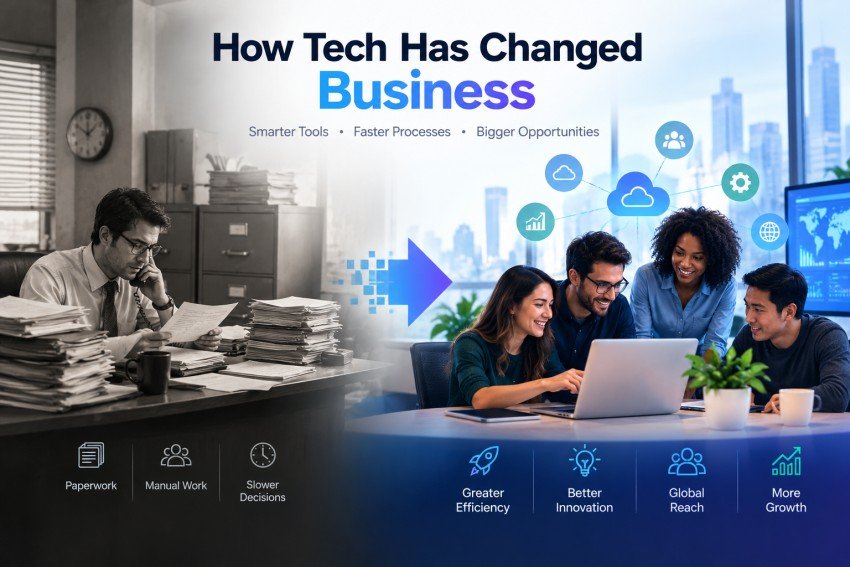
What’s happened to business in 2026 isn’t incremental. Structural. AI absorbs the routine. Cloud infrastructure makes scalability accessible to almost anyone. Data drives decisions that intuition used to guess at — badly. Companies leaning into these shifts, while keeping their core purpose intact, are pulling ahead. Those treating technology as a bolt-on, or resisting it outright, are falling behind in ways that compound fast. New technologies will keep surfacing. But the direction is already obvious: technology isn’t a support function anymore. It’s the engine.

Read Dive is a leading technology blog focusing on different domains like Blockchain, AI, Chatbot, Fintech, Health Tech, Software Development and Testing. For guest blogging, please feel free to contact at readdive@gmail.com.