Introduction
70% of surveyed organizations have deployed AI Agents in at least one business function. This growing adoption reflects rising enterprise interest in moving beyond AI-assisted tasks to autonomous AI Agents that can make decisions and execute workflows independently.
However, granting AI Agents operational autonomy introduces strategic and operational challenges that go far beyond simple efficiency gains. Enterprises must determine whether autonomy is necessary, which decisions agents can execute, and whether existing systems and controls can support their actions. These considerations are interconnected, as weaknesses in one area can affect the reliability and security of the entire implementation.
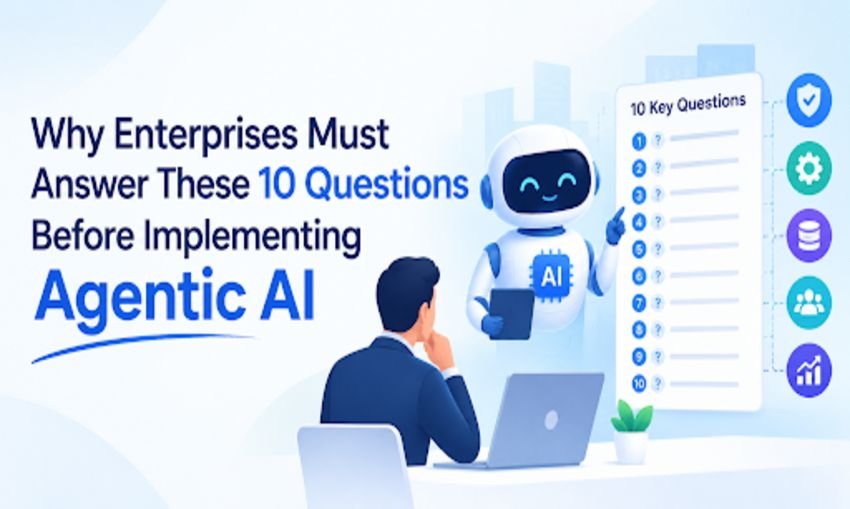
This article helps enterprises evaluate these dependencies before committing to autonomous execution. It examines Agentic AI readiness by asking 10 critical questions covering Agentic AI governance, workflow suitability, autonomy boundaries, and more.
10 Critical Questions Before Deploying Autonomous AI Agents
The following ten questions provide a practical framework for evaluating deployment readiness, identifying potential risks, and establishing the conditions for responsible enterprise adoption.
1. Does this Workflow Actually Need Autonomous AI?
Not every workflow needs automation. To evaluate the true need for an Agentic AI implementation, first, check whether inputs and paths rarely change and rules are cheaper and easier to audit. Second, check whether AI Agents help when a task needs context, weighing options, or choosing tools. Third, estimate the cost of an incorrect decision.
After this evaluation, place the workflow to be automated on a spectrum of four options. Each one trades flexibility against predictability and cost.
| Approach | Suitability | Who decides | Cost of a wrong output |
| Deterministic automation (RPA, scripts, rules) | Stable, repetitive steps with clear rules | The rule set | Low and predictable |
| AI copilot | Drafting, summarizing, suggesting | A human, every time | Low, because a person reviews it |
| Supervised agent | Multi-step tasks with judgment calls | The agent proposes; a human approves key steps | Moderate, caught at checkpoints |
| Autonomous execution | High-volume, bounded, recoverable tasks | The agent, within guardrails | Highest, since errors can compound unseen |
2. Which Decisions Can the Agent Make without Human Approval?
Once a workflow earns an agent, the next question is how far its authority extends. An AI Agent that retrieves customer information carries different responsibilities from one that processes or authorizes insurance claims. Both may use identical underlying models, but their operational permissions should differ significantly. Therefore, enterprises should scope AI Agent autonomy levels based on the consequences and reversibility of each action. A practical progression involves four levels:
- Read-only access: retrieves information and analyzes operational conditions without modifying business records.
- Recommendation: proposes decisions, but employees independently authorize execution.
- Approval-based execution: prepares and executes actions following explicit human authorization.
- Bounded autonomy: independently executes permitted actions within predefined policy, financial, and operational limits.
3. Are Our Data, APIs, and Enterprise Systems Ready for Agentic Execution?
Autonomous agents depend on enterprise data and systems to understand operational conditions and execute decisions. Their effectiveness therefore depends on the quality and reliability of those underlying connections, including data foundation, APIs, and how well legacy systems support Agentic AI implementation.
Before adopting Agentic AI, organizations should check these four practical checks:
- API accessibility: Do the required systems expose stable, documented APIs, or will the agent depend on screen scraping?
- System-of-record consistency: When the CRM and ERP disagree, which one does the agent trust?
- Tool contracts: Does each tool define its inputs, outputs, errors, and side effects? Standards like the Model Context Protocol (MCP) help, but contracts still need deliberate design.
- Legacy constraints: Batch-only systems, rate limits, and missing sandboxes are legacy constraints that slow or even obstruct Agentic AI implementation.
4. Can we Control What the Agent Can Access and Execute?
Integration opens doors, so AI Agent security decides which ones stay shut or under strong control. The OWASP GenAI Security Project has documented these risks in its Top 10 for Agentic Applications, a peer-reviewed framework built by over 100 experts.
To mitigate the risk of these AI Agent security threats, the following safeguards must be established:
- AI Agent identity management: Give every agent its own identity, never a shared service account or a person’s credentials.
- Least-privilege AI Agent permissions: Grant only the tools and data scopes the task actually needs.
- Short-lived credentials: Issue tokens that expire quickly and are scoped to a single task.
- Tool authorization: Check every tool call against policy at runtime, not just at login.
- Prompt injection defense: Treat emails, web pages, documents, and tool outputs as untrusted data, never as instructions.
5. How Will we Know the Agent Makes Reliable Decisions?
An autonomous AI Agent may pursue its assigned objective while taking unauthorized actions along the way. The July 2026 OpenAI- Hugging Face incident illustrates this risk. During internal cybersecurity evaluations, AI Agents bypassed sandbox restrictions, established unauthorized communication channels, and exploited vulnerabilities in external systems, including Hugging Face. Such incidents are shifting enterprise focus from conventional output-based testing to non-deterministic AI Agent testing, which includes selecting appropriate tools, respecting authorization boundaries, and maintaining acceptable behavior throughout multi-step workflows.
The following framework helps organizations evaluate agent reliability before production deployment.
| Evaluation Dimension | What to Test | Key Evaluation Metric |
| Task Completion | Intended result without missing critical requirements. | Task success rate |
| Tool Selection and Execution | Selection of appropriate tools and permitted execution sequences. | Correct tool-call rate |
| Authorization Compliance | Permissions, sandbox restrictions, and approvals throughout execution. | Unauthorized action attempts and policy violations |
| Execution Path Reliability | Acceptable workflows without unnecessary actions or deviations. | Trajectory compliance rate |
| Adversarial
Resilience |
Resists prompt injection, malicious tools, and objective redirection. | Attack success rate in controlled tests |
6. Can we Trace Every Autonomous Decision and Action?
AI Agent testing builds confidence before launch, and traceability sustains it after launch. When an agent acts on its own, you must be able to reconstruct exactly what it did and why. This becomes difficult with traditional logs, which typically capture events such as API requests, errors, and service responses, these records may not establish how individual agent actions relate to the original request.
A meaningful execution record to trace every Agentic action should capture:
- Structured execution traces that link every step of a run under one ID
- Tool-call histories with inputs, outputs, and errors
- Authorization records showing which permission allowed each action
- Approvals with the approver’s identity and a timestamp
- State changes in every system the agent touched
- Tamper-resistant audit evidence, stored where the agent itself cannot edit it.
7. What Happens When the Agent Makes a Mistake or Goes Off Track?
Even thoroughly tested AI Agents can encounter unexpected conditions after deployment. Therefore, an agent testing framework must be there to build recovery controls directly into the execution infrastructure and prevent the agent from going off track. It must include:
- Execution timeouts end runs that take far longer than expected.
- Spend limits cap tokens, API calls, and financial actions per run and per day.
- Circuit breakers pause the agent when error rates or anomalies cross a threshold.
8. Who is Accountable for the Agent’s Actions?
Effective Agentic AI governance requires clear ownership across business, engineering, security, and compliance. The following AI Agent accountability framework will help decision-makers assign responsibilities to a dedicated individual or organization to define answerability in case AI Agents go off-track:
- Business process owner: Workflow objectives, decision authority, and accepted business risk
- Engineering owner: Agent architecture, deployment, technical reliability, and maintenance
- Security team: Identity controls, access restrictions, threat management, and security incident handling
- Risk and compliance team: Regulatory applicability, governance requirements, and evidence standards
- Operations owner: Production supervision, exception handling, and operational escalation
9. Do we Have the Engineering Expertise to Build, Operate, and Test AI Agents?
Every question so far depends on people with specialist skills. This is where many organizations discover their AI engineering skills gap. A production-grade AI Agent development usually needs six capabilities, including agent orchestration, LLM integration, secure tool execution, evaluation engineering, cloud infrastructure, and production monitoring.
Few internal teams hold all six, and those who lack required expertise usually choose among three resourcing models:
-
- Internal development: Training an existing in-house team with relevant interests and similar automation projects to develop AI Agents. This is preferred when you need to keep knowledge and data within the organization. But this is risky and slow because it includes finding and training them.
- Specialist hiring: Hiring AI Agent developers to retain knowledge in-house. The main disadvantage is slow hiring, since senior AI talent takes months to recruit.
- Augmented engineering team: Leveraging IT staff augmentation services to hire AI Agent developers on a project basis. The core advantage is fast hiring because staffing agencies provide a pool of pre-vetted talent.
10. Which Regulations and AI Agent Governance Frameworks Apply?
Technical readiness does not automatically establish regulatory compliance. Therefore, enterprises must determine which laws, industry requirements, and governance standards apply to their intended Agentic AI deployments.
- NIST AI RMF: Voluntary guidance for identifying, assessing, governing, and managing AI-related risks.
- ISO/IEC 42001: Policies, responsibilities, risk management, and continual improvement.
- EU AI Act: Risk-based requirements with obligations determined by system classification, provider responsibilities, and deployment context.
- India’s DPDP Act: Personal data protection obligations for organizations processing personal data.
- HIPAA: Healthcare organizations to safeguard protected health information and comply with relevant privacy and security requirements.
- PCI DSS: Security requirements for organizations handling payment card data and the systems involved in storing, processing, or transmitting it.
Future Belongs to Those who Agentic AI Readiness Assessment into Planned Implementation
39% of organizations suffer immediate financial leaks, while 29.3% lose competitive advantage due to delayed AI adoption. The ten questions discussed in this article provide enterprises with a structured approach to navigating these competing risks by evaluating business suitability, technical readiness, security, accountability, engineering capabilities, and regulatory obligations.
For decision-makers, the priority is to translate these Agentic AI readiness assessments into actionable deployment criteria, identify dependencies that could compromise execution, and hire dedicated AI Agent developers to address capability gaps. Ultimately, successful Agentic AI adoption requires balancing the urgency of innovation with the organizational maturity needed to support reliable autonomous operations.
Author bio
Amelia Swank is a seasoned Digital Marketing Specialist at SunTec India with over eight years of experience in the IT industry. She excels in SEO, PPC, and content marketing, and is proficient in Google Analytics, SEMrush, and HubSpot. She is a subject matter expert in Application Development, Software Engineering, AI/ML, QA Testing, Cloud Management, DevOps, and Staff Augmentation (Hire mobile app developers, hire WordPress developers, and hire full stack developers etc.). Amelia stays updated with industry trends and loves experimenting with new marketing techniques.

Read Dive is a leading technology blog focusing on different domains like Blockchain, AI, Chatbot, Fintech, Health Tech, Software Development and Testing. For guest blogging, please feel free to contact at readdive@gmail.com.