
Excerpt
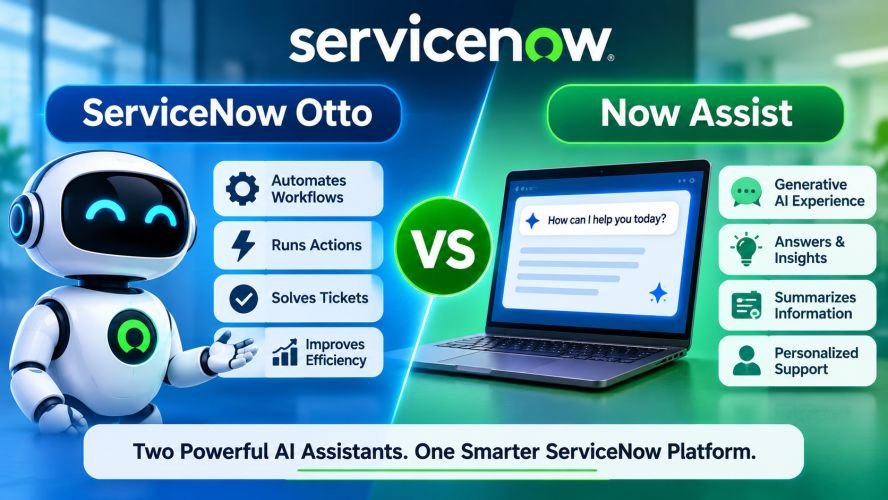
Does ServiceNow Otto replace ServiceNow Now Assist? How does ServiceNow Otto differ from Now Assist? If you are looking for answers to these questions, you can find them in this blog. This blog compares the key capabilities of the two ServiceNow products. By the end of the blog, you will clearly understand how they differ.
Introduction
ServiceNow is evolving with its AI capabilities, from generative AI assistance to agentic AI, to provide enhanced service to its customers. It helps the company understand users’ requests, orchestrate workflows, and complete tasks more efficiently.
ServiceNow Otto and Now Assist are two ServiceNow products that both use AI capabilities to resolve user requests. However, their capabilities and features differ in multiple ways.
This article compares the two ServiceNow products against key parameters and helps you understand the differences in detail.
Table of Contents
- ServiceNow Otto and Now Assist – An Overview
- ServiceNow Otto and Now Assist – A Quick Look
- Key differences between ServiceNow Otto and Now Assist
- How does ServiceNow Otto differ from Now Assist?
- Does ServiceNow replace Now Assist?
- FAQs
- Conclusion
ServiceNow Otto and Now Assist – An Overview
ServiceNow Otto is an AI assistant that understands natural-language requests and orchestrates AI agents to complete tasks. In addition to answering questions and helping teams, it handles complete workflows across different enterprise applications.
ServiceNow Now Assist also has generative AI capabilities that help you automate text-intensive tasks, understand information, generate content, and improve productivity. It uses large language models (LLMs) and ServiceNow contextual data to provide extended support to various ServiceNow applications.
Learn ServiceNow Training from experts and gain the skills to automate workflows, streamline IT operations, optimize service management, and build intelligent enterprise solutions.
ServiceNow Otto and Now Assist – A Quick Look
Let’s take a quick look at the differences between ServiceNow Otto and Now Assist based on different key aspects.
| Key Aspects | ServiceNow Otto | ServiceNow Now Assist |
| Primary focus | Summarising, generating, and recommending content | Understanding requests and executing tasks |
| Type | Workflow-embedded and conversational AI assistant | Conversational and multimodal AI assistant |
| Key AI capabilities | Generative AI and agentic workflows | AI agents and autonomous orchestration |
| Voice interaction | It provides specific AI voice experiences | It provides conversational AI voice agents |
| Multimodal interaction | It provides embedded generative AI experiences | It supports multiple interaction modes, including chat and voice |
| Data analysis | Generates AI-assisted insights and summaries | Uses AI Data Explorer for natural-language enterprise data analysis |
| User interaction | It supports user-assisted workflows and chats | It supports natural language requests |
| Governance | It uses ServiceNow platform security and AI controls | It uses AI Control Tower for centralised AI governance, monitoring, and auditing |
Key differences between ServiceNow Otto and Now Assist
This section discusses the differences between ServiceNow Otto and Now Assist in detail.
- Key features of ServiceNow Otto and Now Assist
Let’s look at the key features of ServiceNow Otto and Now Assist.
- ServiceNow Otto
-
-
- ServiceNow Otto panel – A conversational AI side panel that summarises chats, cases, and incidents, generates resolution notes, and answers questions.
- Voice input – ServiceNow Otto supports decoding human voice commands directly through the Otto panel.
- Autonomous AI agents – They execute multi-step, agentic workflows across IT, HR, customer service (CSM), and security systems.
- Smart documents skill – It can extract data automatically from images, handwritten notes, and documents to enable form autofills, batch processing, and interactive document Q&A
- AI admin hub – It allows you to manage model providers such as Google Gemini, Anthropic Claude, and Azure OpenAI.
-
- Now Assist
-
- Incident summarisation – Now Assist automatically condenses long incident streams, chat histories, and case notes into key action items, root causes, and resolution steps quickly.
- Autonomous AI Agents and Agentic Workflows: Now Assist uses genAI skills to execute multi-step, operational tasks with human-in-the-loop governance guardrails.
- Virtual Agent Chatbot: It uses Large Language Models (LLMs) to process natural language queries, decode vague requests, and execute tasks across external systems without manual intervention.
- Now Assist for ITSM: It equips support agents with automated incident-resolution steps, chat-reply recommendations, and article generation from resolved cases for ITSM
- Now Assist for HRSD: It enhances self-service and accelerates HR case resolution through conversational Q&A and automated document summaries.
- Use cases of ServiceNow Otto and Now Assist.
Let’s take a look at the use cases of servicenow Otto and Now Assist.
- ServiceNow Otto
-
-
- Understands IT requests and coordinates resolutions
- Coordinates onboarding activities across HR, IT, and other departments
- Handles employee requests across HR and other departments
- Manages customer requests across various systems and teams
- Explores business data using natural-language queries and works to complete requests
-
- Now Assist
-
- Summarises incidents and generates resolution notes
- Generates knowledge articles and content associated with customer onboarding
- Summarises employee cases and generates responses
- Explores information and generates AI-assisted insights
- Type of Response
Otto is designed for completing tasks across systems. Now Assist, on the other hand, uses generative AI to answer questions and recommend actions.
How does ServiceNow Otto differ from Now Assist?
ServiceNow Otto unifies Now Assist, Moveworks, and AI Experience. With this combined power, ServiceNow Otto accelerates multimodal conversations and orchestrates agentic workflows.
It uses Virtual Agent, EmployeeWorks, and Fulfillers workspaces to support Microsoft Teams, Google Chat, and Slack. It can easily process voice, text, and multimodal input such as images, forms, and screenshots.
ServiceNow Otto takes requests in different forms, identifies the intent, and routes them to the appropriate virtual or human agent based on need. It then returns the result to the user.
Does ServiceNow replace Now Assist?
ServiceNow has begun replacing the Now Assist and Moveworks assistant features with servicenow Otto. However, Now Assist features and capabilities still exist in the respective resources. This transition mainly doesn’t change current customer licensing requirements.
FAQs
- Does ServiceNow Otto support AI agents and workflow automation?
Yes. Otto can orchestrate AI agents and workflow automation to handle multi-step business requests. AI Agent Studio helps organisations build and configure agents for specific business processes.
- What is ServiceNow AI Agent Studio?
It is a development environment within the ServiceNow AI Platform that enables you to create, configure, test, manage, and deploy AI agents and agentic workflows.
- What is the key difference between ServiceNow Otto and AI Agent Studio?
You can use AI Agent Studio to create and configure AI agents. On the other hand, ServiceNow Otto uses and coordinates AI agents.
Conclusion
We hope that this article helped you understand the differences between ServiceNow Otto and Now Assist based on their key capabilities and features. You should understand how ServiceNow Otto is gaining more attention than Now Assist because of its combined power.

Read Dive is a leading technology blog focusing on different domains like Blockchain, AI, Chatbot, Fintech, Health Tech, Software Development and Testing. For guest blogging, please feel free to contact at readdive@gmail.com.