
Security Testing as a Service (STaaS) is a subcontracted cybersecurity framework where 3rd party specialists manage compliance monitoring, penetration testing, and vulnerability assessments on an on-demand or subscription basis. It swaps personnel and in-house tools with cloud-based and scalable access to ethical hackers.
In fact, Security Testing as a Service (STaaS) and relevant app security testing markets are witnessing this rapid growth. This growth is driven by cloud-native testing frameworks such as Pen Testing as a Service (PTaaS), outsourced talent requirements, and continuous deployment and continuous integration (CI/CD) pipelines. PTaaS provides an alternative to traditional consultant-based assessments.
According to Yahoo Finance, the worldwide security testing market is anticipated to rise from USD 10.96 billion in 2025 to more than 40Bn USD. Hence, it is proliferating at a massive Compound Annual Growth Rate (CAGR) of 24.6%.
Keeping this scenario under consideration, we are presenting the 3 main components of STaaS.
Penetration Testing As A Service (PTaaS)
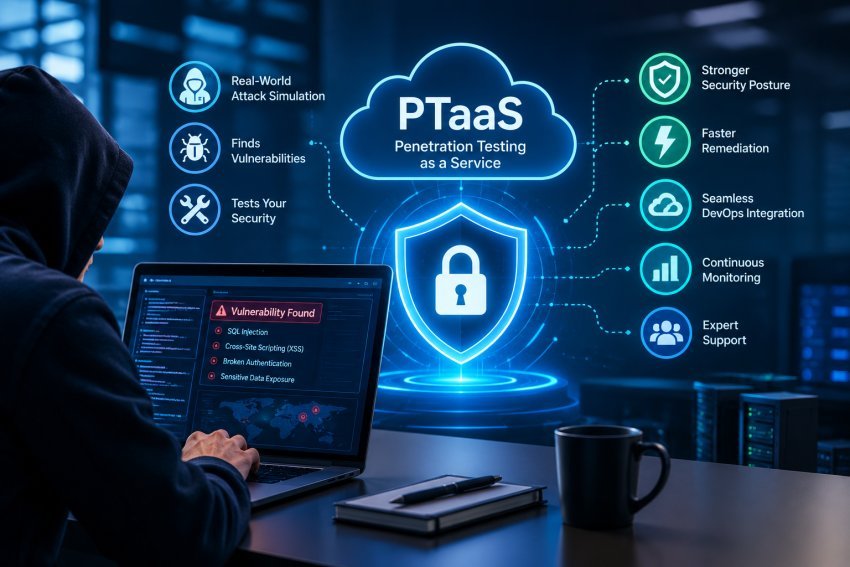
Penetration Testing as a Service (PTaaS) is a cloud-delivered model that blends human-led ethical hacking with automated scanning to provide on-demand, continuous security testing. Unlike traditional annual pentests, PTaaS allows organizations to request tests anytime, track vulnerabilities in real time, and integrate security seamlessly into their software development lifecycle. Main advantages of PTaaS include:
Penetration Testing as a Service (PTaaS) is defined as a cloud-delivered framework that amalgamates human-led ethical hacking with automated scanning for on-demand and continuous security assessment. In comparison to traditional annual pen tests, PTaaS permits companies to request tests anytime, trace vulnerabilities immediately, and incorporate security flawlessly into their software development lifecycle. The main advantages include:
- It is always ready for compliance
- It has scalability and cost efficiency
- It provides quicker remediation
- There is continuous testing
Automated Application Testing
There are two types of automated application testing: Static Application Security Testing (SAST) and Dynamic Application Security Testing (DAST). Let’s get into details:
Static Application Security Testing (SAST) assesses an app’s source code, binaries or bytecode to detect security vulnerabilities without implementing the program. It is often referred to as white box testing. This is because it pinpoints insecure coding patterns initially in the development lifecycle to stop vulnerabilities from passing on to production. The main advantages entail:
- Actionable guidance
- Continuous and automated scanning
- Shift-left security
- Lesser remediation costs
- Preliminary vulnerability detection
Dynamic App Security Testing (DAST) is an extrinsic security technique that assesses the security of web apps and APIs by replicating actual malicious attacks. This is because DAST doesn’t need any access to the source code. It analyzes the software in its natural runtime ecosystem to see exploitable weaknesses like authentication flaws, XSS, and SQL injection. The main benefits entail:
- DevSecOps Integration
- Realistic Runtime Analysis
- Zero Code Access Needed
- Language Agnostic
- Lower False Positive Rate
Compliance and Auditing
In Security Testing as a Service (STaaS), compliance incorporates the following regulatory models (e.g., PCI-DSS, HIPAA, and SOC 2). Whereas auditing is a process based on evidence to guarantee that STaaS tools function without any mistakes, security controls function as intended, and logs are immutable. Providers constantly assess your cloud configuration and systems to guarantee they follow stringent regulatory models like PCI DSS, GDPR and SOC 2.
Compliance sets the rules for ways security and data privacy should be managed. Auditing determines whether the STaaS providers or your intrinsic testing procedures are implementing those rules appropriately. Differentiating between the two permits companies to constantly shift left. The vulnerability detection during pipeline assessment is significant rather than annual audit. The main advantages entail the following:
- Expertise
- Scalability
- Cost Efficiency
Conclusion
The Security Testing as a Service is a cloud computing framework where a provider leases data storage, management, and capacity services on a pay-per-use or subscription basis. It eradicates and offloads physical maintenance and hardware costs to the service provider. This allows companies to scale resources on-demand.
Frequently Asked Questions (FAQs)
What is meant by STaaS?
Security Testing as a Service (STaaS) is a subcontracted cybersecurity framework where 3rd party specialists manage compliance monitoring, penetration testing, and vulnerability assessments on an on-demand or subscription basis. It swaps personnel and in-house tools with cloud-based and scalable access to ethical hackers.
What are the three components of STaaS?
- Penetration Testing As A Service (PTaaS)
- Automated Application Testing (SAST and DAST)
- Compliance and Auditing

Read Dive is a leading technology blog focusing on different domains like Blockchain, AI, Chatbot, Fintech, Health Tech, Software Development and Testing. For guest blogging, please feel free to contact at readdive@gmail.com.