

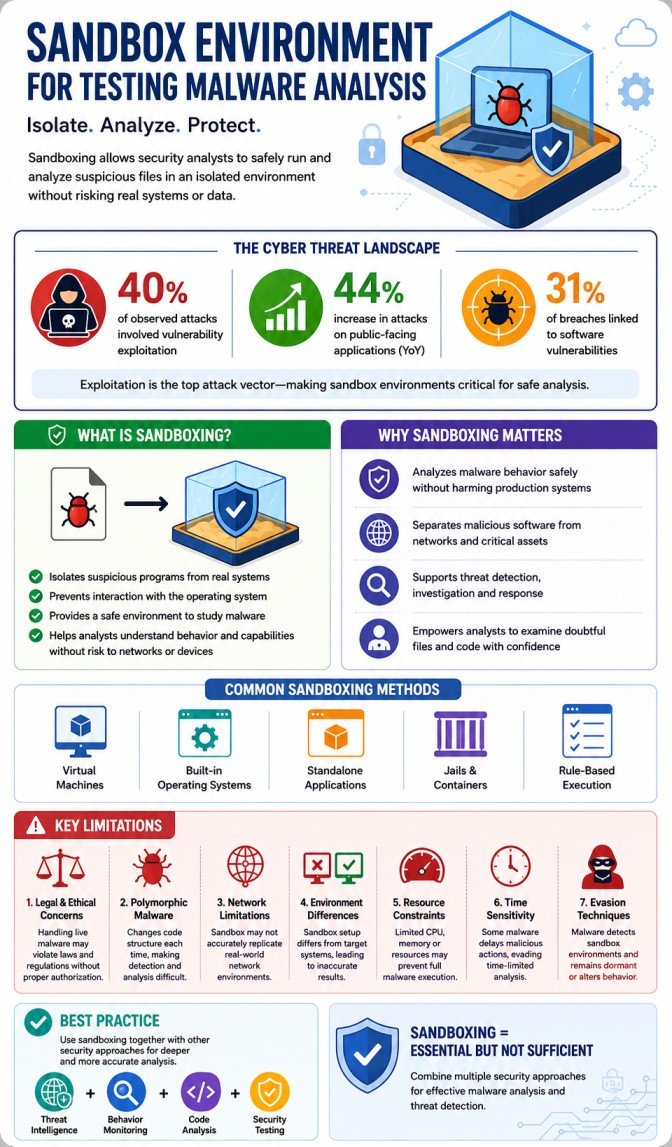
The rising proliferation of cyber threats has made the sandbox environment for testing malware analysis an important element in the latest cybersecurity. Vulnerability exploitation was reported for 40% of observed attacks. Public-facing apps rose by 44% every year, according to IBM’s 2026 X-Force Threat Intelligence Index. In addition, 31% of breaches stemmed from software vulnerabilities, according to Verizon’s 2026 Data Breach Investigation Report. This makes exploitation the top attack vector. These statistics show why companies depend more on sandbox environments to safely implement, detect, and examine malicious code before it can interact with production mechanisms.
The Significance of Sandboxing In Malware Analysis
Sandboxing is a security method that is implemented to stop the program’s interaction with the operating system, simply due to an unassessed program or the program having some malicious code. Sandboxing is famous because it can be utilized for malware analysis. This allows malware programs to execute in a testing ecosystem to study and examine the way the program is expected to perform under some situations. There are numerous methods incorporated in sandboxing, which include rule-based execution, Applets, Built-in operating systems, standalone applications, jail, and virtual machines.
Sandboxing separates the assessed malicious software from the systems and networks. It also offers an isolated and safe ecosystem for studying and evaluating possible malware. A malware analyst can implement doubtful code or files within a sandbox without risking damage to the host ecosystem. This allows analysts to examine the malware’s behavior and comprehend its capabilities without putting the network or systems at risk.
Critical Limitation of Sandboxing
Despite the numerous advantages of Sandboxing, there are a few limitations in its use for Dynamic Malware Analysis. Some of the limitations are highlighted below:
1. Ethical & Legal Concerns:
Evaluating the actual malware in a sandbox ecosystem may violate rules and ethical laws. Therefore, malware researchers must guarantee they have proper authorization and track ethical and legal protocols when managing live malware samples.
2. Polymorphic Malware:
This sort of malware varies its code appearance and structure every time it infects a new mechanism. This adaptive behavior makes it ambiguous for a static sandbox ecosystem to evaluate the malware effectively.
3. Limitations of the Network:
A few malware depend on real network interactions to finish their malicious activities. Perhaps, Sandboxing may not replicate the real network ecosystems. This can stop the analysis of some aspects of the malware’s behavior.
4. Environment Differences:
It is always extremely ambiguous to duplicate the actual production ecosystem in Sandbox environments. This makes the ecosystem different, importantly from the real target ecosystems where the malware is intended to function. Malware created to target particular configurations or mechanisms perhaps differently or not be implemented at all in the sandbox. This leads to inaccurate conclusions.
5. Resource Constraints:
The majority of the time, sandboxes function with fewer resources to mimic actual-world scenarios. This prevents some types of malware from completely activating or implementing their payload. This leads to incomplete analysis.
6. Sensitivity of Time:
A few malware are created to delay their malevolent activities for longer time periods. This potentially evades detection within a time-limited sandbox ecosystem. As the analysis may just function for a predetermined time, the malicious behaviors cannot be completely captured.
7. Dodging Methods:
Malware developers are becoming sophisticated in creating evasion methods to pinpoint whether their code is functioning in a sandbox ecosystem. They can amend their behaviors or remain latent when executed in a sandbox. This makes it ambiguous for malware researchers to observe the complete malware capabilities.
Directing Limitations
Irrespective of the limitations mentioned above, Sandboxing is an important dynamic malware analysis, particularly when implemented in conjunction with other methods like threat intelligence, behavior observation, and code analysis to attain an in-depth understanding of the suspicious files and apps. Security analysts need to be aware of these limitations and to utilize an amalgamation of approaches to overcome them and perform effective analysis.
Frequently Asked Questions (FAQs)
What is meant by a sandbox environment for Testing Malware Analysis?
Sandboxing is a security method that is implemented to stop the program’s interaction with the operating system, simply due to an unassessed program or the program having some malicious code.
What does a sandbox environment for testing malware analysis do?
Sandboxing separates the assessed malicious software from the systems and networks. It also offers an isolated and safe ecosystem for studying and evaluating possible malware. A malware analyst can implement doubtful code or files within a sandbox without risking damage to the host ecosystem. This allows analysts to examine the malware’s behavior and comprehend its capabilities without putting the network or systems at risk.
What are some limitations of a sandbox environment for testing malware analysis?
- Dodging Methods
- Time Sensitivity
- Resource Constraints
- Environment Differences
- Limitations of the Network
- Polymorphic Malware
- Ethical & Legal Concerns
If you enjoy reading in-depth technology and cybersecurity content, Read Dive is an excellent resource. The platform regularly publishes detailed articles, industry news, expert opinions, and practical guides covering a wide range of technology-related subjects. Visit the Read Dive homepage to discover more insightful and engaging blog posts.

Read Dive is a leading technology blog focusing on different domains like Blockchain, AI, Chatbot, Fintech, Health Tech, Software Development and Testing. For guest blogging, please feel free to contact at readdive@gmail.com.