
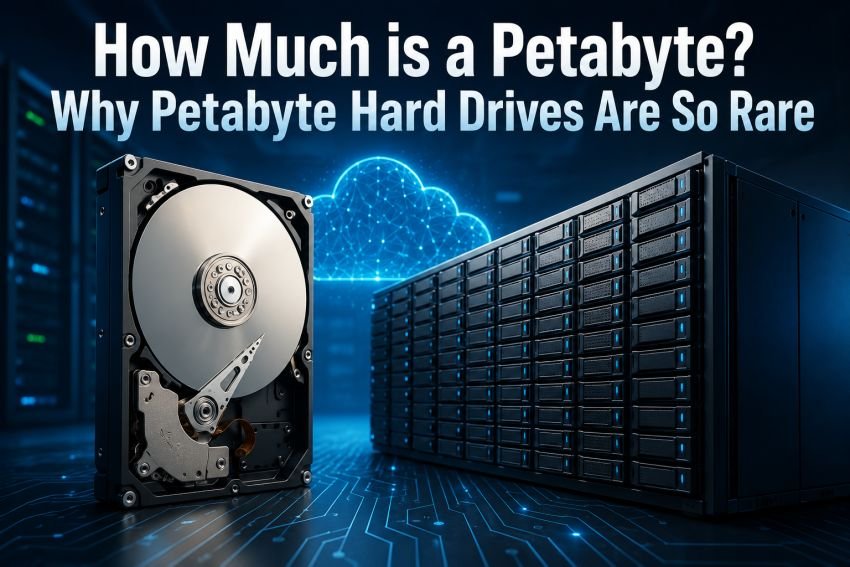
When people hear about massive data storage, one of the first questions they throw out is, how much is a petabyte? A petabyte (PB) is a huge unit of digital storage, basically equal to 1,024 terabytes (TB) or 1,048,576 gigabytes (GB). It’s enough room to save millions of very sharp photos, thousands of 4K movies, or multiple years of business and scientific information. But since petabytes are so useful, why do petabyte hard drives seem so rare, like basically not something you see at home?
How much is a petabyte?
To wrap your head around how much a petabyte is, it helps to compare it with everyday storage stuff. Most consumer laptops sit somewhere around 256 GB up to 1 TB, and external hard drives often fall in the 1 TB to 20 TB range. In other words, one petabyte is like having more than 50 high-capacity 20 TB hard drives mashed together.
Even so, organizations such as cloud providers, research groups, and big enterprises deal with petabytes of data all the time. Still, they don’t usually depend on one single hard drive. Instead, they put together storage setups using hundreds, or even thousands, of disks that work side by side.
Petabyte Storage Size Comparison
| Storage Unit | Equivalent Size | Real-World Example |
|---|---|---|
| 1 Kilobyte (KB) | 1,024 Bytes | A short text document |
| 1 Megabyte (MB) | 1,024 KB | One high-quality photo |
| 1 Gigabyte (GB) | 1,024 MB | Around 250 songs or one HD movie |
| 1 Terabyte (TB) | 1,024 GB | About 250,000 photos or hundreds of HD movies |
| 1 Petabyte (PB) | 1,024 TB (1,048,576 GB) | Millions of photos, thousands of 4K movies, or years of enterprise data |
| Typical Consumer Hard Drive | 1–20 TB | Personal computers and external storage |
| Petabyte Storage System | 1 PB or more | Built using hundreds or thousands of hard drives in data centers |
Why can’t you really get Petabyte hard drives today?
Petabyte hard disks have not been created yet for both technical and reliability reasons. Hard disk drives can only write so many bytes to their magnetic platters; when manufacturers reach that limit with current technology, they can no longer increase how much is written to them at once. Although manufacturers continue to find new ways to increase platter storage density (such as heating the magnetic medium used in hard drives), fitting an entire petabyte of data on a single drive will be impossible for many more years.
Data integrity is also a concern; if a single hard drive containing 1 petabyte of data fails, the loss could be catastrophic. Many large corporations use multiple drives to provide redundancy for their data, thereby creating an accurate, stable, cost-effective means to back up data long-term.
Huge expenditures are irrelevant
Assuming engineers can somehow create a 1TB HDD today, it will be prohibitively expensive for anyone but businesses requiring such substantial amounts of data. Without the need for this kind of storage, supply will continue to outweigh demand, and as a result, there will not be much incentive for high-volume production. Most companies needing petabyte-sized data will likely purchase large-scale systems or use cloud computing to achieve their goals rather than rely on a single gigantic HDD.
Will there be everyday access to petabytes of HDDs?
Every year, improvements occur in technologies associated with storing data. Researchers have been developing new ways to record this information, which means one day we may have a much broader range of data storage options, such as enormous HDDs. However, before there is consumer-level access to these types of HDDs, additional problems associated with their use must be resolved. Examples are density, heat build-up, durability, and cost-effectiveness.
Conclusion
If you’re ever asking yourself how much a petabyte is, it’s pretty straightforward: 1,024 terabytes, which is a storage capacity most people will probably never really need. Instead of building one lone petabyte hard drive, the tech world is doing petabyte-scale setups by stitching together many smaller and dependable drives into heavier-duty storage systems. As progress continues, petabyte drives might eventually become practical, but for now, they’re more or less unrealistic for everyday use.
Frequently Asked Questions (FAQs)
How many GB are in a petabyte?
1 Petabyte (PB) equals 1,000,000 gigabytes (GB) exactly in the decimal system, which is what most hard drive makers use
How much does a petabyte cost?
In general, one petabyte on-premises runs about $1.3 million, and if you go with Wasabi Hot Cloud Storage, it comes to around $367,980 over five years

Read Dive is a leading technology blog focusing on different domains like Blockchain, AI, Chatbot, Fintech, Health Tech, Software Development and Testing. For guest blogging, please feel free to contact at readdive@gmail.com.