
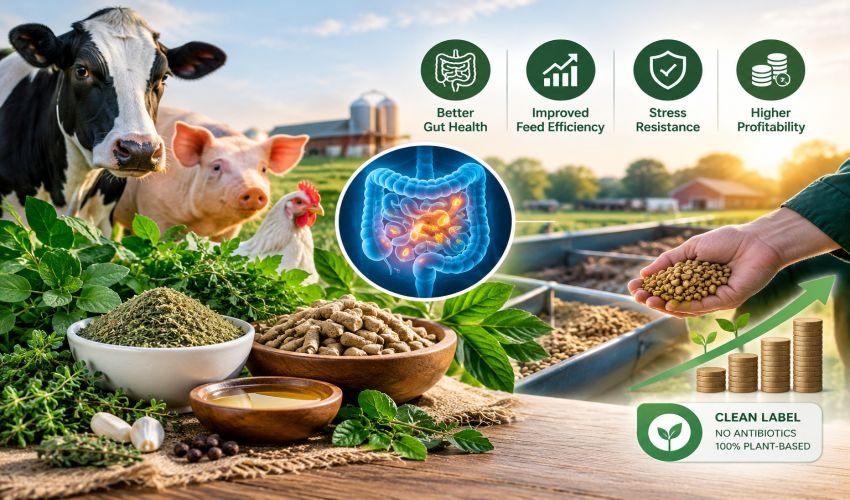
Commercial livestock producers and feed formulators face immense pressure from regulators and consumers to remove synthetic chemicals and antibiotic growth promoters (AGPs) from their operations. This shift is no longer a fringe movement or a passing trend.
However, you cannot afford to sacrifice herd or flock productivity simply to meet clean-label demands. Feed represents the largest single expense in any commercial operation. Any alternative to traditional AGPs must definitively protect your Feed Conversion Ratios (FCR) to be viable.
Bridging this gap between clean-label requirements and on-farm profitability requires specialized plant-based nutritional additives that are engineered to maintain biological performance. Producers need solutions that optimize feed conversion and protect gut integrity, even under severe environmental stress. This article examines the hard science and economic realities behind phytogenic feed additives, proving how natural interventions can secure your bottom line.
Key Takeaways
-
Plant-based (phytogenic) feed additives use bioactive compounds to naturally balance intestinal microflora and protect gut health during production stress.
-
Natural osmolytes and antioxidants specifically mitigate the metabolic costs of environmental stressors like heat and crowding, keeping energy focused on growth.
-
Clinical data proves that 100% natural feed ingredients can effectively replace AGPs by physically improving gut morphology and nutrient absorption.
-
Transitioning to high-quality natural additives delivers a strong ROI by lowering overall ration costs and increasing feed digestibility across commercial operations.
The Biological Cost of Production Stress on FCR
Environmental and biological stressors are unavoidable in commercial livestock and aquaculture production. Heat stress, rapid growth phases, pathogen pressure, and high stocking densities create an immediate oxidative imbalance within the animal. When a broiler or pig experiences these stressors, their body generates excess free radicals, triggering a systemic inflammatory response.
This inflammatory activation directly impairs gut integrity. The intestinal barrier becomes compromised, leading to a condition commonly known as “leaky gut.” Pathogens and toxins slip into the bloodstream, forcing the animal’s immune system into overdrive.
From a production standpoint, this immune response is incredibly expensive. An activated immune system diverts massive amounts of dietary energy and amino acids away from muscle accretion and growth. Instead of turning feed into meat, the animal uses that feed simply to survive the stress event.
This diverted energy directly results in a degraded FCR. When livestock eat the same amount of feed but produce less yield, you suffer an immediate financial loss. Managing this oxidative stress is not just about animal welfare; it is a strict economic necessity for feed formulators looking to maximize profit margins.
What Are Phytogenic Feed Additives and How Do They Work?
Phytogenic feed additives are strictly defined as 100% natural, plant-derived bioactive compounds. They should not be confused with simple “clean-label” marketing buzzwords or basic dried herbs. Premium phytogenics are highly standardized extracts containing specific active molecules like essential oils, saponins, flavonoids, and tannins.
These natural feed ingredients function biologically in livestock and aquaculture to replace the roles traditionally held by synthetic chemicals. Rather than acting as a blanket antimicrobial like an AGP, phytogenics offer highly specific, cellular-level interventions. They stimulate endogenous digestive enzymes, modulate the gut microbiome, and reinforce the intestinal barrier against pathogens.
This shows that the “power of nature” is actually just complex biochemistry. By leveraging the specific defense mechanisms that plants have evolved over millions of years, producers can target common production issues with surgical precision.
Combating Heat Stress and Inflammation
Severe environmental stress, particularly heat stress, causes animals to reduce feed intake and lose cellular hydration. Natural osmolytes and specific plant enzymes combat this by helping cells retain water without expending excess energy. This cellular hydration protects the intestinal lining from physically breaking down during periods of high heat.
Simultaneously, natural antioxidants found in phytogenics mitigate metabolic heat generation. They scavenge the excess free radicals produced during heat stress, stopping the inflammatory cascade before it starts. This prevents the severe performance dips and mortality spikes usually seen in commercial flocks and herds during summer months.
Peer-reviewed research confirms the effectiveness of this mechanism. Recent studies show that bioactive compounds reduce inflammation and the metabolic costs associated with oxidative stress, improving feed efficiency and growth stability. By preventing the immune system from draining dietary energy, these plant-based compounds keep livestock growing efficiently regardless of environmental challenges.
Improving Gut Morphology and Nutrient Absorption
A healthy gut is the engine of feed efficiency. Plant-based ingredients structurally improve the gut to maximize nutrient uptake. Specific bioactive compounds stimulate the proliferation of intestinal cells, which actively changes the physical shape of the gut lining.
This physical change increases the absorptive surface area of the intestines. Furthermore, specialized natural bio-efficiency additives improve micelle and liposome formation in the gut. This accelerates fat and fat-soluble nutrient absorption, ensuring the animal extracts the maximum nutritional value from complex commercial diets.
Can Natural Additives Truly Replace Synthetic Chemicals and AGPs?
A common misconception among commercial producers is that “natural” inherently means “less effective.” Feed mill managers often worry that removing AGPs will inevitably lead to rampant gut health issues and poor flock uniformity. However, modern scientific advancements have proven that 100% plant-based additives can truly replace synthetic chemicals without a drop in biological performance.
The difference lies in standardization and quality control. Premium natural additives undergo rigorous Quality Assurance Programs, including NIR (Near-Infrared) testing to guarantee active compound levels. Certifications like OMRI and FAMI-QS ensure these products meet strict safety and efficacy standards. When standardized properly, phytogenics match the performance of synthetics by promoting a naturally robust gut rather than just wiping out bacteria.
Below is a comparison detailing how natural phytogenics stack up against traditional AGPs in commercial settings:
|
Feature/Metric |
Antibiotic Growth Promoters (AGPs) |
Natural Phytogenic Additives |
|---|---|---|
|
Mechanism of Action |
Broad-spectrum antimicrobial suppression. |
Microbiome modulation, improved morphology, and antioxidant support. |
|
Impact on FCR |
Lowers FCR by reducing bacterial load. |
Lowers FCR by increasing villus height and nutrient digestibility. |
|
Resistance Risk |
High risk of antimicrobial resistance (AMR). |
Zero risk of building antimicrobial resistance. |
|
Regulatory Status |
Banned or heavily restricted in major global markets. |
Widely approved, clean-label compliant, and suitable for organic use. |
|
Stress Mitigation |
Ineffective against oxidative heat stress. |
Actively reduces cellular oxidative stress and inflammation. |
The Economic Reality: Ration Costs and Production ROI
Translating the biological benefits of natural feed ingredients into a clear, bottom-line financial return on investment is the final hurdle for producers. Efficacy is irrelevant if the cost of the additive destroys the profit margin. Fortunately, transitioning to 100% natural feed ingredients positively impacts overall ration costs.
By using all-natural multi-enzyme complexes and phytogenics, producers unlock greater nutritive value from their basal diets. Because these ingredients increase the digestibility of proteins and fats, nutritionists can safely reformulate diets to use less expensive feedstuffs without penalizing animal growth. You can safely lower your overall ration costs while maintaining target harvest weights.
These ingredients offer a powerful dual benefit. They secure consumer trust and ensure compliance with strict food-chain safety regulations. At the same time, they actively drive economic performance for both conventional commercial and organic operations by squeezing every ounce of value out of the feed.
Conclusion
Biologically active plant compounds protect your FCR by physically maintaining gut health, increasing absorptive surface area, and managing oxidative stress. By utilizing natural osmolytes and targeted antioxidants, these additives prevent environmental stressors from stealing dietary energy away from growth. The clinical evidence shows that natural solutions match the performance of outdated synthetic tools.
You do not have to choose between clean-label regulatory compliance and farm profitability. Properly formulated phytogenics bridge that gap, offering a scientifically validated way to lower ration costs and boost nutrient absorption.
The future of commercial animal nutrition relies on verifiable, 100% natural feed ingredients. As regulatory pressures continue to mount and feed costs fluctuate, adopting high-performance plant-based additives is the smartest strategy to protect your livestock, your feed efficiency, and your bottom line.

Read Dive is a leading technology blog focusing on different domains like Blockchain, AI, Chatbot, Fintech, Health Tech, Software Development and Testing. For guest blogging, please feel free to contact at readdive@gmail.com.