Backlinks can help shoppers discover an online store and give search engines more context about its most useful pages. But an ecommerce site may have thousands of URLs, and trying to promote all of them spreads time and budget thin. Knowing how to prioritize ecommerce pages for backlinks means choosing destinations that can attract relevant links and turn the resulting attention into lasting value.
The best candidate is not always the page with the highest search volume or the most expensive product. Start by looking for a combination of business importance, search potential, and a credible reason another website would link to the page.
Start with pages that matter to the business
First, identify categories and products that support the store’s goals. These might be high-margin lines, products with reliable stock, or categories the business is actively trying to grow. A page that attracts links but leads to discontinued items or low-value sales may deliver little practical benefit.
Check performance data before making a shortlist. Consider organic impressions, current rankings, conversion rate, average order value, and whether a page has room to improve. A category already appearing on the second or third search results page may be a stronger candidate than a page with no demonstrated demand. The aim is to find pages where increased authority and visibility could make a measurable difference.
Choose a page that deserves a link
People link to useful resources, not merely to a URL because a store wants more backlinks. Some product pages naturally earn attention when an item is distinctive, innovative, or relevant to a particular community. Category pages can also be link-worthy when they help readers compare options or make a decision.
Before outreach, ask what a publisher’s audience would gain by visiting the page. A category page with clear specifications, practical buying guidance, and a well-organized selection gives writers more reason to cite it. If the page is little more than a grid of products, consider improving it first. Useful details might include compatibility notes, sizing or materials information, selection criteria, and answers to common questions.
For a deeper look at approaches to building backlinks to ecommerce pages, consider how different link opportunities fit the page’s role. A product page may suit a review or specialist discussion, while a broad category could support a guide or resource list. The best destination depends on both the subject of the linking content and the value the page provides.
Check the page before promoting it
A backlink campaign cannot compensate for a poor landing experience. Confirm that the page is indexable, loads reliably on mobile, and has a stable URL. Check for broken links, duplicate or thin descriptions, confusing filters, and out-of-stock products. If a page is likely to change, decide how its URL and content will be maintained so that earned links do not point to a dead end.
Technical details matter especially for filtered category pages. Search and filter combinations can generate many near-duplicate URLs, so make sure the version you promote is the intended, canonical destination. Also review internal links: a linked category should be easy to reach from relevant navigation and supporting content. That helps visitors continue browsing after they arrive.
Use a simple scoring system
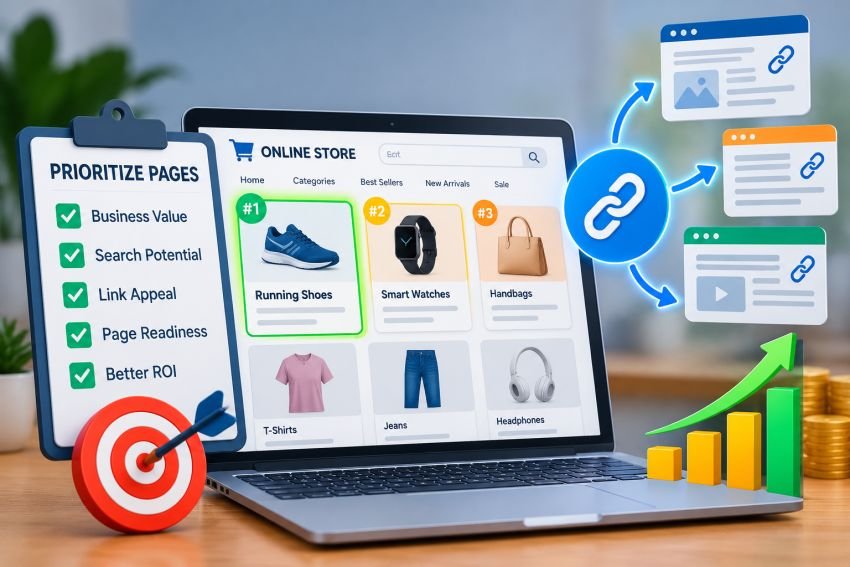
A small scoring sheet can make prioritization less subjective. Rate each candidate from one to five on these factors:
- Business value: Does the page support products or categories the store wants to grow?
- Search opportunity: Is there evidence of demand and realistic room to improve visibility?
- Link appeal: Is there a clear, reader-focused reason for another site to cite it?
- Page readiness: Is the URL useful, technically sound, and likely to remain available?
- Measurement: Can you track visits, rankings, assisted conversions, or another meaningful outcome?
Give extra weight to readiness and link appeal. A commercially important page may still be a poor campaign target if it offers nothing beyond a sales pitch. Conversely, a helpful category page with strong internal support may be worth improving even if it is not currently the store’s top seller.
Build the process around your team’s capacity
Prioritization also involves deciding what the team can realistically improve and promote. Smaller businesses may need outside help with development, content, or outreach, but hiring is most effective when the work is clearly scoped. For teams planning an early-stage store or a new ecommerce feature, this guide to web development services for startups outlines why defined priorities and structured hiring can help keep a launch focused. Osdire, a freelance marketplace, is one option for finding specialists across areas such as programming, design, and marketing.
Set a manageable first batch rather than launching campaigns for every eligible URL. Record each page’s starting performance, the changes made, and the outreach activity. Review results over time: a link may bring referral traffic before rankings shift, and a ranking improvement does not guarantee sales. Use those findings to refine the next round of targets.
Effective ecommerce link building is a selection problem as much as an outreach problem. Prioritize pages with business relevance, real search opportunity, a credible reason to earn citations, and a strong visitor experience. That combination makes each campaign more focused—and gives the links you earn a useful destination.

Read Dive is a leading technology blog focusing on different domains like Blockchain, AI, Chatbot, Fintech, Health Tech, Software Development and Testing. For guest blogging, please feel free to contact at readdive@gmail.com.