
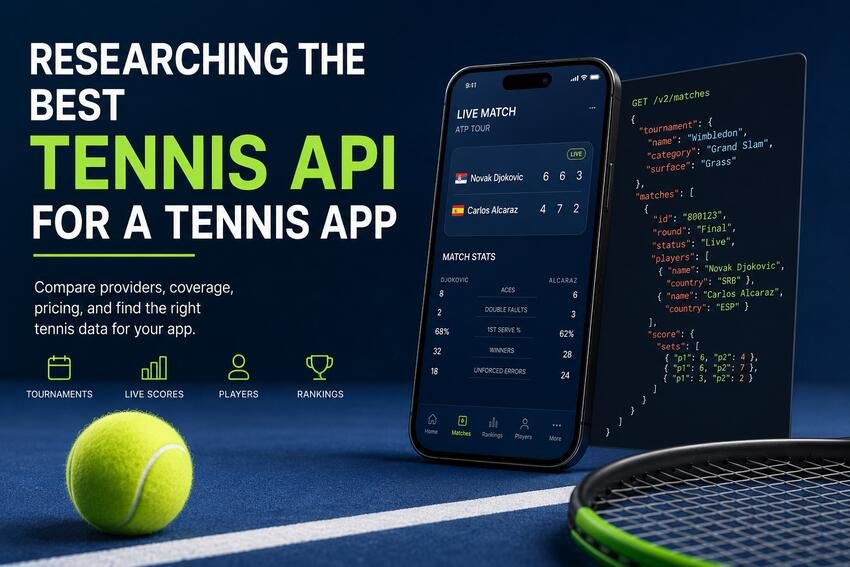
Building a tennis app today is easier than ever, but only if you have access to reliable, detailed, and affordable tennis data. Whether you are creating a live scores app, betting analytics platform, player comparison tool, fantasy sports product, coaching dashboard, or AI prediction system, the quality of your data source will directly affect the quality of your product.
That is why choosing the right tennis API is one of the most important early decisions for any developer or startup. A specialist provider such as Tennis API can be a practical option for teams that need tennis-focused data without the cost and complexity of major enterprise sports data companies.
What Data Does a Tennis App Need?
The type of data you need depends on the application you are building. A simple tennis scores app may only require live scores, match results, tournament schedules, and player rankings. However, more advanced tennis products usually need much deeper data.
Modern users expect features such as head-to-head records, historical results, surface-specific performance, tournament history, player statistics, rankings, form analysis, and match trends. These features require more than just a basic live score feed.
If you are building a serious tennis app, historical data is especially important. It allows you to create richer player profiles, compare performance over time, identify trends, and power predictive models.
The Enterprise Option: Sportradar
When developers begin researching sports data providers, Sportradar is often one of the first names they encounter. It is one of the biggest sports data companies in the world and works with large sportsbooks, media companies, and sports organizations.
For large organizations that need multi-sport coverage, enterprise infrastructure, official partnerships, and global data feeds, Sportradar can be a strong option. However, it is often not the most practical choice for smaller tennis-specific projects.
The main issue is cost. Enterprise providers are typically priced for large companies rather than independent developers, early-stage startups, or niche tennis websites. Contracts can be expensive, and pricing may be difficult to justify before a product has traction.
Another issue is complexity. Big sports data providers usually support many sports, leagues, competitions, and data formats. If your application only focuses on tennis, that extra complexity can slow down development.
Why Specialist Tennis APIs Are Attractive
Specialist APIs are becoming more popular because they solve one problem well. Instead of buying access to a large multi-sport data system, developers can choose a tennis-focused provider that is built around the specific needs of tennis applications.
A dedicated tennis API can focus on ATP, WTA, Challenger, ITF, tournament results, rankings, fixtures, player information, head-to-head records, and historical match data. This focus can make integration easier and the data more relevant.
Developers may also compare available tennis data providers through marketplaces and directories such as RapidAPI’s tennis API collection, especially when researching different options before committing to a provider.
Coverage Should Be the First Thing You Check
When evaluating any tennis API, coverage should be your first priority. A provider may look good on the surface, but the real value is in the depth and consistency of its data.
Important questions include: does the API cover ATP and WTA? Does it include Challenger and ITF events? Are historical matches available? Can you access tournament results, player statistics, rankings, and head-to-head data? Is the data useful for both current fixtures and long-term analysis?
The more complete the coverage, the more flexible your application becomes. You can start with live scores or fixtures, then later add analytics, prediction features, betting tools, player pages, or tournament archives.
Why Historical Tennis Data Matters
Many developers initially focus only on live match data. Live scores are important, but historical data often creates the most valuable features in a tennis app.
For example, a player comparison tool needs previous meetings, career records, surface records, and recent form. A betting analytics platform needs tournament history, player trends, and past results. A machine learning model needs a large archive of historical matches to generate meaningful predictions.
Without historical data, an app can feel shallow. With it, users can explore deeper insights and spend more time engaging with your product.
Developer Experience Is Also Important
Good data is only useful if developers can work with it efficiently. Clear documentation, logical endpoints, consistent response formats, and reliable uptime all matter.
This is especially important during major tournaments such as Wimbledon, the US Open, the Australian Open, and Roland Garros. Tennis apps can see traffic spikes during these events, so reliability is essential.
A focused tennis API can often be easier to integrate than a large enterprise system. For startups, this can reduce development time and help get a product to market faster.
Common Tennis API Use Cases
Tennis APIs can power many different types of products. Live score websites use them for match updates and schedules. Statistics platforms use them for player profiles, rankings, and historical comparisons. Betting tools use them for form analysis, surface trends, and head-to-head research.
Coaching apps can also use tennis data to analyze player performance, while AI projects can use historical records to train prediction models. The more structured the API data is, the more use cases it can support.
Cost Versus Value
The most expensive API is not always the best one for your project. Enterprise providers may offer impressive infrastructure, but if you only need tennis data, you may end up paying for features you do not use.
For a tennis-focused app, the better question is whether the provider offers the right mix of coverage, historical depth, reliability, documentation, and pricing. A specialist tennis API may deliver better value because it is designed for exactly this use case.
Final Thoughts
Choosing the best tennis API depends on your product goals. If you are a large company that needs official multi-sport data across many markets, an enterprise provider may make sense. But if you are building a dedicated tennis app, analytics platform, betting tool, or AI model, a specialist tennis data provider is often a more practical option.
Big players like Sportradar are powerful, but they can also be expensive and complex. For many developers, the smarter approach is to use a tennis-focused API that offers the coverage, historical data, and developer experience needed to build a strong product.
Before committing to any provider, review the coverage carefully, test the documentation, think about your future feature roadmap, and make sure the API can support both your launch version and long-term growth.

Read Dive is a leading technology blog focusing on different domains like Blockchain, AI, Chatbot, Fintech, Health Tech, Software Development and Testing. For guest blogging, please feel free to contact at readdive@gmail.com.