
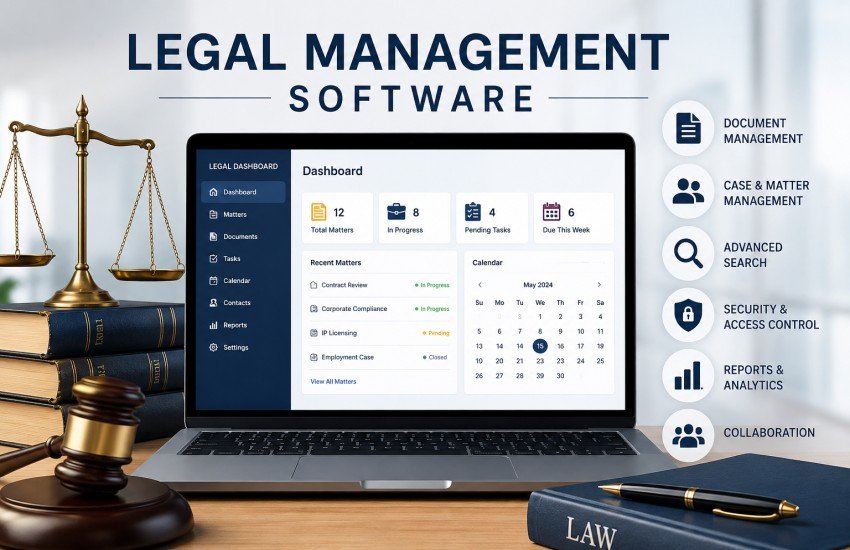
Legal firms and corporate legal departments handle a considerable amount of documents, case information, contracts, regulations, and client information every single day. With the help of appropriate legal management software, these tasks can be made easier, productivity increased, and the risk of missing data decreased. Legal knowledge management software is especially important in that it helps organizations to efficiently manage their legal knowledge.
1. Centralized Knowledge Management
A crucial component of legal management software is its centralized knowledge database. Legal teams are able to store case files and legal documents, precedents, templates, policies, and other materials in one safe environment, thus making it easier to access the information.
2. Advanced Document Management
Lawyers have to deal with a lot of paperwork; thus, document management is crucial. Legal software is of help to the teams in terms of making, organizing, editing, modifying, developing, and finding documents without much effort.
3. Significant Search Functions
The ability to locate relevant legal information promptly helps boost productivity. The features associated with legal knowledge management software comprise advanced search capabilities, which allow users to conduct searches by means of keywords, filters, tags, etc.
4. Case and Matter Management
Legal management platforms allow using the tools for monitoring the status of a case or matter during the process of its consideration. The teams get to know what the deadlines and case statuses are, what assignments they have, what dates must be adhered to, what documents and correspondence are connected with the case, and so on.
5. Automation
Thanks to automation, tedious administrative tasks are carried out more quickly. Legal software may be utilized to perform such tasks as routing documents, approving documentation, sending reminders, notifying people, and carrying out various recurring operations.
6. Access and Security
Legal data is very private, thus security is essential. New systems offer the option of role-based access, user verification, controls, scrambling data, and audit trails. These options give the manager the ability to know who can view, change, or distribute certain information.
7. Tools for Collaborative Work
Lawyers tend to interact with each other, not only between departments but also between offices and geographical locations. Collaboration capabilities let approved users exchange papers and talk about a case, comment on a certain document, and work collectively on legal materials.
8. Reporting and Analytics Features
Reporting services provide important information about legal practice. The team can manage the amount of information processed, deadlines, activity concerning documents, efficiency, etc.
9. Integration With Other Systems
The abilities of integration make it easy to incorporate legal management software into an existing workflow. Depending on the system, the software could be integrated with email, calendars, accounting software, CRM software, document storage systems, and others.
Conclusion
Appropriate legal management systems transform how legal departments structure their data, deal with different cases, and cooperate with each other. The functions of the systems, which range from centralized storage of information to advanced searching and protection, make legal companies perform their functions more efficiently. The investment in legal management systems makes it easy for companies to access needed legal information.
Frequently Asked Questions (FAQs)
What is legal knowledge management software?
Legal knowledge management software is a platform designed to capture, organize, search, and share legal information, expertise, documents, precedents, templates, and organizational knowledge.
What are the main features of legal management software?
Common features include document management, case and matter management, knowledge repositories, advanced search, workflow automation, collaboration, security, reporting, and third-party integrations.
How does legal knowledge management software benefit law firms?
It helps lawyers find relevant information faster, reuse existing knowledge, reduce duplicated research, improve collaboration, and preserve institutional expertise.

Read Dive is a leading technology blog focusing on different domains like Blockchain, AI, Chatbot, Fintech, Health Tech, Software Development and Testing. For guest blogging, please feel free to contact at readdive@gmail.com.