Do you ever wonder if your software can function as intended and still not address what your user actually needs? This is why verification and validation practices in software testing are necessary.
Software quality is more than just squashing bugs after the software has been built. It is also about ensuring that the product is built as expected and, just as crucially, that the product being built is the right product. Verification and validation help software teams accomplish both objectives by looking at the product from different perspectives.
Whether you are a software tester, developer, project manager, or just looking to learn software testing, knowing how to distinguish between verification and validation will only help you in building reliable, secure, and user-friendly applications.
What Is Verification and Validation in Software Testing?
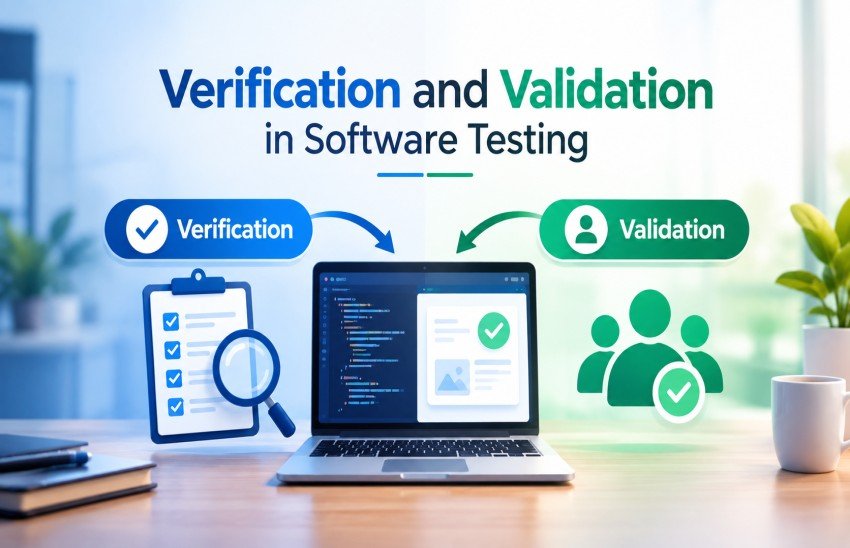
Verification is a quality assurance process that helps to ensure that a software product meets its requirements. Validation is a complementary process that checks whether the product meets the expectations of users.
Although the two terms are often combined, they answer different questions:
- Verification: Are we building the product right?
- Validation: Are we building the right product?
Verification is mostly concerned with checking the compliance of the products produced from software development activities with the specified requirements. Validation is concerned with studying an actual software product in order to find out whether it meets user expectations in terms of usage.
Both processes are crucial since a product can be built according to technical requirements but actually not satisfy users.
Verification vs. Validation: What Is the Difference?
Comprehending the difference between verification and validation is one of the most significant concepts in software testing.
|
Verification |
Validation |
| Checks whether the product is built correctly | Checks whether the right product is built |
| Focuses on requirements, design, and development artifacts | Focuses on the actual software |
| Usually does not require code execution | Requires executing and testing the software |
| Primarily a static activity | Primarily a dynamic activity |
| Helps identify defects early | Helps confirm the product meets user needs |
| Includes reviews and inspections | Includes functional and system testing |
Why Are Verification and Validation Important?
Verifying and validating a product during the testing process is more important than just finding defects. Both of them together constitute a systematic approach to testing a software product.
1. They Help Detect Defects at an Early Stage
Verification and validation, when carried out at regular intervals, help detect defects in the requirements phase, design phase, and also in the coding stage.
The earlier a defect is identified, the less it costs to fix it. So we can say that verification and validation help in reducing the cost of fixing defects.
2. They Improve the Software Quality
Validation helps in ensuring that the developed application does what it is supposed to do. Carrying out different test scenarios helps detect various defects even if the software passes the basic test cases. This, in turn, improves the software quality.
3. They Reduce Development Costs
Finding out a simple requirement discrepancy in the requirement phase and fixing it is way cheaper than fixing it during production. This is one major reason why verification and validation are very important procedures in the software development life cycle.
4. They Boost Customer Satisfaction
A software product might perform well technically but might be lacking in other areas that the customer might value. Validation helps in ensuring that what the customer wants is built into the product.
Thus, verification (which checks if the product is being built right) and validation (which checks if the right product is being built) help increase customer satisfaction as the customers get what they expect and need.
5. They Minimize Business Risks
Defects in the software can lead to financial loss, data breaches, and system downtime and also affect the reputation of the company. A robust verification and validation process can help avoid these risks.
Verification and Validation Process
The verification and validation process calls for several activities that take place throughout the development life cycle of a software application.
- Requirements analysis is the first step in the process, where the team checks the requirements specifications to understand, clarify, and verify requirements.
- Reviewing the design is the second stage, which looks at the technical design and specification to identify problems.
- Review development artifacts: At this stage, developers and testers conduct code reviews, walkthroughs, and inspections to reveal inconsistencies and defects.
- Develop test cases: At this point, the testers create test cases based on the requirements and specifications.
- Execute software testing: This involves actually testing the software through different levels of testing, including acceptance testing, unit, system, and integration tests.
- Compare test results with requirements: The sixth step is to evaluate the results of the tests and compare them with the requirements to establish if the requirements are met.
- Fix and retest defective parts: At this stage, the developers fix the errors found during testing and move on to retesting to ensure that they resolve the problems.
Verification and Validation in the Software Development Life Cycle Essay
Verification and validation are two processes that should not take place only at the end of the development cycle. Both can occur throughout the entire Software Development Life Cycle (SDLC).
For example, verification is performed during the requirements gathering step to ensure that no ambiguous requirements have been made. Meanwhile, reviews and inspections take place during design and development to prevent defects. At the same time, validation checks whether the constructed software product meets the requirements’ specifications and user expectations during testing. These activities can be carried out continuously to improve quality rather than waiting for the end of the cycle to test the software product for defects.
Best Practices for Verification and Validation
To ensure verification and validation in software testing are performed correctly, software teams should apply the following best practices:
- Begin peer reviews and inspections early in the development lifecycle (requirements and design phases).
- Establish traceability between requirements and testing, at both the test case and result levels, to ensure that all requirements are tested and that defects are properly resolved.
- Make use of automation for repetitive tasks. This includes regression testing, which is vital for validation.
- Involve key stakeholders such as developers, testers, business analysts, and users during the verification and validation processes since they can offer different yet valuable perspectives on the software being developed.
- Focus on realistic testing during validation to ensure that the software being developed meets the requirements as specified by the users.
- Thoroughly document all reviews, test execution, and defect description and resolution procedures.
- Carry out regression testing after making changes during validation to ensure that existing features still work as intended.
Final Thoughts
Verification and validation in software testing are key concepts for developing reliable software products. In particular, verification ensures that the procedures in the development process are correct, whereas validation checks whether the resulting software system meets the user requirements.
The most appropriate way to differentiate between these notions is to remember the simple rule: verification is about “doing the right things” while validation is “doing things right.”
Through the combined application of verification and validation in the software development lifecycle, companies can benefit from identifying and correcting software defects at an early stage, reducing overall risks and costs, enhancing software quality, and building customer confidence.
In this regard, considering the strong competition in the software industry, quality should become the top priority, and software testing should be regarded as an important tool to achieve it.
Frequently Asked Questions (FAQs)
What is verification and validation in software testing?
Verification checks whether software is being developed according to specified requirements and standards. Validation checks whether the completed software meets user needs and intended business objectives.
What is the main difference between verification and validation?
The main difference is their focus. Verification asks, “Are we building the product right?” Validation asks, “Are we building the right product?”
Is verification done before validation?
Generally, verification activities occur throughout development, while validation is heavily focused on testing the working software. However, both processes can overlap and are performed continuously in modern development environments.
What are examples of verification?
Examples include requirements reviews, design inspections, code reviews, walkthroughs, static analysis, and checking documentation against established standards.
What are examples of validation?
Examples include functional testing, integration testing, system testing, usability testing, performance testing, security testing, and user acceptance testing.

Read Dive is a leading technology blog focusing on different domains like Blockchain, AI, Chatbot, Fintech, Health Tech, Software Development and Testing. For guest blogging, please feel free to contact at readdive@gmail.com.