Do you know? The market size of Pen Test As A Service (PTaaS) is currently USD 0.72 billion globally. However, it is anticipated to go up to USD 1.98 billion in 2031.
This shows that cyberthreats are evolving at an unstoppable speed in this hyper-connected digital landscape of 2026. Antivirus software is no longer a viable strategy because attackers are leveraging automated botnets, polymorphic malware, and AI-driven exploits. They are depending only on static defenses like firewalls. Therefore, companies must proactively detect and address vulnerabilities inside their networks before malicious actors do. This is where Pen Test As A Service comes in.
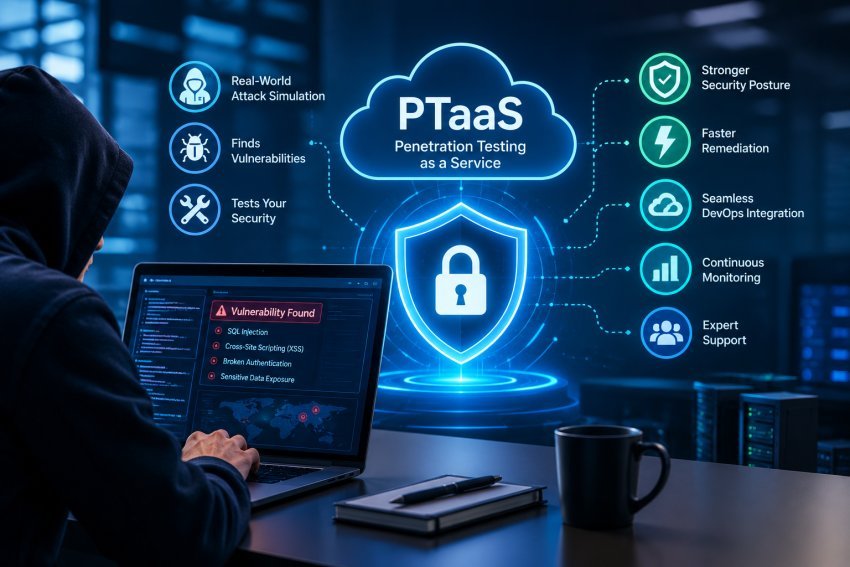
It advocates a continuous cycle of testing and remediation. It suggests that your security position is always changing. You can combat this moving target by continuous testing, remediation, and management. PTaaS demonstrates the evolution of traditional pen testing, converting from one-event to an integrated and continuous security practice. This latest approach guarantees that businesses are safe throughout the year, instead of one point in time.
Therefore, we are presenting to you 12 reasons why it has become indispensable.
Here are 12+ key reasons
1. Quick Feedback on Code Changes
Pen Test As A Service (PTaaS) flawlessly embeds into the software development lifecycle by offering continuous vulnerability assessments and security testing. It signals developers to security risks before deploying new code by continuously observing code changes and detecting vulnerabilities. This is a proactive approach that keeps the development team ahead of possible threats by offering quicker feedback on code changes. This allows them to address vulnerabilities effectively and promptly.
2. Continuous Testing
Traditional point-in-time assessments sometimes miss significant vulnerabilities introduced between releases, where app code is updated rapidly, in this dynamic DevOps ecosystem. New-generation PTaaS like Terra integrates into CI/CD pipelines to activate tests automatically with every deployment. This guarantees that security keeps up with the speed of engineering and allows quicker detection.
3. Decreased Time to Remediation
Pen testing delays can be for some weeks when managed manually, from scoping to delivery. PTaaS platform eradicates this lag by flowing results immediately. Security teams can retest, assign, and triage vulnerabilities quicker. This lowers average time to resolution and reduces exposure.
4. Scalable Coverage
The PTaaS platform scales testing across assets simultaneously. This allows wider coverage without needing a proportional increase in headcount. Dashboard consolidates all activity, whereas automation manages test runs and reporting. This allows companies to operationalize web app security best practices across their complete portfolio.
5. Business Logic-Aware Attack Replication
Top PTaaS platforms can duplicate attacker behavior to reveal errors tied to the way an app is intended to operate. These entail logic errors like manipulating user permissions, abusing discount logic, or bypassing purchase logic. These vulnerabilities are different for every app and need testing approaches that take into consideration business context.
6. Compliance Without the Noise
The majority of the PTaaS platforms provide built-in compliance testing against PCI-DSS standards, HIPAA, ISO 27001, and SOC 2. They offer remediation evidence, test logs, and an audit-ready pen testing report. They are all formatted for regulatory and technical stakeholders.
7. Quicker Remediation Support
Quicker remediation support provided by PTaaS providers can immensely improve the effectiveness and efficiency of vulnerability remediation. These companies provide strategic help, visual aids like expert guidance, videos, and screenshots to assist developers locate resolve vulnerabilities effectively and rapidly.
Using these resources is important for organizing the vulnerability remediation process. The in-depth assistance offered by PTaaS providers can help developers comprehend the root cause of vulnerabilities. They also provide all guide regarding the ways to fix them. Visual aids like videos and screenshots can make it simpler for developers to grasp the particular areas that require attention and the ways to address them effectively. In addition, expert guidance from PTaaS providers guarantees that developers attain the most precise and updated information for resolving vulnerabilities.
8. Access to Security Engineers
PTaaS, or Penetration Testing as a Service, allows organizations to access a team of experienced security engineers without exhausting in-house resources. By connecting with security experts through PTaaS, organizations can efficiently resolve security gaps and streamline their approach to penetration testing. This ensures their team can focus on strategic initiatives while leaving the technical aspects to the security engineers.
9. Decreased Downtime
The use of pen test as a service can significantly eliminate service interruption risks and prevent financial losses that are connected to downtime. By implementing regular pen tests, companies can detect weaknesses and vulnerabilities in their system prior to being exploited by attackers. This permits on-time remediation of any possible risks. This decreases the chances of service interruptions and the associated financial losses.
PTaaS offers the advantage of continuous monitoring and detection of major mistakes. This allows for immediate remediation and alteration. This proactive approach identifies and addresses possible security threats can immensely decrease the impact of possible attacks. This reduces the risk of service interruptions and the resulting financial losses.
10. Integration with DevOps
Pen Test As A Service (PTaaS) facilitates shift-left strategies by embedding security testing into CI/CD pipelines. This guarantees that security becomes an integrated and continuous part of the software development lifecycle (SDLC).
In other words, integrating Pen Test As A Service (PTaaS) into a DevOps pipeline transitions a company from old-school, reactive security testing to a proactive DevSecOps framework. In comparison to legacy yearly pen tests, PTaaS amalgamates continuous automated scanning with immediate time and human-led validation. Therefore, PTaaS plays a significant role when it comes to the cybersecurity health of your app.
11. Lesser Operational Overheads
Cloud-based platforms decrease the requirement for follow-ups, report generation, and manual coordination. It also frees up internal resources for security tasks.
12. Incremental and Frequent Testing
PTaaS allows continuous and regular testing to identify new vulnerabilities as they emerge rather than relying on annual tests. This minimizes the risk window between tests.
13. Enhanced Collaboration
Centralized portals permit testers, developers, and security teams to trace findings, share context, and interact directly. This also decreases remediation cycles and miscommunication.
14. Improved Visibility
Real-time analytics and continuous dashboards provide companies clear visibility into their security posture. This helps to trace overall risk over time, remediation progress, and open issues.
15. On-demand Testing
Teams can begin tests whenever required, during new releases, infrastructure changes, and post-incident, without waiting for long scheduling processes and procurement. Therefore, no funds are wasted when apps and software are tested on demand rather than on a routine. You will only allocate in-house staff or outsource testing when there is demand.
Conclusion
Pen Test as a Service (PTaaS) is not just a quicker delivery framework. It redefines the way companies operationalize offensive security. The best PTaaS platform adjusts testing into development workflows, offers meaningful coverage across difficult attack surfaces, and bridges the gaps between remediation and discovery. That is the basic shift: from point-in-time audits to continuous, context-aware testing that adjusts. No doubt, it has become the top choice for companies.
Frequently Asked Questions (FAQs)
What is meant by PTaaS?
PTaaS demonstrates the evolution of traditional pen testing, converting from one-event to an integrated and continuous security practice. This latest approach guarantees that businesses are safe throughout the year, instead of one point in time.
What are some benefits of PTaaS?
- Incremental and Frequent Testing
- Enhanced Collaboration
- Improved Visibility
- On-demand Testing

Read Dive is a leading technology blog focusing on different domains like Blockchain, AI, Chatbot, Fintech, Health Tech, Software Development and Testing. For guest blogging, please feel free to contact at readdive@gmail.com.