As cyberattacks evolve to be more advanced, it is vital for organizations to incorporate security measures that are beyond basic security elements in order to protect any sensitive information, systems, networks, and structures. One of the ways in which this can be achieved is through vulnerability assessments or penetration testing, which is a crucial step.
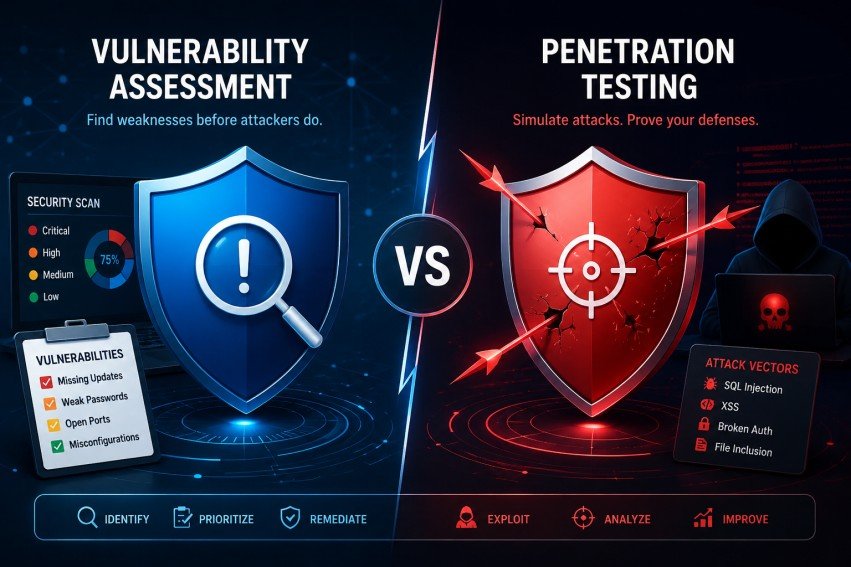
Many people confuse these two terms as they are used in similar contexts; however, they have different meanings since a vulnerability assessment performs the function of recognizing and categorizing security loopholes, while penetration testing makes use of these loopholes to perform a series of tests to determine the way they could be exploited.
What Is a Vulnerability Assessment?
The vulnerability assessment can be defined as a structured process of determining and prioritizing the weaknesses in the security of an organization’s IT infrastructure, whether in applications, operating systems, networks, cloud systems, devices, configurations, or any other technology assets. The main aim is to detect vulnerabilities. Vulnerability scanners and other tools enable the security team to find existing vulnerabilities as well as to identify the issues warranting attention. A typical vulnerability assessment includes the following steps:
- Identify the assets and define the assessment scope
- Scanning for known vulnerabilities
- Understanding and analyzing the vulnerability
- Prioritization of risks
- Preparing a report
- Implementation of patches
- Continuous monitoring of the environment
Vulnerability assessment is a good solution for companies requiring more insights into the security situation. Vulnerability assessments can also assist security teams in finding new vulnerabilities and fixing them. However, it is important to note that using scanners does not guarantee success. Scanners might show several false positives or miss some weaknesses.
What Is Penetration Testing?
“Penetration testing” is sometimes referred to as “pen testing” and involves a process in which an organization’s security systems, applications, and networks are subject to cyber-attack attacks, which are simulated in nature.
Instead of merely identifying a specific vulnerability, however, penetration testers go one step further and seek whether this vulnerability could be exploited successfully in real life or not.
This form of attack raises several questions, such as whether it could allow an attacker to succeed. Some questions that the pen testing asks are
- Will it be possible for an attacker to exploit a specific vulnerability?
- What would the degree of access be in this case?
- Is it possible to transfer from one vulnerability to another?
- How would security systems react?
- What sensitive data would be available to an attacker?
- What will the outcome be?
It is true that pen-testing normally combines automated tools and human expertise in equal proportions. Depending upon the type of penetration test, participants might look into vulnerabilities, try to exploit them, analyze the extent of exploitation, etc.
Unlike vulnerability assessments, penetration tests involve active experts’ participation, which makes them more resource-consuming.
Vulnerability Assessment vs. Penetration Testing: Key Differences
The simplest way to understand the difference is this:
| Factor | Vulnerability Assessment | Penetration Testing |
| Primary purpose | Identify vulnerabilities. | Validate exploitability |
| Approach | Primarily automated | Manual and automated |
| Scope | Broad | More targeted and in-depth |
| Frequency | Regular or continuous | Usually periodic |
| Focus | Detection and prioritization | Exploitation and impact |
| Output | Vulnerability and risk reports | Detailed attack and exploitation findings |
| Expertise required | Security and vulnerability management skills | Specialized penetration-testing expertise |
| Main question | “What weaknesses exist?” | “Can these weaknesses be exploited?” |
How Does a Vulnerability Assessment Work?
A typical vulnerability assessment goes through multiple stages, not always in the same order, but close enough. You might say it starts with planning and scoping, then moves into scanning and identification, followed by analysis, reporting, and then remediation and monitoring.
Planning & Scoping
Security teams first work out which systems, applications, networks, and assets are going to be looked at. At the same time, objectives and testing requirements are set too, like what they expect to prove or how deep they need to go.
Scanning and Identification
Automated scanners check the environment for known security weaknesses. They also flag stale software, configuration problems, and a bunch of other possible issues. Sometimes human review fills in where needed, for example, if the tool misses something or if context matters.
Analysis and Risk Prioritization
After the scans finish, the outputs get reviewed to gauge severity and what kind of real-world impact the vulnerability could create. Many orgs use the Common Vulnerability Scoring System (CVSS) framework, so remediation can be prioritized in a more sensible way.
Reporting
Security teams then document the findings. This includes the vulnerabilities themselves, the risk levels, affected assets, potential consequences, and recommended remediation actions. It’s basically the paper trail and the roadmap.
Remediation and Monitoring
Finally, organizations patch the vulnerable software, adjust configurations, reinforce controls, and fix other weaknesses that were identified earlier. Then regular reassessment is done, because new vulnerabilities can show up once the environment changes or new dependencies arrive.
How Does Penetration Testing Work?
Penetration testing tends to lean more toward an attack-oriented flow. Like not just checking, but actually trying things in a controlled way.
Planning and Authorization
The organization and the testing team set the objectives, the scope, the rules of engagement, and which systems can be looked at. Authorization really matters because without it, active testing should not happen.
Information Gathering
Testers go after information about the target environment to get a clear picture of the technology, the attack surface, and those possible entry points.
Vulnerability Assessment
During this stage, pen testers might run automated tools to spot likely weaknesses, then they manually inspect what came back. Just because a tool flags something, it doesn’t mean it’s real.
Controlled Exploitation
Next, testers try exploiting specific vulnerabilities that were already agreed on as in-scope. The goal is to show the risk in a safe manner, not to cause pointless interruption or collateral damage.
Reporting
The end documentation typically covers the vulnerabilities found, the successful attack paths, the possible business impact, and solid recommendations to improve the security controls.
Remediation and Retesting
Once the issues are fixed, testers may repeat the testing step to confirm the changes actually work and that the earlier attack path is no longer usable.
When should you use a vulnerability assessment?
A vulnerability assessment is especially helpful when an org needs ongoing or repeated visibility into its security gaps, not just some one-time snapshot and done. You can think of it as when you need to observe a fairly large set of systems, and you keep running into the same known vulnerabilities again and again, so you can help sort out which patching tasks matter first. It also fits when you want to keep an up-to-date view of the attack surface, which is basically that whole “where could someone slip in?” picture.
You should also lean on it if you’re trying to back a vulnerability management program, catch configuration issues and software weaknesses, and run routine security checks. For a lot of organizations, vulnerability assessments end up being the foundational layer, almost like the backbone, of a continuous vulnerability management program even if the team roles change, the names shift, or the tooling gets swapped out.
When Should You Use Penetration Testing?
Penetration testing is often the right move when you need a clear sense of how well your security controls would really hold up against a real-world attack, not just a “pass and move on” result. Sometimes teams do it mostly to reduce uncertainty, and honestly to see what might slip through during day-to-day operations. Organizations usually consider penetration testing when:
- Launching a major application or infrastructure change
- Evaluating critical internet-facing systems
- Testing security controls, in a practical way, not just theoretical checks
- Assessing attack paths
- Validating the impact of vulnerabilities, so you know the real business risk
- Preparing for specific compliance requirements
- Testing incident detection and response capabilities, so you can measure readiness
- Conducting periodic security reviews.
Penetration testing can also uncover weaknesses that automated scanning may not notice, especially if the vulnerability depends on tricky interactions, business logic, or an attack chain that evolves as it goes.
How to Pick Between Vulnerability Assessment and Penetration Testing?
Honestly, the best move depends on stuff like your org’s size, the money you have, your goals, the tech setup you’re running, and whatever compliance rules you must follow.
If you’re working with limited resources, doing regular vulnerability assessments can feel like a pretty efficient path to find and rank security gaps, even if it’s more about “what’s wrong” than “can someone actually break in?”
Bigger organizations, with tricky or layered infrastructure, may do better with a mix of continuous vulnerability management plus periodic penetration testing. Your security objective matters a lot too. If you want to locate and prioritize vulnerabilities, start with a vulnerability assessment. But if you need to prove whether particular weaknesses can be used in practice or whether your security controls can handle a real-world-style attack, then penetration testing is usually the better fit.
Also, some regulations can be picky and ask for specific types of testing. For instance, PCI DSS includes requirements tied to vulnerability scanning and penetration testing for the environments that apply.
Final Thoughts
The whole conversation about vulnerability assessment vs. penetration testing is not really about forcing a choice between them. It’s more like they cover separate pieces of the cybersecurity puzzle, in the real world.
A vulnerability assessment helps you discover, inspect, and rank weaknesses across your environments. Penetration testing goes deeper; it simulates attacks and checks whether those vulnerabilities can actually be exploited, not just “theoretically present.”
The strongest security strategy usually combines both approaches. Continuous vulnerability discovery, paired with periodic more in-depth validation, tends to give the clearest picture.
Using both together, you can move beyond simply knowing where vulnerabilities exist and get a more grounded understanding of which exposures could genuinely endanger your systems.
Frequently Asked Questions (FAQs)
Is vulnerability assessment the same as penetration testing?
No. A vulnerability assessment primarily identifies and prioritizes potential weaknesses, while penetration testing attempts to exploit vulnerabilities to validate their real-world impact.
Which is better: vulnerability assessment or penetration testing?
Neither is universally better. Vulnerability assessments provide broad and recurring visibility, while penetration tests provide deeper validation. Most mature security programs benefit from both.
How often should vulnerability assessments be performed?
Vulnerability assessments are generally performed regularly or continuously because new vulnerabilities can emerge as systems and software change.
How often should penetration testing be performed?
Penetration testing is typically performed periodically and may also be triggered by major infrastructure, application, or security changes, as well as specific compliance requirements.
Can automated tools replace penetration testers?
Automated tools are valuable for identifying known vulnerabilities and supporting security testing, but penetration testing often requires human expertise to understand context, attack paths, business logic, and potential impact.
What is the main difference between vulnerability scanning and penetration testing?
Vulnerability scanning focuses on finding potential security weaknesses, whereas penetration testing focuses on safely demonstrating whether those weaknesses can be exploited.

Read Dive is a leading technology blog focusing on different domains like Blockchain, AI, Chatbot, Fintech, Health Tech, Software Development and Testing. For guest blogging, please feel free to contact at readdive@gmail.com.