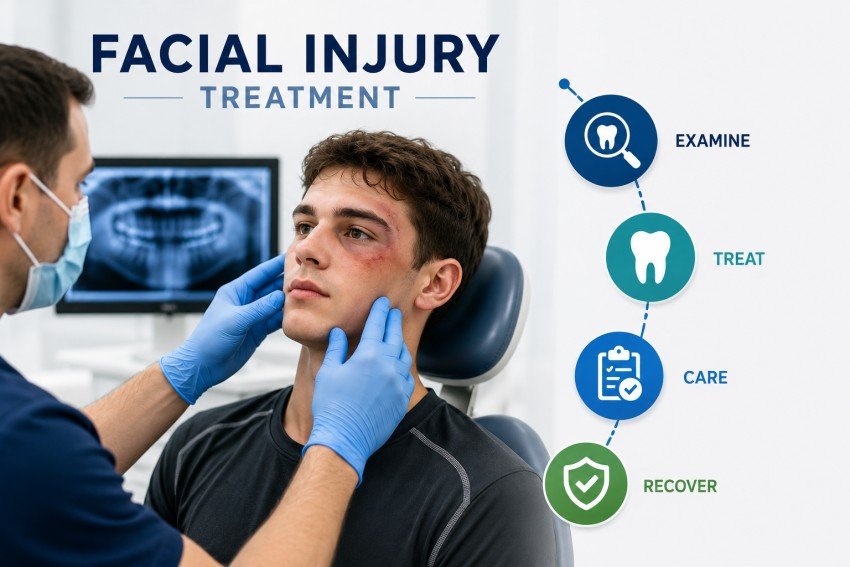
A hard pass hits the cheek, an elbow catches the jaw, or a fall sends an athlete face-first into the court. Pain and swelling may appear quickly, but what you see on the surface does not always reveal the full injury.
A cold compress can ease discomfort and limit swelling, yet it cannot identify damage to the teeth, jaw, facial bones, soft tissues, or nearby structures. Changes in your bite, tooth position, jaw movement, facial sensation, or appearance may indicate that you need a professional evaluation.
Founded in 1982, Great Expressions has taken this promise nationwide, with 250 practices in 9 states: Michigan, Ohio, Georgia, Massachusetts, Texas, Florida, New York, New Jersey, and Connecticut. Understanding when facial injury treatment may be necessary helps athletes make safer decisions after an impact. This guide covers warning signs, immediate action, professional evaluation, and factors that influence a safe return to sports.
Key Takeaways:
- Do not judge a facial injury by swelling alone. Damage to the teeth, jaw, facial bones, or soft tissues may be more serious than it looks.
- Ice has limits. A cold compress can ease pain and swelling, but it cannot diagnose or repair an underlying injury.
- Watch for changes in normal function. A different bite, a loose tooth, limited jaw movement, numbness, or altered facial appearance can signal a need for professional evaluation.
- The first response matters. Stopping play, controlling bleeding, protecting injured teeth, and seeking the right level of care can help prevent further harm.
- Feeling better does not always mean an athlete is ready to play. Healing, stability, normal function, and reinjury risk should guide a safe return to sports.
What Warning Signs Mean a Facial Injury Needs Professional Care?
A facial injury can look minor while affecting structures beneath the skin. After a collision, fall, or direct hit, pay attention to more than bruising or swelling. Changes in how the teeth, jaw, eyes, or face normally look or function can provide important clues about the extent of an injury.
Warning signs that deserve prompt professional assessment include:
- A loose, displaced, broken, or missing tooth.
- A bite that suddenly feels different or uneven.
- Difficulty opening or closing the mouth normally.
- Bleeding that persists despite gentle pressure.
- Numbness, tingling, or reduced facial sensation.
- A noticeable change in facial shape or symmetry.
- Pain that becomes severe or continues to worsen.
- Swelling that increases quickly after the impact.
- A jaw that feels unstable or moves unusually.
- Blurred or double vision, or other changes in eyesight.
Do not assume limited swelling means the injury is minor. A damaged tooth root, jaw injury, or facial fracture may cause few obvious external changes at first. An athlete who develops changes in bite, movement, sensation, or vision should stop playing and be assessed by the appropriate healthcare professional.
When Is a Facial Injury an Emergency?
Some symptoms require emergency medical care rather than waiting for a dental appointment. Seek immediate help for difficulty breathing, uncontrolled bleeding, loss of consciousness, serious vision changes, or signs of head or neck trauma. Prompt dental or specialist assessment is more appropriate for injuries involving damaged teeth, an altered bite, or jaw problems when no medical emergency is present.
What Should You Do Immediately After a Hit to the Face?
The first few minutes after a facial impact can influence what happens next. Instead of testing whether the athlete can keep playing, focus on protecting injured areas and getting the right care.
- Stop activity and assess the athlete. Move the athlete out of play and check how they feel. Being able or willing to continue does not prove the injury is minor.
- Control bleeding carefully. Apply gentle pressure with clean gauze or cloth when appropriate. Bleeding that cannot be controlled requires urgent medical attention.
- Apply a cold compress externally. Hold it against the injured area to help reduce swelling and discomfort. Cold cannot diagnose or repair damaged structures.
- Check the teeth and mouth. Look for broken, loose, displaced, or missing teeth and changes in how the upper and lower teeth meet.
- Protect a knocked-out permanent tooth. Pick it up by the crown, not the root. If dirty, gently rinse it with water without scrubbing. When possible, gently place the tooth back into its socket. If reinsertion is not possible, keep the tooth moist in milk and seek immediate dental care. The American Association of Endodontists (AAE) traumatic dental injury guidance emphasizes acting quickly after a permanent tooth is knocked out, since timely care can affect the chance of saving the tooth.
- Seek appropriate care. First aid can support facial injury treatment, but it cannot replace a professional assessment when deeper structures may be injured.
Record when the injury happened, what caused it, the direction of impact, immediate symptoms, and changes afterward. These details can help the healthcare professional evaluate the injury.
How Are Sports-Related Facial Injuries Evaluated and Treated?
Professional evaluation begins with understanding the impact itself. A clinician may ask how the injury happened, where the face was struck, the direction of the force, what symptoms followed, and whether normal oral or facial function has changed.
Depending on the injury, the examination may include:
- Tooth stability and signs of fractures.
- Bite alignment and changes in how teeth meet.
- Jaw movement and function.
- Cuts or other soft-tissue damage.
- Facial shape and symmetry.
- Numbness or altered sensation.
- Signs of facial bone involvement.
Imaging may be recommended when an examination alone cannot show the full extent of suspected damage. Treatment then depends on the structures involved. Dental trauma may require stabilization, repositioning, restoration, or other appropriate care.
Suspected jaw or facial fractures may require assessment by an oral and maxillofacial surgeon. The American Association of Oral and Maxillofacial Surgeons (AAOMS) recognizes facial trauma as part of this specialty, whose surgeons receive training in treating injuries involving the face, mouth, and jaws.
When an injury affects multiple facial or dental structures, Great Expressions Dental Centers can help athletes determine whether they need dental care or evaluation by a specialist.
When Is It Safe to Return to Sports After a Facial Injury?
Feeling better after a facial injury does not necessarily mean an athlete is ready to compete again. Pain and swelling may improve before injured teeth, the jaw, or other facial structures are stable enough to withstand another impact. Returning too soon can expose a healing area to further injury.
A safe return-to-play decision may depend on:
- The type and severity of the original injury.
- Stability of affected teeth or facial structures.
- Comfortable, normal jaw function.
- Progress of healing.
- Whether additional care is still needed.
- Likelihood of another facial impact during the sport.
- Recommendations from the treating clinician.
Pain tolerance should not be the main test of readiness. An athlete may be able to run, practice, or tolerate discomfort while an injured structure remains vulnerable. Normal function, adequate healing, and the risk of reinjury provide more meaningful information when deciding when to return.
When appropriate, a properly fitted mouthguard or sport-specific facial protection may help protect a recovering area after the athlete has been cleared to participate. The type of protection should match the injury, sport, and the clinician’s recommendations.
Protect the Athlete, Not Just the Score
Ice can be useful after a hit to the face, but less pain and swelling do not always mean everything underneath has recovered. Teeth, the jaw, facial bones, and nearby structures can be injured even when an athlete starts feeling better. What matters is whether the face and mouth continue to look, feel, and function normally.
Athletes, parents, and coaches should pay attention to changes in the bite, jaw movement, facial sensation, tooth stability, or appearance after an impact. Playing through an unexplained change may put an injured area at risk of further harm.
With multiple Great Expressions Dental Centers locations, athletes and families can more easily find dental care when a facial injury needs professional attention. When something does not look, feel, or function normally after facial trauma, choose professional evaluation over playing through it. Call us today to schedule an appointment and take the next appropriate step.

Read Dive is a leading technology blog focusing on different domains like Blockchain, AI, Chatbot, Fintech, Health Tech, Software Development and Testing. For guest blogging, please feel free to contact at readdive@gmail.com.