Quality is important in almost every industry. Whether a company makes software, medicines, food, medical devices, machines, or provides professional services, it needs a reliable way to make sure its work meets the required standards.
This is where quality assurance (QA) and quality control (QC) come in.
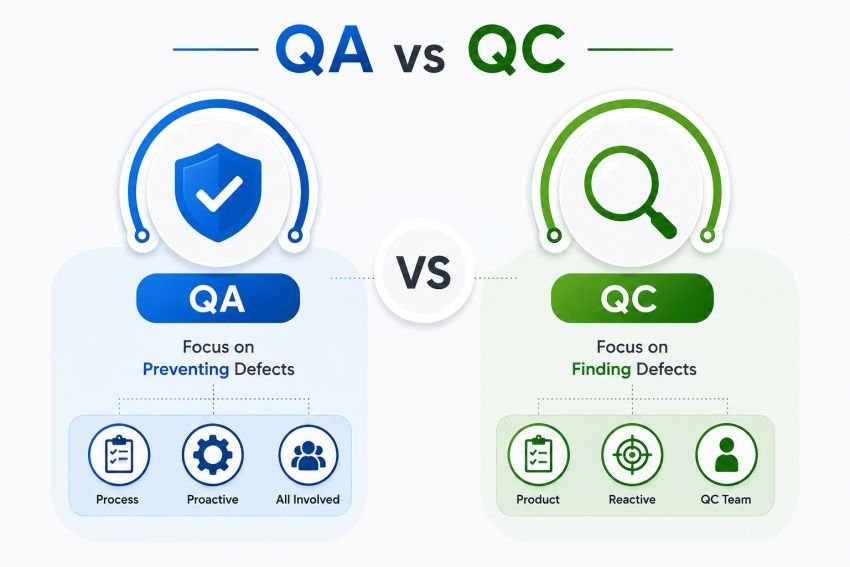
People often use these terms as if they mean the same thing. They are closely connected, but they are not identical. QA focuses mainly on building and improving the processes that help prevent problems, while QC focuses on checking the actual product, service, or output to find problems and confirm that requirements have been met.
Understanding this difference can help businesses reduce defects, improve customer satisfaction, meet regulatory requirements, and create more consistent results.
In this guide, we will explain QA vs QC in simple terms, compare their roles, discuss their benefits, look at practical examples, and explain how both can work together as part of a strong quality management system.
What Is Quality Assurance?
Quality assurance, commonly called QA, is a planned and systematic approach used to provide confidence that a product, service, or process will meet defined quality requirements.
In simple words, QA is about building quality into the way work is done.
Instead of waiting until a finished product has a problem, QA looks at the process that creates the product. The goal is to create reliable processes that reduce the chance of errors, defects, and deviations occurring in the first place.
For example, imagine a company develops a banking application. A QA approach may include defining development standards, creating testing procedures, documenting requirements, reviewing designs, training employees, conducting audits, controlling changes, and establishing procedures for handling problems.
The goal is not simply to find a broken feature at the end. The goal is to create a development process that consistently produces a reliable application.
The U.S. Environmental Protection Agency describes QA as the broader plan for ensuring quality across a program. Its QA approach can include study design, training, documentation, data management, analysis, and defined QC measures.
ASQ similarly describes quality assurance as part of quality management that provides confidence that quality requirements will be fulfilled. That confidence can be important internally for management and externally for customers, regulators, certifiers, and other stakeholders.
Common QA Activities
QA can include:
- Quality planning
- Defining quality objectives
- Creating policies and procedures
- Developing standard operating procedures (SOPs)
- Process design
- Employee training
- Supplier management
- Auditing
- Documentation
- Change control
- Risk management
- Process monitoring
- Corrective and preventive actions
- Continuous improvement
- Quality system reviews
These activities help create a system in which quality is not left to chance.
What Is Quality Control?
Quality control, or QC, is the operational side of quality management that checks whether a product, service, process, or result actually meets established requirements.
In simple terms, QC asks:
“Did we actually produce what we were supposed to produce?”
QC commonly involves inspection, measurement, sampling, testing, verification, and evaluation.
For example, a pharmaceutical company may test a completed batch of medicine. A software company may test an application before release. A manufacturing company may inspect finished products for defects.
If the result does not meet the required specification, QC helps identify the problem so that the product can be rejected, corrected, reworked, or investigated before it reaches the customer.
ASQ defines quality control as part of quality management focused on fulfilling quality requirements and describes it as the operational techniques and activities used to fulfill those requirements.
The EPA also explains that QC consists of specific steps used to determine the validity of sampling and analytical procedures.
Common QC Activities
QC activities can include:
- Product inspection
- Sampling
- Laboratory testing
- Measurement
- Functional testing
- Software testing
- Batch inspection
- Validation testing
- Data verification
- Comparing results with specifications
- Identifying nonconformities
- Rejecting defective products
- Reworking products
- Recording test results
QC is therefore more focused on checking actual results than designing the entire quality system.
QA vs QC: What Is the Difference?
The simplest way to understand the difference is this:
QA focuses on preventing problems. QC focuses on finding problems.
QA is generally process-oriented, while QC is generally product- or output-oriented.
QA asks:
“Are we using the right process to produce quality?”
QC asks:
“Does the result meet the required quality?”
However, this does not mean that QA happens only before production and QC happens only after production. In real organizations, quality activities can happen throughout the lifecycle.
Qualio describes QA as a proactive or preventive activity and QC as a more reactive activity used to inspect and verify products or outputs. It also explains that QC is commonly considered a subset of broader QA activities.
Simple QA and QC Relationship
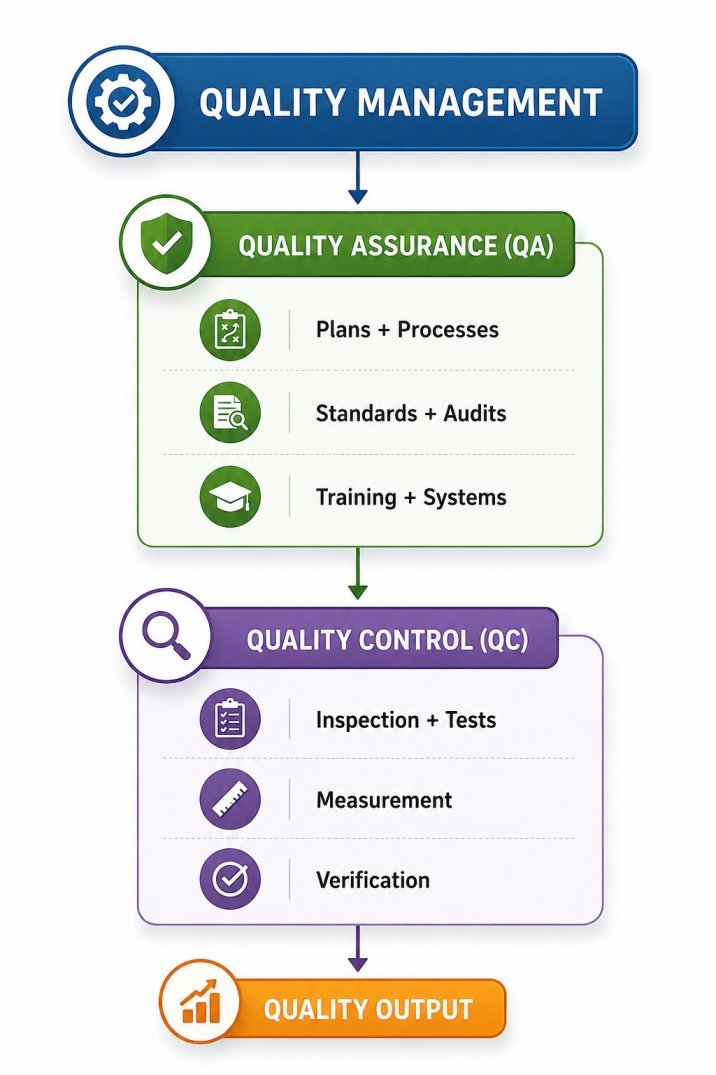
This is an original simplified representation of the relationship described by ASQ, where QA and QC are two aspects of quality management and QC is generally treated as a subset of QA activities.
QA vs QC: Key Differences at a Glance
| Factor | Quality Assurance (QA) | Quality Control (QC) |
|---|---|---|
| Main focus | Process | Product or output |
| Main goal | Prevent problems | Detect problems |
| Approach | Proactive | Generally reactive |
| Main question | Are we following the right process? | Does the result meet requirements? |
| Focus | How work is performed | What was produced |
| Activities | Planning, audits, training, documentation | Inspection, testing, sampling |
| Timing | Throughout the lifecycle | During and after production or delivery |
| Responsibility | Often organization-wide | Often assigned to specialized personnel |
| Orientation | Process-oriented | Product-oriented |
| Result | Better processes | Verified results |
| Example | Creating an SOP | Testing a finished product |
| Improvement | Prevents recurring problems | Identifies problems that require action |
The distinction is not about choosing one over the other. A strong quality system needs both.
1. Proactive QA vs Reactive QC
One of the easiest ways to understand QA vs QC is to look at their approach to problems.
QA is proactive
QA tries to prevent defects before they happen.
For example, suppose a company discovers that employees are entering customer information incorrectly. A QA response might include:
- Reviewing the existing process
- Updating the procedure
- Providing employee training
- Adding validation rules
- Reviewing documentation
- Monitoring the process
The objective is to reduce the possibility of the same problem happening again.
QC is reactive
QC identifies a problem after it appears in an output or during testing.
For example, if a software tester finds that a payment button does not work, that is a QC finding. The team can record the defect, investigate it, fix it, and test the application again.
Ideally, the QC finding should also lead to a QA review.
If the same type of defect keeps appearing, the organization should ask why the process is allowing it to happen.
This connection between QC findings and QA improvement is important because finding individual defects is not enough. The organization should also learn from those defects.
2. Process vs Product
Another major difference is what each activity focuses on.
QA focuses on the process
QA examines how work is planned and performed.
Examples include:
- Creating SOPs
- Establishing development standards
- Defining quality requirements
- Training employees
- Conducting audits
- Managing suppliers
- Reviewing processes
- Controlling changes
- Establishing documentation requirements
QC focuses on the product or output
QC examines whether the actual result meets the defined requirements.
Examples include:
- Testing a software application
- Inspecting a manufactured product
- Testing a laboratory sample
- Checking a pharmaceutical batch
- Measuring product dimensions
- Reviewing a completed document
A useful way to remember this is:
QA controls the way quality is created. QC checks the quality that was created.
3. System vs Parts
QA usually looks at the wider quality system.
For example, a manufacturer may have a QA system covering:
- Supplier qualification
- Employee training
- Manufacturing procedures
- Documentation
- Change management
- Audits
- Risk management
- Corrective actions
QC may focus on individual parts of that system, such as inspecting raw materials or testing finished products.
This means QA looks at the bigger picture, while QC often examines specific outputs or components.
4. Creation vs Verification
QA helps create the roadmap for producing quality.
It can define requirements for:
- Product design
- Manufacturing
- Packaging
- Distribution
- Documentation
- Service delivery
- Internal processes
QC then verifies whether the resulting product or service meets those requirements.
For example:
QA: Define the required dimensions and establish the manufacturing process.
QC: Measure the finished product and confirm that its dimensions meet the specification.
Both activities are necessary.
5. Entire Team vs Dedicated Personnel
QA is often an organization-wide responsibility.
Everyone can contribute to QA by following approved procedures, maintaining accurate records, completing training, reporting problems, and participating in improvement activities.
QC is often performed by dedicated personnel whose responsibilities include inspection, testing, measurement, and verification.
Qualio explains that QA activities can involve the wider organization, while QC is generally handled by personnel with specific product verification, inspection, and testing responsibilities.
This distinction can vary between organizations. Smaller companies may have employees performing both QA and QC duties.
What Are the Main Types of Quality Assurance?
There is no single universally standardized list of “four types” of QA. However, Qualio describes four useful categories commonly used to understand QA:
1. Process Quality Assurance
This focuses on the processes used to create a product or deliver a service.
The goal is to make processes consistent, controlled, and capable of producing the required results.
2. Product Quality Assurance
This focuses on ensuring that products are designed and produced according to defined quality requirements.
3. Organizational Quality Assurance
This considers the organization’s wider systems, policies, culture, training, and quality management practices.
4. Supplier Quality Assurance
This focuses on the quality of materials, components, services, or products received from suppliers.
For example, a manufacturer may evaluate suppliers, establish requirements, audit supplier processes, and sample incoming materials.
Qualio notes that these four categories are a common and useful way to organize QA thinking, although they are not a standardized industry definition.
What Are the Main QA Processes?
A practical QA program usually contains several connected activities.
1. Quality Planning
The organization first defines what “good quality” means.
This can include:
- Quality objectives
- Customer requirements
- Regulatory requirements
- Performance standards
- Acceptance criteria
- Data quality objectives
The EPA emphasizes establishing data quality objectives or requirements before sample collection and analysis in its environmental monitoring context.
2. Design and Development
Quality considerations should be included during design rather than added only at the end.
Teams can identify risks, define controls, review designs, and establish testing requirements before production begins.
3. Process Implementation
The organization creates and implements procedures that help employees perform work consistently.
These procedures may include SOPs, work instructions, checklists, policies, and process controls.
4. Inspection and Testing
Testing and evaluation help determine whether the process and resulting outputs meet defined requirements.
Although inspection and testing are strongly associated with QC, they can also form part of a broader QA system when they are used to evaluate and improve the overall quality process. Qualio includes inspection and testing among QA activities while distinguishing targeted QC verification from the broader QA framework.
5. Continuous Improvement
A quality system should not remain unchanged forever.
Organizations can use:
- Customer feedback
- Audit results
- Test results
- Defect data
- Process measurements
- Complaints
- Nonconformities
to identify opportunities for improvement.
6. Documentation and Reporting
Quality-related activities need reliable records.
Documentation can include:
- Test results
- Audit findings
- Training records
- Procedures
- Change records
- Corrective actions
- Inspection results
- Quality reports
The EPA specifically highlights adequate recordkeeping and documentation for traceability of samples and data.
What Are Common QC Procedures?
QC activities vary by industry, but several are widely used.
Product Inspection
A finished or partially finished product is examined against defined requirements.
Sampling
A selected sample is tested instead of testing every item, when an appropriate sampling approach is permitted.
Laboratory Testing
Laboratory methods can be used to determine whether materials or products meet required specifications.
Validation Testing
Testing can be used to confirm that a product, process, or method performs as expected.
Software Testing
Software teams use testing to identify defects and verify that applications behave according to requirements.
Measurement
Physical or technical characteristics can be measured and compared with specifications.
Data Verification
Data can be reviewed to determine whether it is complete, accurate, and suitable for its intended purpose.
QA and QC Examples
The difference becomes easier to understand through real-world examples.
Example 1: Software Development
Imagine a company is building an online shopping application.
QA activities
The QA process may include:
- Defining coding standards
- Creating development procedures
- Reviewing requirements
- Establishing testing policies
- Training team members
- Conducting process audits
- Defining documentation standards
- Establishing defect-management procedures
QC activities
The QC team may:
- Test login functionality
- Test shopping cart behavior
- Test payment processing
- Check page performance
- Verify calculations
- Test different browsers
- Record defects
- Retest corrected features
Here, QA builds the framework for quality, while QC verifies the actual software.
Example 2: Pharmaceutical Manufacturing
Consider a pharmaceutical company producing tablets.
QA
QA may establish:
- Manufacturing procedures
- Employee training
- Supplier requirements
- Documentation controls
- Change control
- Audit procedures
- Quality standards
- Corrective and preventive action procedures
QC
QC may:
- Test raw materials
- Inspect production samples
- Test completed batches
- Measure specific product characteristics
- Compare results with specifications
If testing shows that a batch does not meet critical requirements, the batch may be rejected or investigated.
Qualio uses pharmaceutical manufacturing to illustrate how QC can identify a failed batch while QA helps investigate and improve the process behind the problem.
Example 3: Food Manufacturing
Suppose a company produces packaged food.
QA may include:
- Creating hygiene procedures
- Training employees
- Establishing supplier standards
- Defining storage procedures
- Creating sanitation requirements
- Conducting audits
QC may include:
- Inspecting finished packages
- Checking product weight
- Testing samples
- Checking labels
- Verifying packaging
- Recording defects
If QC finds repeated packaging problems, QA can investigate the process and introduce changes to prevent recurrence.
Example 4: Environmental Testing
Environmental monitoring provides another useful example.
The EPA explains that a QA plan can define how a monitoring effort is designed, how volunteers or personnel are trained, how samples and data are managed, and which QC measures are required. It also emphasizes standardized scientific procedures, sample integrity, documentation, data-quality assessment, and complete and accurate reporting.
For example:
QA: Establish the sampling plan, training, procedures, documentation requirements, and data-quality objectives.
QC: Follow defined sampling and analytical checks to determine whether the resulting data is valid.
This example shows why QA and QC should not be treated as completely separate activities.
QA, QC, and Inspection: Are They the Same?
No.
Inspection is an important QC-related activity, but QC is broader than simply looking at a product.
ASQ describes inspection as measuring, examining, or testing one or more characteristics of a product or service and comparing them with specified requirements to determine conformity.
For example, checking whether a manufactured component has the correct dimensions is inspection.
QC can include that inspection along with testing, sampling, verification, recording results, and other operational activities used to fulfill quality requirements.
QA is broader still because it includes the planned and systematic activities used to provide confidence that quality requirements will be fulfilled.
QA and Auditing
Auditing is another important part of QA.
An audit is a planned, independent, and documented assessment used to determine whether agreed requirements are being met.
Audits can examine:
- Quality management systems
- Processes
- Products
- Services
- Regulatory compliance
For example, an organization may audit a manufacturing process to determine whether employees are following approved procedures.
If an audit identifies a weakness, the organization can investigate the cause and make improvements.
ASQ identifies auditing as part of the quality assurance function and explains that audits compare actual conditions with requirements and report the results to management.
Corrective Action: Where QA and QC Meet
One of the most important connections between QA and QC occurs when QC finds a problem.
Imagine that a QC test finds a product outside the required specification.
QC identifies and documents the problem.
But simply fixing that individual product may not be enough.
The organization should ask:
- Why did the problem happen?
- Has this happened before?
- Could it happen again?
- Does the process need to change?
This is where QA becomes important.
A QC finding can trigger a broader QA investigation, corrective action, preventive action, process review, training update, or procedure change.
Qualio gives a similar example in which a nonconforming result can trigger a CAPA investigation to identify the root cause and improve processes so the issue does not happen again.
Simple Improvement Cycle
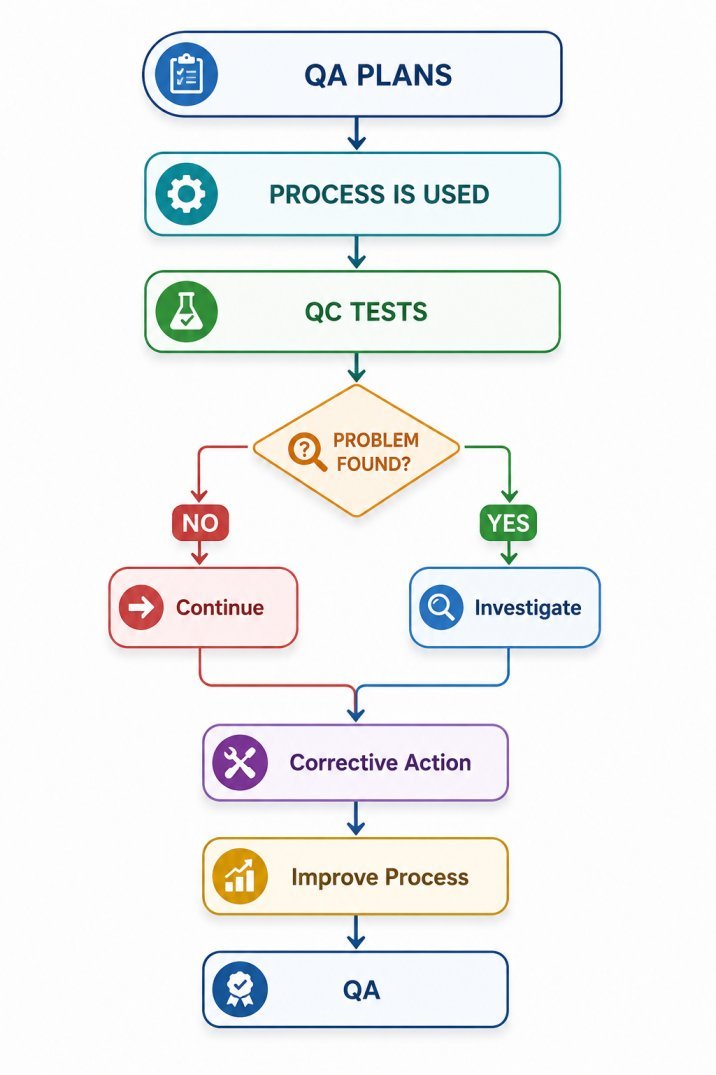
This creates a continuous feedback loop instead of treating quality as a one-time inspection.
Benefits of Quality Assurance
A strong QA system can provide several benefits.
Prevents Recurring Problems
By improving processes rather than only fixing individual defects, organizations can reduce the chance of repeated problems.
Improves Consistency
Well-defined procedures help employees perform tasks more consistently.
Supports Compliance
QA can help organizations meet customer, contractual, regulatory, and industry requirements.
Reduces Waste
Preventing errors can reduce rework, rejected products, delays, and other unnecessary costs.
Improves Customer Confidence
Consistent quality can strengthen customer trust and satisfaction.
Supports Continuous Improvement
QA creates a framework for using data, audits, feedback, and findings to improve processes.
Benefits of Quality Control
QC also provides important advantages.
Finds Defects
QC helps identify problems before products or services reach customers.
Verifies Requirements
Testing and inspection provide evidence that outputs meet defined specifications.
Reduces Customer Complaints
Finding defects internally can prevent defective products from reaching customers.
Supports Corrective Action
QC results provide useful evidence for investigating quality problems.
Protects Product and Service Quality
Regular testing and inspection help organizations maintain required quality levels.
Provides Data
QC generates test and inspection results that can be used for analysis and improvement.
What Happens If a Company Uses Too Little QA?
Without enough QA, an organization may rely too heavily on finding problems after they occur.
This can create several problems:
- Repeated defects
- Inconsistent processes
- Weak documentation
- Poor employee training
- Increased rework
- Higher operating costs
- Difficulty demonstrating compliance
- Slow continuous improvement
A company may keep fixing the same problems without addressing their root causes.
What Happens If a Company Uses Too Little QC?
Too little QC creates a different problem.
An organization may have excellent policies and procedures on paper but lack evidence that the actual output meets requirements.
Possible consequences include:
- Defects reaching customers
- Product recalls
- Customer complaints
- Failed tests
- Nonconformities
- Safety risks
- Regulatory problems
- Damage to reputation
Qualio makes this point clearly: without sufficient QC, an organization can have strong-looking policies that do not accurately reflect what is being delivered to customers.
QA vs QC: Which One Is More Important?
Neither one should be considered a replacement for the other.
The better question is:
How can QA and QC work together?
QA establishes the system, processes, standards, and controls needed to achieve quality.
QC provides evidence that the actual results meet those requirements.
If an organization uses QA without enough QC, it may not know whether its processes are actually producing the expected results.
If it uses QC without enough QA, it may repeatedly discover the same problems without improving the processes that cause them.
ASQ and Qualio both emphasize the complementary relationship between QA and QC.
QA vs QC in Different Industries
QA and QC are not limited to manufacturing.
Software
QA: Development processes, standards, reviews, testing strategy, documentation, and process improvement.
QC: Functional testing, regression testing, performance testing, security testing, and defect verification.
Healthcare
QA: Policies, procedures, training, audits, process monitoring, and quality improvement.
QC: Checking test results, laboratory controls, equipment checks, and verification activities.
Construction
QA: Project quality plans, approved procedures, material requirements, supplier controls, and inspections planning.
QC: Site inspections, measurements, material testing, and verification of completed work.
Manufacturing
QA: Production systems, training, supplier quality, procedures, audits, and process controls.
QC: Sampling, inspection, measurement, testing, and final verification.
Service Businesses
Quality is not only about physical products.
ASQ points out that service organizations may not always have a tangible product to inspect, but they can still have quality-control activities for products involved in providing the service, such as documents, designs, rental equipment, or other tangible items.
For a consulting company, for example:
QA: Establish report-writing standards, review procedures, employee training, and documentation rules.
QC: Check a completed report for accuracy, formatting, completeness, and compliance with client requirements.
Quality Assurance and Quality Control in Data Management
Data quality is another area where QA and QC are closely connected.
The EPA’s approach highlights several important principles:
- Define data quality requirements before collecting data.
- Use scientifically valid and standardized procedures.
- Maintain sample integrity and security.
- Keep adequate records for traceability.
- Assess and document data quality.
- Report complete and accurate results.
These principles can also be useful outside environmental monitoring.
For example, a company collecting customer data can establish rules for data entry, validation, storage, access, documentation, and review.
QC activities can then check whether actual records meet those requirements.
Why Documentation Matters in QA and QC
Documentation is one of the foundations of a reliable quality system.
Without documentation, it can be difficult to answer basic questions such as:
- What process was followed?
- Who performed the task?
- Which version of a procedure was used?
- What test was performed?
- What were the results?
- Was a problem found?
- What corrective action was taken?
- Did the process change afterward?
The EPA specifically emphasizes documentation and traceability as part of QA/QC activities.
Qualio also identifies documentation and reporting as important QA activities and notes the value of recording test results, corrective actions, and audit findings.
Good documentation turns quality activities into evidence that can be reviewed and improved.
Quality Management Systems, QA, and QC
QA and QC normally operate within a wider quality management system (QMS).
A QMS provides the overall structure for managing quality.
It can include:
- Quality policies
- Objectives
- Procedures
- Roles and responsibilities
- Training
- Documentation
- Audits
- Risk management
- Supplier management
- Change control
- Corrective actions
- Monitoring
- Continuous improvement
QA and QC are therefore not isolated departments or activities. They can be connected through the organization’s broader quality system.
For organizations with complex quality requirements, digital quality management systems can also help manage documents, training, audits, suppliers, quality events, and other activities. Qualio discusses electronic quality management systems (eQMS) as a way to connect QA and QC activities and reduce manual administrative work.
A Short History of QA and QC
The concepts of quality have existed for a very long time, but modern quality management developed significantly during industrialization and mass production.
ASQ notes that quality control became particularly important in the 1920s as mass production increased the need to control product quality and process variation.
By the 1950s, the quality profession expanded further into quality assurance and auditing. Independent verification became especially important in industries where public health and safety were major concerns.
Over time, quality management moved beyond simply inspecting finished products. Modern quality systems increasingly emphasize process improvement, prevention, risk management, customer requirements, data, and continuous improvement.
Common QA and QC Mistakes
Understanding the difference is useful, but organizations also need to avoid common mistakes.
Mistake 1: Treating QA and QC as the Same Thing
They are connected but have different roles.
Mistake 2: Relying Only on Final Inspection
Finding defects at the end does not automatically prevent them from happening again.
Mistake 3: Ignoring QC Results
QC findings contain valuable information about where processes may be failing.
Mistake 4: Focusing Only on Documentation
Having procedures on paper does not guarantee that employees follow them or that the output meets requirements.
Mistake 5: Forgetting Continuous Improvement
Quality systems should evolve when new risks, defects, customer requirements, or regulatory expectations appear.
Mistake 6: Treating Quality as Only the Quality Department’s Responsibility
Quality can involve the entire organization. Employees who design, develop, purchase, manufacture, test, deliver, or support products and services can all influence quality.
QA vs QC: A Practical Way to Remember the Difference
If the two terms still seem confusing, use this simple example.
Imagine you own a bakery.
QA asks:
“How can we create a process that consistently produces good bread?”
You may establish:
- Ingredient standards
- Recipe instructions
- Employee training
- Oven procedures
- Cleaning procedures
- Supplier requirements
- Storage rules
QC asks:
“Is this bread actually good enough to sell?”
You may:
- Check the weight
- Inspect appearance
- Check packaging
- Verify labeling
- Test samples
- Remove defective products
So:
QA builds the system.
QC checks the result.
That simple distinction explains much of the relationship between the two.
QA vs QC: Final Comparison
| Question | QA | QC |
|---|---|---|
| What does it focus on? | Processes and systems | Products, services, and outputs |
| What is the goal? | Prevent quality problems | Detect and address quality problems |
| Is it proactive? | Primarily yes | Primarily reactive |
| Who is involved? | Often the wider organization | Often specialized personnel |
| What does it use? | Plans, procedures, audits, training | Tests, inspection, measurement |
| When does it happen? | Throughout the lifecycle | During and after production or delivery |
| What does it produce? | A controlled quality process | Evidence about actual quality |
| What happens after a problem? | Improve the underlying process | Identify, document, and verify the problem |
| Example | Creating an SOP | Testing a product |
| Relationship | Broader quality activity | Commonly a subset of QA |
Final Thoughts on QA vs QC
The difference between quality assurance and quality control is easier to understand when you stop thinking of them as competing activities.
QA and QC work together.
Quality assurance creates the plans, processes, standards, controls, training, documentation, and improvement mechanisms that help an organization produce consistent quality.
Quality control then examines actual products, services, processes, or data to determine whether they meet the defined requirements.
When QC identifies a problem, the information should not simply stop with the defective product. It can feed back into QA so the organization can investigate the cause, improve the process, update procedures, provide additional training, or introduce other corrective actions.
That creates a continuous quality cycle:
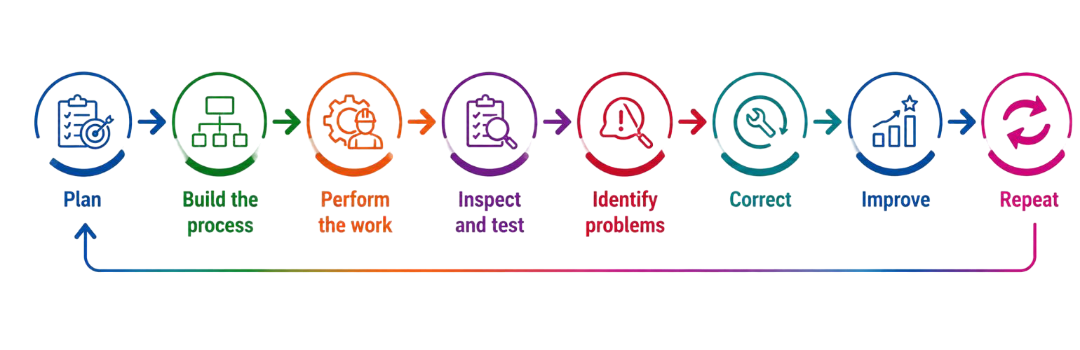
The most effective organizations therefore do not ask whether they should choose QA or QC. They recognize that both are necessary parts of a strong quality management approach.
In short, QA helps prevent quality problems by improving the process, while QC helps detect and verify quality problems by examining the actual output. When the two work together, organizations can improve consistency, reduce defects, satisfy requirements, support compliance, protect customers, and create a stronger culture of continuous improvement.
Frequently Asked Questions
What does QA stand for?
QA stands for Quality Assurance. It refers to planned and systematic activities designed to provide confidence that quality requirements will be fulfilled.
What does QC stand for?
QC stands for Quality Control. It refers to operational techniques and activities used to fulfill and verify quality requirements.
What is the main difference between QA and QC?
QA mainly focuses on processes and preventing problems, while QC mainly focuses on inspecting, testing, and identifying problems in products, services, or outputs.
Is QA better than QC?
No. QA and QC have different purposes and work best together. QA helps create reliable processes, while QC verifies actual results.
Is QC part of QA?
In many quality management frameworks, QC is considered a subset of the broader QA activities. ASQ specifically describes QC as a subset of QA activities.
Is testing QA or QC?
Testing is commonly associated with QC because it checks whether a product or output meets requirements. However, testing can also support a broader QA system by providing information used to evaluate and improve processes.
Is auditing part of QA?
Yes. ASQ identifies auditing as part of the quality assurance function. Audits compare actual conditions with requirements and report findings to management.
Can one person perform both QA and QC?
Yes. In smaller organizations, one person may perform both QA and QC responsibilities. In larger organizations, the responsibilities may be separated among different teams or roles.
Why are both QA and QC important?
QA helps prevent problems by improving processes, while QC helps identify problems by checking actual results. Using both gives an organization a stronger and more complete approach to quality.
What is the easiest way to remember QA vs QC?
Think of it this way:
QA = prevent problems through better processes.
QC = find problems through inspection and testing.
Both work together to achieve consistent quality.

Read Dive is a leading technology blog focusing on different domains like Blockchain, AI, Chatbot, Fintech, Health Tech, Software Development and Testing. For guest blogging, please feel free to contact at readdive@gmail.com.