

Regression testing is indeed tedious. It requires you to constantly review your existing code to determine if any bugs have resulted from the last release. However, in most cases, there will be no bugs at all, and this makes regression testing even more time-consuming.
Did you know? Automated regression testing tools accelerate the feedback loop and reduce strategic testing costs by implementing the repetitive validation suites 10 times quicker in comparison to manual assessments.
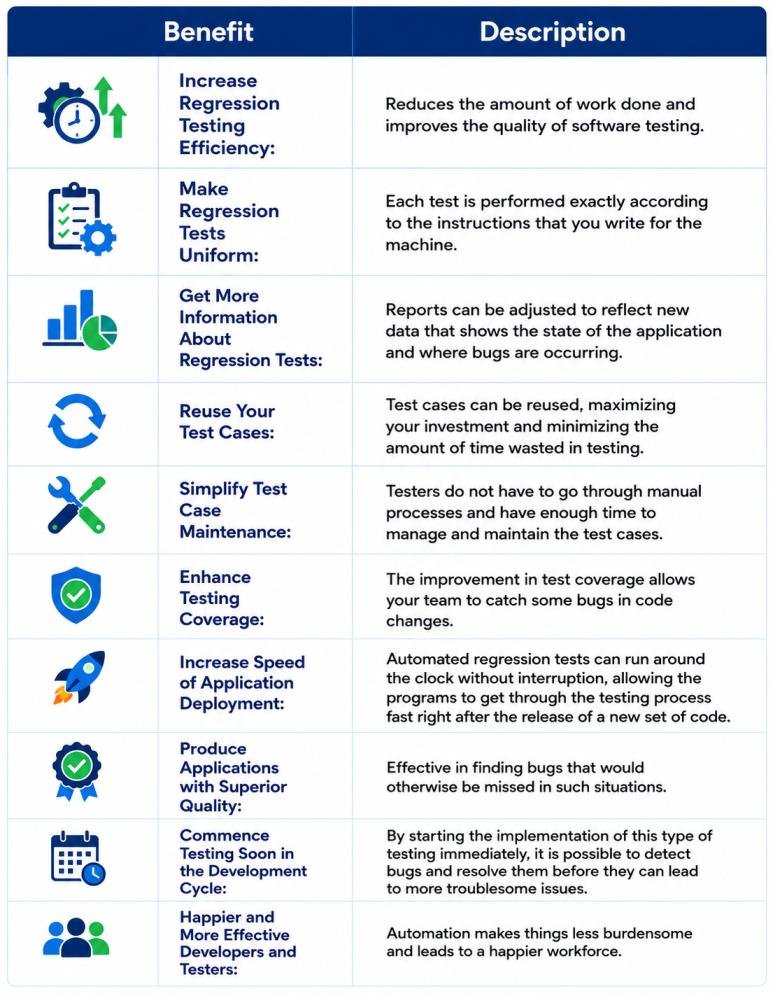
The good thing is that many tasks connected with regression testing can be automated, which reduces the tediousness of the whole process and provides several advantages. The table below will help you take a complete overview of the discussion in this article:
The Benefits of Automated Regression Testing Tools
Top 10 Regression Testing Tools
1. Selenium
Selenium is an open-source automation framework widely used for web application and regression testing across different browsers and programming languages.
Location: Chicago, USA
Rating: 4.3/5
Founded: 2004
2. Playwright
Playwright is an open-source testing framework developed by Microsoft for reliable end-to-end and automated regression testing across Chromium, Firefox, and WebKit.
Location: Sunnyvale, USA
Rating: 4.7/5
Founded: 2020
3. Cypress
Cypress is a modern testing platform designed for web applications, offering fast and reliable automated end-to-end, integration, and regression testing.
Location: Atlanta, USA
Rating: 4.7/5
Founded: 2015
4. Katalon
Katalon is an automation testing platform that supports web, mobile, API, and application testing with reusable automated test cases.
Location: Atlanta, USA
Rating: 4.4/5
Founded: 2016
5. TestComplete
TestComplete is an automated testing tool for web, desktop, and mobile applications, helping teams create repeatable functional and regression tests.
Location: Somerville, USA
Rating: 4.2/5
Founded: 2009
6. Tricentis Tosca
Tricentis Tosca is an enterprise test automation platform that uses a codeless approach to create reusable automated tests and improve regression testing.
Location: Austin, USA
Rating: 4.3/5
Founded: 2007
7. Ranorex Studio
Ranorex Studio is a test automation solution for web, desktop, and mobile applications, offering record-and-replay and code-based automation features.
Location: Graz, Austria
Rating: 4.2/5
Founded: 2007
8. BrowserStack
BrowserStack is a cloud-based testing platform that allows teams to perform automated testing across different browsers, operating systems, and real mobile devices.
Location: Dublin, Ireland
Rating: 4.4/5
Founded: 2011
9. ACCELQ
ACCELQ is an AI-powered, no-code continuous testing platform designed for automated testing across web, mobile, API, and enterprise applications.
Location: Dallas, USA
Rating: 4.8/5
Founded: 2014
10. Appium
Appium is an open-source automation framework primarily used for testing mobile applications on Android and iOS, making it useful for automated regression testing.
Location: Global / Open Source
Rating: N/A
Founded: 2011
Increase Regression Testing Efficiency
One of the main frustrations associated with regression testing is that the application becomes more and more complex over time and that you have to conduct more and more tests, which is becoming increasingly harder. Quite soon you may find yourself wasting most of the time reviewing already tested features or even avoiding regression tests altogether.
The introduction of automated regression testing helps to reduce the amount of work done and improves the quality of software testing as well.
Make Regression Tests Uniform
Have you ever faced a situation where you weren’t able to replicate the result of a regression test? This can happen if you’re not sure how the tester performed the test. When everyone uses a unique approach to testing, it becomes impossible to know if testing is done correctly.
Lack of uniformity means it’s possible to miss some bugs, thereby complicating the process of development and potentially harming the quality of software.
Using automated regression tests, you have a perfect tool at hand. Automated testing means that each test is performed exactly according to the instructions that you write for the machine. You are aware of the type of regression test you employ, which code is being tested, and how the scripts are formed. Therefore, whenever you encounter issues, you can be sure that no mistakes were made by the testers.
Get More Information About Regression Tests
Your regression testing solution can produce a report that contains everything needed for quick bug identification. You can set up your test reports in such a way that they provide only the information that is required, and thus you don’t have to deal with unnecessary information. As your application becomes more complex, reports can be adjusted to reflect new data that shows the state of the application and where bugs are occurring.
Reuse Your Test Cases
Regression testing involves a lot of effort and specialized skills to create test cases. It doesn’t make sense to come up with new test cases for every round of regression testing. This problem becomes especially relevant when you are regularly releasing new updates.
With the help of automated regression testing, test cases can be reused, thus maximizing your investment and minimizing the amount of time wasted in testing.
Simplify Test Case Maintenance
Maintaining test cases and keeping them effective is another time-consuming process while executing regression testing. Once your program is changed, the test cases might not be effective in detecting bugs anymore.
When using automated regression testing, testers do not have to go through manual processes and have enough time to manage and maintain the test cases.
Enhance Testing Coverage
One more thing that is positively affected when testers have enough time is the testing coverage. This feature occurs thanks to the nature of the test cases, which can be reused for automated testing. The improvement in test coverage allows your team to catch some bugs in code changes. In addition to the automated tests, your testers are able to conduct some manual exploratory tests too.
Increase Speed of Application Deployment
Agile software development is a required course of action for some businesses. However, rapid development is of no use if the applications are full of bugs. In order to implement this method successfully, obtaining the right mixture of speed of deployment and quality of the application is indispensable. Automated regression tests can run around the clock without interruption, allowing the programs to get through the testing process fast right after the release of a new set of code.
Produce Applications with Superior Quality
Due to manual regression testing often being sidelined, the onus of regression testing falls mostly on developers who may not have enough time on hand to perform the required tests on a consistent basis. Given that developers do not have much experience with testing, performing effective regression tests may be challenging for them because regression testing is not part of their skill set.
Manual regression testing on testers may lead to difficulties associated with time demands as well as the repetitive nature of the tasks. It may be the case that the tests become less effective because two possibilities of testing arise.
Automated regression testing is effective in finding bugs that would otherwise be missed in the said situations, thus making it possible to provide applications that correspond to quality requirements.
Commence Testing Soon in the Development Cycle
As manual input is not needed, automated regression testing can be used at the beginning of the development process. By starting the implementation of this type of testing immediately, it is possible to detect bugs and resolve them before they can lead to more troublesome issues.
Happier and More Effective Developers and Testers
Regression testing is crucial in the development of superior quality software, but it is not the most interesting process when it is done manually. If releases are very frequent, the team has to perform regression tests repeatedly and consume a lot of time. If regression testing is among many other responsibilities of the team, it becomes quite burdensome.
Conclusion
If regression testing is automated, developers and testers are able to concentrate on more meaningful tasks requiring intellectual effort. They will spend time solving problems instead of repeating similar tests whenever there is a minor change in the application.
Frequently Asked Questions (FAQs)
What is automated regression testing?
Automated regression testing is the practice of using software tools to run pre-written test scripts automatically. This process checks that recent code changes, bug fixes, or new features have not broken existing functionality.
What is the significance of automated regression testing?
- Saves Time
- Catches Bugs Early
- Improves Accuracy
- Fits CI/CD Pipelines
Why would you use a regression test?
The main purpose of regression testing is to confirm that recent code changes, bug fixes, or new features do not break existing functionality or introduce unintended side effects.

Read Dive is a leading technology blog focusing on different domains like Blockchain, AI, Chatbot, Fintech, Health Tech, Software Development and Testing. For guest blogging, please feel free to contact at readdive@gmail.com.