Software has become a major part of everyday life. People use applications to communicate, shop, manage money, study, travel, and run businesses. Because of this, software needs to work correctly, reliably, and safely.
But how do development teams make sure an application meets those expectations?
The answer is software quality assurance.
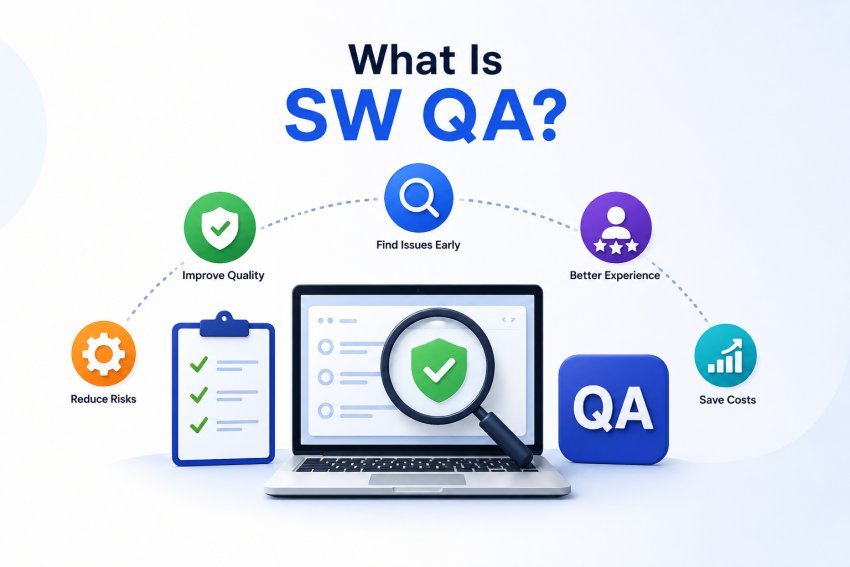
SW QA, short for Software Quality Assurance, is the structured approach used to help ensure that software processes and products meet defined quality requirements. It is not simply about finding bugs after development is complete. Instead, quality assurance focuses on building quality into the entire software development process.
From understanding user requirements to testing the final product, QA activities help teams identify risks early and improve the way software is created. This guide explains what software quality assurance is, how it works, why it matters, and how organizations can build an effective quality process.
What Is Software Quality Assurance?
Software Quality Assurance, commonly called SQA, is a planned and systematic approach to ensuring that software meets established requirements and quality standards.
Quality assurance focuses heavily on preventing problems, rather than waiting until customers discover them.
For example, imagine a company developing an online banking application. A software bug could cause users to see incorrect account information or prevent them from completing transactions. Instead of simply fixing problems after the application goes live, a strong QA process helps the team review requirements, test important features, monitor development practices, and reduce risks throughout the project.
Quality assurance is therefore broader than software testing alone.
According to widely accepted quality management principles, QA involves systematic activities designed to provide confidence that requirements will be met. In software development, this means creating processes that support reliable and consistent results throughout the software lifecycle.
Why Is Software Quality Assurance Important?
Poor-quality software can create serious problems for both businesses and users.
A defective application may lead to frustrated customers, financial losses, security concerns, damaged reputation, and expensive repairs. Finding a problem after software has been released can also be more difficult than identifying it during development.
This is why quality assurance should begin early.
An effective QA approach helps organizations:
- Reduce the number of software defects
- Identify problems earlier in development
- Improve customer satisfaction
- Create more reliable applications
- Support better communication between teams
- Reduce unnecessary rework
- Improve development processes over time
- Build confidence before releasing software
Quality is not the responsibility of only one person or department. Developers, testers, product managers, designers, and business stakeholders all play a role in delivering a successful product.
How SW QA Works Throughout the Software Development Lifecycle
A common misunderstanding is that QA starts when developers finish writing code. In reality, quality should be considered throughout the Software Development Lifecycle, or SDLC.
Requirements Review
Quality begins with understanding what the software is supposed to do.
QA professionals may review requirements to identify unclear, incomplete, or conflicting information. If a requirement is confusing, developers may build the wrong feature even if their code works perfectly.
For example, a requirement saying, “The system should load quickly,” is too vague. What does “quickly” mean?
A better requirement might define a measurable expectation, such as a page loading within a specific time under normal conditions.
Clear requirements make testing and development much easier.
Design Review
Before coding begins, teams often make important decisions about the software’s architecture and design.
QA can help identify potential risks during this stage. For example, a team may consider:
- How will the system handle many users?
- What happens if a server fails?
- Are important user actions properly validated?
- Can the application protect sensitive information?
Finding weaknesses during design can prevent larger problems later.
Development and Code Quality
Developers are responsible for writing the software, but quality assurance supports good development practices.
Teams may use:
- Coding standards
- Code reviews
- Version control
- Static code analysis
- Automated checks
- Unit testing
These practices help maintain consistency and identify problems early.
Testing
Testing is an important part of quality assurance, but it is only one part of the larger process.
Testers may check whether the software behaves correctly under different conditions. They can perform manual tests, automated tests, performance tests, security checks, and other evaluations depending on the project.
Release and Continuous Improvement
Quality work does not always end when software is released.
Teams can monitor the application, review production problems, collect user feedback, and study defects that escaped earlier testing.
This information helps improve future versions of the software and strengthens the overall development process.
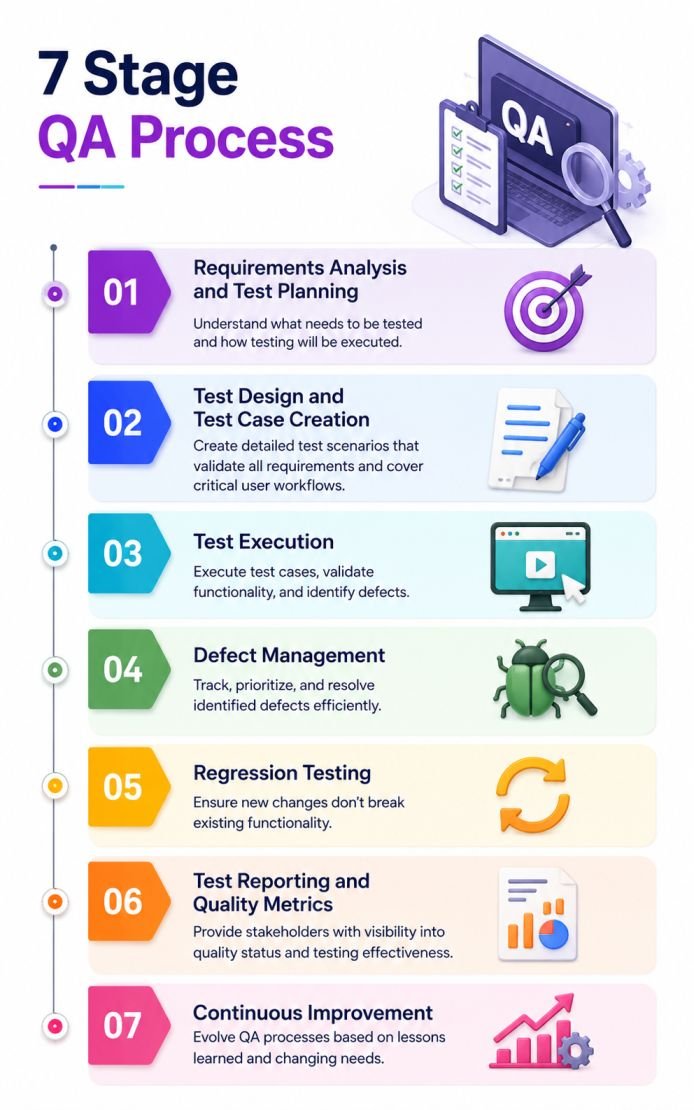
7 Stages of the QA Process
Software QA vs. Software Testing
Software QA and software testing are closely connected, but they are not exactly the same.
Quality assurance is generally more focused on processes and prevention. Testing focuses more directly on checking whether the software works as expected and identifying defects.
| Area | Software Quality Assurance | Software Testing |
|---|---|---|
| Main focus | Preventing defects | Finding defects |
| Scope | Entire development process | Software product and features |
| Approach | Process-oriented | Product-oriented |
| Timing | Throughout the SDLC | Often performed during development and before release |
| Main goal | Improve processes and confidence in quality | Verify that the software behaves correctly |
Both are important.
A company can perform excellent testing but still have weak processes. For example, if requirements are constantly unclear, testers may repeatedly discover problems that could have been prevented earlier.
The strongest teams combine effective processes with thorough testing.
Common Activities in Software Quality Assurance
Different organizations use different QA practices depending on their products and risks. However, several activities are common across many software projects.
Creating a Quality Plan
A quality plan explains how the team will approach quality.
It may define:
- Quality goals
- Team responsibilities
- Testing approaches
- Tools and environments
- Acceptance criteria
- Risk areas
- Reporting methods
A clear plan helps everyone understand what quality means for the project.
Reviewing Requirements and Documents
Reviews can identify problems before development begins.
Teams may review user stories, technical documents, designs, and acceptance criteria to make sure important information is complete and understandable.
Performing Different Types of Testing
Software may require several types of testing.
Common examples include:
Functional testing: Checks whether features work according to requirements.
Performance testing: Examines how software behaves under different workloads.
Regression testing: Ensures that new changes have not broken existing features.
Security testing: Helps identify weaknesses that could put systems or users at risk.
Usability testing: Evaluates whether users can understand and use the software effectively.
The right testing strategy depends on the application’s purpose and level of risk.
Tracking and Managing Defects
When testers discover problems, those issues should be documented clearly.
A useful defect report usually includes information about:
- What happened
- What was expected
- Steps to reproduce the problem
- The environment where it occurred
- Screenshots or other supporting evidence
- The severity or impact of the issue
Clear reporting helps developers understand and resolve problems efficiently.
Monitoring Quality Metrics
Teams can use data to understand how their processes are performing.
Useful metrics may include:
- Number of defects discovered
- Defect severity
- Test coverage
- Defect escape rate
- Failed test cases
- Time required to fix critical problems
However, metrics should be used carefully. A single number rarely tells the complete story.
For example, having fewer reported bugs does not automatically mean software quality is better. It could simply mean fewer people are testing the application.
A Practical Example of Software Quality Assurance
Imagine a company developing a food delivery application.
The application allows users to:
- Create an account.
- Search for restaurants.
- Add food to a cart.
- Make a payment.
- Track their delivery.
Without proper quality processes, the team might wait until the entire application is finished before testing it.
That could create major problems.
Instead, a strong QA approach might begin by reviewing requirements. The team could clarify how payments should work and what should happen if a transaction fails.
During development, developers might perform unit tests and code reviews.
Testers could then verify important scenarios, such as:
- Adding multiple items to a cart
- Applying discount codes
- Handling failed payments
- Displaying accurate order information
- Supporting many users at busy times
Before release, the team could perform regression and performance testing.
After launch, the company could monitor errors and user feedback.
This is a practical example of how SW QA supports quality throughout the entire lifecycle instead of treating testing as the final step.
Best Practices for Building an Effective QA Process
Start Quality Early
Do not wait until coding is finished.
Review requirements and designs early because preventing problems is often easier than repairing them later.
Define Clear Acceptance Criteria
Every important feature should have clear expectations.
For example, instead of saying, “Users should be able to log in,” define important conditions such as valid login, invalid passwords, locked accounts, and password recovery.
Use Automation Where It Provides Value
Automation can be especially useful for repetitive tests.
For example, regression tests that must run frequently may be good candidates for automation.
However, not every test should be automated. Exploratory testing and usability evaluations often benefit from human judgment.
Communicate Across Teams
Quality problems are often communication problems.
Developers, testers, designers, and business teams should discuss expectations regularly.
Early conversations can prevent misunderstandings that might otherwise become expensive defects.
Learn From Defects
Do not simply fix a bug and move on.
Ask important questions:
- Why did this problem happen?
- Could it have been prevented?
- Why was it not discovered earlier?
- What process should be improved?
This approach turns mistakes into opportunities for improvement.
Challenges in Software Quality Assurance
Software quality assurance can be difficult, especially when teams face tight deadlines and rapidly changing requirements.
Common challenges include:
Changing Requirements
Frequent changes can affect existing features and test plans.
Teams should maintain good communication and evaluate how changes affect the rest of the system.
Limited Time for Testing
Deadlines sometimes create pressure to reduce testing.
A better approach is to prioritize testing based on risk. Critical features should receive appropriate attention before lower-risk areas.
Complex Technology
Modern applications may include cloud services, APIs, mobile devices, databases, and third-party systems.
Testing these connected environments requires careful planning.
Maintaining Test Automation
Automated tests can save time, but they also require maintenance.
When software changes, outdated automated tests may need to be updated.
How to Improve Software Quality in Your Organization
Organizations looking to strengthen their QA practices can start with a few practical steps.
First, define what quality means for your software and users.
Second, involve QA thinking from the beginning of the project rather than only before release.
Third, establish clear requirements and acceptance criteria.
Fourth, use a balanced combination of manual and automated testing.
Finally, review defects and customer feedback regularly to identify areas for improvement.
Quality assurance works best when it becomes part of the organization’s culture rather than a final checkpoint.
Conclusion
Software Quality Assurance plays a critical role in creating reliable, useful, and trustworthy applications. It is much broader than simply testing for bugs. A strong quality approach considers requirements, design, development practices, testing, releases, and continuous improvement.
The main goal is not to promise that software will never contain a defect. Complex software can rarely guarantee that. Instead, the goal is to create effective processes that reduce risk, identify important problems, and give teams greater confidence in what they release.
When organizations build quality into the entire development lifecycle, they are better prepared to deliver software that meets user expectations and supports long-term business success.
Frequently Asked Questions
1. What does SW QA mean?
SW QA means Software Quality Assurance. It refers to the planned processes and activities used to help ensure that software meets defined quality requirements and performs as expected.
2. Is software QA the same as software testing?
No. Testing is an important part of quality assurance, but QA is broader. QA focuses on improving processes and preventing problems throughout the software development lifecycle, while testing focuses on evaluating software and identifying defects.
3. What does a software QA engineer do?
A software QA engineer may review requirements, create test plans, perform manual or automated testing, report defects, verify fixes, and help teams improve quality processes.
4. Why is software quality assurance important?
Software quality assurance helps reduce defects, improve reliability, support customer satisfaction, and identify risks earlier in development.
5. Can software testing be completely automated?
No. Automation is useful for repetitive and predictable tests, but human testers are still valuable for exploratory testing, usability evaluation, and situations that require judgment and creativity.
6. When should QA begin in a software project?
QA should begin as early as possible. Reviewing requirements and designs before development can help prevent problems that would be more expensive to fix later.
7. What makes a good software QA process?
A good process includes clear requirements, early quality planning, appropriate testing, strong communication, useful metrics, risk-based prioritization, and continuous improvement.

Read Dive is a leading technology blog focusing on different domains like Blockchain, AI, Chatbot, Fintech, Health Tech, Software Development and Testing. For guest blogging, please feel free to contact at readdive@gmail.com.