Did you know? According to research:
- The average cost of a data breach has reached up to $4.88 million, which makes it a financial necessity.
- 72% of companies believe that pen testing plays an imperative role in preventing them from a security breach.
- Only 17% of companies never implement a single pen test and leave major security blind spots.
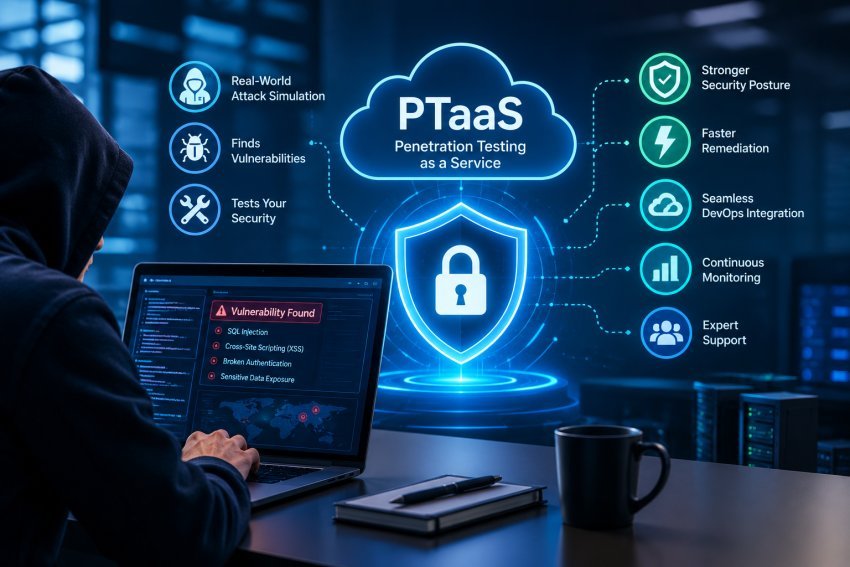
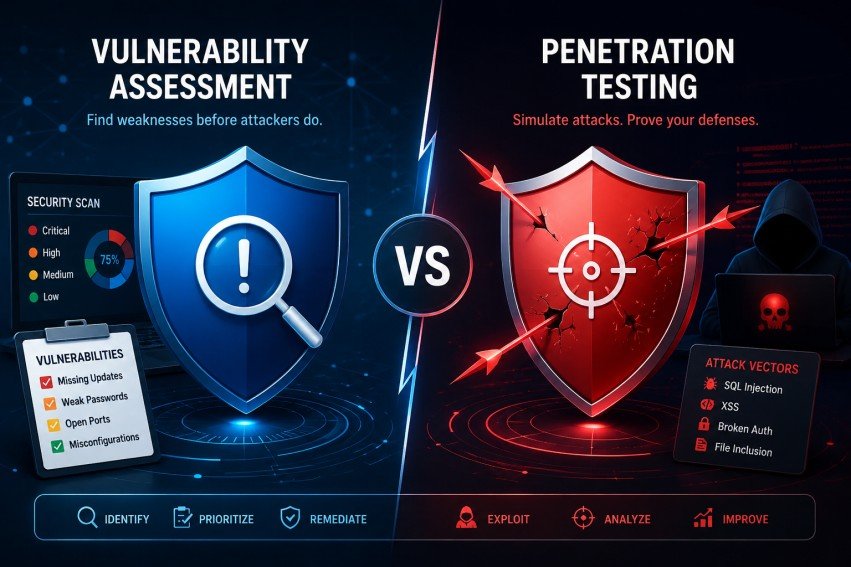
This highlights the significance of penetration testing. But first, we need to define what pen testing means. Pen testing is a replicated, authorized cyberattack on a network or computer system to identify security vulnerabilities before hackers exploit them. Pen testing is a 5-stage process.
Stages of Penetration Testing
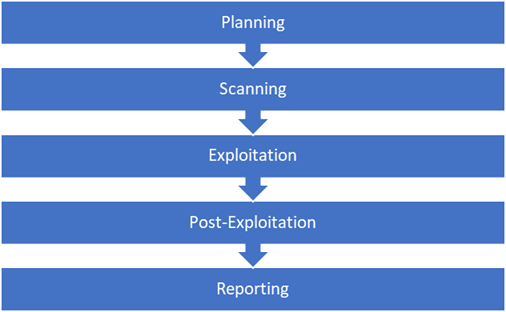
- Planning: Defining the rules, scope, and objectives of the test.
- Scanning: Incorporating tools to view the way the system responds to intrusion attempts.
- Exploitation: Finding ways to breach vulnerabilities such as weak passwords.
- Post-Exploitation: Looking at the degree to which an attacker can get deep and the level to which they can stay.
- Reporting: Reporting the flaws detected and the ways to resolve them.
This penetration testing is further divided into 2 categories:
- Internal pen testing
- External pen testing
Types of Penetration Testing
Internal Penetration Testing
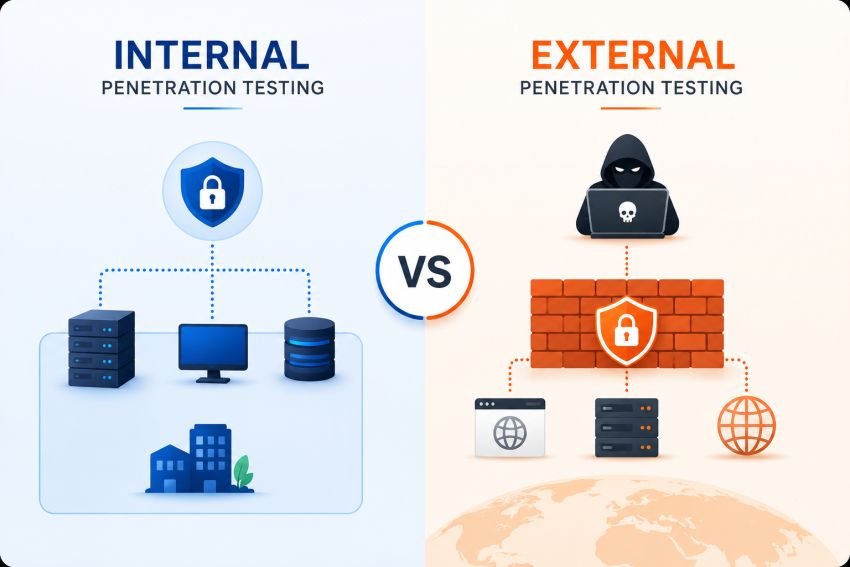
The internal infrastructure pen test concentrates on assessing attacks that could be carried out by an opponent who has already attained a proper hold within your network and is finding ways to promote themselves to attain more control and cause more harm. It also deals with security breaches that could be exploited by a malicious insider who wants to cause harm to areas of the company that are outside their access level.
Carrying Out Internal Pen Testing
After the discovery stage, there is an identification phase. A few examples of the types of activity that can take place in this stage are as follows:
- Intrusive testing of user accounts to try to attain unauthorized access on network machines.
- Trespassing of network routers and changes to monitor and regulate traffic, insert weaknesses, and take control of endpoints via exploitation protocols. For example, the web proxy auto-discovery protocols that normally assist in connecting with the internet can be abused by local attackers to sniff your web traffic.
- Exploiting popular vulnerabilities in software functioning locally to get into servers, raise current access, and prove attackers could implement malicious code.
External Penetration Testing
It is a security test that replicates an actual cyberattack from the public internet against a company’s internet-facing infrastructure. It targets firewalls and perimeter routers, DNS servers and email, VPN and remote access gateways, public-facing web apps, and APIs.
Carrying Out Internal Pen Testing
- Reconnaissance: Testers incorporate open-source intelligence (OSINT) and footprinting to plot domains, open ports, and subdomains with no previous credentials.
- Exploitation and Scanning: Manual techniques and automated tools pinpoint misconfigurations, weak authentication, and unpatched software. They attempt to chain weaknesses to convert weaknesses into active breaches.
- Reporting: An in-depth document highlights the paths, actual exploitability, and prioritized steps for remediation.
Latest Trends in Internal and External Penetration Testing
Here are some of the latest trends in internal and external penetration testing.
External Penetration Testing Trends
- Dynamic Attack Surface Management: Scans can go beyond static IP ranges to cover exposed API gateways that change every hour, API endpoints, and ephemeral cloud assets.
- Blast Radius and Reachability Focus: Instead of raw CVSS severity scores, the prioritization is driven by attackers on the internet.
- AI-Augmented Reconnaissance: Automated tools incorporate AI agents to plot multi-step exploits and filter out wrong positives quicker.
Internal Penetration Testing Trends
- Zero-Trust Architecture Validation: Testers routinely bypass the traditional assumption of micro-segmentation controls, testing stringent identity verification and internal network safety.
- Active Directory & Identity Abuse: The centers depend on lateral movement and credential dumping because one compromised user account regularly triggers complete domain takeovers.
- Purple Teaming Integration: Internal testing progressively amalgamates actual attack simulations with defensive monitoring feedback to see if security operations centers (SOCs) catch lateral movements.
Internal vs. External Penetration Testing
| Parameters | Internal | External |
| Objectives | The main objective is to identify vulnerabilities within an internal network that could be exploited by attackers who have crossed external defenses. It concentrates on internal system security, user privilege management, and internal access controls. | The main objective is to assess the company’s defense parameters like external-facing apps, VPNs, and firewalls to pinpoint vulnerabilities that can be exploited by cybercriminals and external hackers attempting to breach from outside. |
| Threat Simulation Focus | Replicates attacks from insiders who have attained internal access through physical breach, social engineering, and compromised credentials. It detects risks like access to sensitive information, lateral movement, and privilege escalation | Replicates attacks from outsiders who are trying to damage the company’s network from the internet. These attackers perhaps exploit bad perimeter security, web app vulnerabilities, and exposed services. |
| Scope | The scope entails intranet apps, servers, workstations, and network infrastructure. | The scope entails externally facing assets like exposed ports, VPNs, public APIs, email servers, and websites. |
| Methodologies | These methodologies focus on assessing the effectiveness of external security policies and detecting weak access controls, lateral movement, and privilege escalation. | It incorporates finding vulnerabilities in external-facing systems, detecting misconfigurations, unpatched software, and vulnerabilities in DNS setups. |
| Typical Use Cases | Replicating attacks by compromised accounts, assessing for data leakage risks, and evaluating the effect of an attacker who has crossed perimeter defenses. | Evaluating the company’s resilience against external attacks and threats, detecting exposed entry points like web apps, and preparing for possible data breaches |
Choosing Between Internal and External Penetrating Testing
While selecting between internal and external pen testing, companies must take into consideration numerous factors to adjust the testing approach to their particular requirements, entailing the following. Numerous companies, specifically those that function in regulated and high-risk ecosystems, benefit from a double approach that entails internal and external penetration testing.
Organization Size and Industry
Small and Medium-Sized Businesses (SMBs): External pen testing is sometimes the main focus because SMBs are vulnerable to external attacks. This is due to limited internal security infrastructure. SMBs lack sophisticated internal defenses. This makes them a basic target for external threats like DDoS, web app attacks, and phishing. External pen testing also helps prioritize external vulnerabilities that are easily exploitable.
Highly Regulated Industries & Large Enterprises: Both internal and external pen testing are important. Bigger companies with difficult internal infrastructures require internal tests to evaluate internal network security, entailing risks associated with privileged access, lateral movement, and insider threats. Industries such as energy, healthcare, and financial services must resolve both internal and external vulnerabilities to comply with strict cybersecurity rules and safeguard sensitive customer information.
Current Security Posture
Strong Security Posture: If your company already has a strong external defense layer (prevention systems and intrusion detection), it may be more significant to concentrate on internal pen testing to guarantee that lateral movement and insider threats are eliminated.
Weak Security Posture: External pen testing must be a priority if your company’s defenses are weak or you have had breaches. Detecting external vulnerabilities such as exposed services, obsolete software, and misconfiguration can significantly decrease the risk associated with successful external attacks.
Regulatory Compliance Requirements
Healthcare, Financial Services, and GDPR: Compliance methods like GDPR, HIPAA, and PCI DSS sometimes need vulnerability assessments, entailing pen testing. The majority of regulations mandate both external and internal testing, as they look to guarantee both internal controls and external defenses.
Critical Infrastructure: Regulatory bodies for critical infrastructure perhaps need pen tests that concentrate on both internal threats and external vulnerabilities. Compliance sometimes demands a holistic risk evaluation, entailing both external and internal testing.
Conclusion
Robust and secure infrastructure is important for your company’s cybersecurity. Companies can eliminate the risks associated with security breaches and safeguard against possible financial costs by implementing regular internal and external pen testing to detect and assist in resolving vulnerabilities. External pen testing is conducted remotely by ethical hackers. Companies depend upon external pen testing to advance their security posture by resolving main issues prior to converting them into a security incident.
Frequently Asked Questions (FAQs)
What is an internal pen test?
Internal penetration testing is a replicated cyberattack launched from inside a company’s network to look for security weaknesses that a rogue insider or a malicious actor could exploit.
What is an external pen test?
External penetration testing is a replicated cyberattack launched from the public internet against a company’s exposed assets to detect security weaknesses before actual hackers do.
What are the three types of pen tests?
- Black box,
- White box, and
- Gray box testing.

Read Dive is a leading technology blog focusing on different domains like Blockchain, AI, Chatbot, Fintech, Health Tech, Software Development and Testing. For guest blogging, please feel free to contact at readdive@gmail.com.