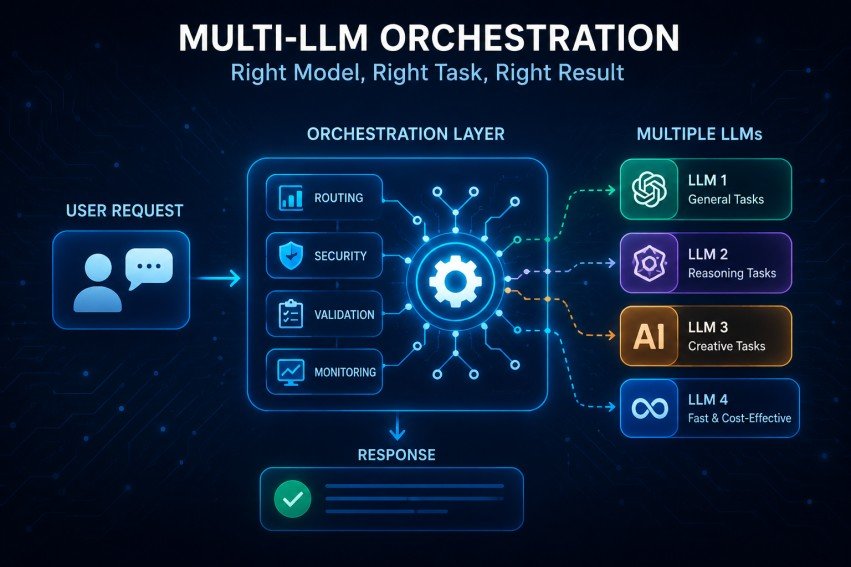
Multi-LLM orchestration allows an AI application to coordinate several large language models instead of relying on one model for every request. The orchestration layer can route tasks according to complexity, required accuracy, response time, cost, availability, and data-handling requirements.
This architecture can help businesses create more flexible and resilient AI systems. A smaller model may handle routine classification, while a more capable model processes complex analysis. If a preferred service is unavailable, an approved alternative may support continuity.
However, using multiple LLMs also introduces new challenges. Models behave differently, prompts may not transfer reliably, and data cannot always be sent to every provider. Successful orchestration therefore requires deliberate routing, validation, security, monitoring, and governance.
Why One LLM May Not Suit Every Task
Business AI systems often support several types of work. The same application may need to classify requests, extract structured data, summarize documents, generate customer communications, and analyse complex cases.
Using the most capable model for every step can increase costs and response times unnecessarily. Using a smaller model for every request may reduce quality on demanding tasks.
Different LLMs may also have different strengths in areas such as:
- instruction following;
- structured output;
- long-document processing;
- tool use;
- multilingual content;
- reasoning;
- response speed;
- private deployment;
- operating cost.
Multi-LLM architecture allows organizations to match these characteristics to individual tasks. The objective is not to identify one universally superior model but to select an appropriate model for each defined requirement.
Begin With a Workflow Assessment
Model selection should follow an understanding of the business workflow.
Teams should map the stages of the process, including its inputs, decisions, data sources, software tools, exceptions, and expected outputs. They can then determine where an LLM is useful and where conventional software is more appropriate.
For example, an LLM may interpret an unstructured customer message. Deterministic code can verify the account, apply a calculation, and enforce transaction limits. A second LLM may prepare a response only after these checks succeed.
This separation prevents models from being used for tasks that require exact and repeatable results. It also makes the system easier to evaluate because each component has a clearly defined responsibility.
Create a Model-Task Map
A model-task map documents which LLM is responsible for each part of the workflow and why it was selected.
For every task, the organization should define:
- required input;
- expected output format;
- minimum quality threshold;
- acceptable response time;
- permitted operating cost;
- data sensitivity;
- available tools;
- fallback model;
- escalation conditions.
A routine intent-classification task may prioritize speed and cost. A complex compliance analysis may require stronger reasoning, access to authoritative sources, and human approval.
The map should be based on tests using representative business data rather than general model rankings. Public benchmarks may provide useful context, but they cannot predict performance on every organization’s documents, terminology, or workflows.
Select a Routing Method
Routing determines which LLM receives a particular task. The simplest approach uses predefined rules.
For example, the system may send routine classification to one model, document analysis to another, and sensitive tasks to a model operating in an approved environment. Rules-based routing is transparent and relatively easy to test.
Dynamic routing uses a classifier or model to examine each request before choosing an LLM. It may consider complexity, input length, topic, language, or required tools.
Another approach starts with a lower-cost model and escalates the task if the response fails validation. This method can reduce costs for simple requests, but repeated attempts may increase latency and total usage.
The routing strategy should optimize successful task completion rather than the price of an individual model call.
Standardize Inputs and Outputs
Different LLMs may interpret the same prompt differently. They may also produce outputs with inconsistent structure, tone, terminology, or detail.
The orchestration layer should normalize inputs and validate outputs before sending them to other components.
Structured formats can help downstream software process model responses. The system should check that required fields are present, values use the correct type, and responses follow the permitted schema.
Prompts may need model-specific versions. An instruction designed for one LLM may perform poorly with another, even when both models support the same general capabilities.
A useful architecture separates shared business requirements from provider-specific prompts and interfaces. This makes individual LLMs easier to test, update, or replace without changing the complete application.
Protect Sensitive Data
Multi-LLM systems may involve several providers, deployment environments, and data-processing arrangements. Not every model should receive the same information.
The orchestration layer must examine data sensitivity before considering cost or convenience. A request containing personal, financial, medical, or confidential business information may need to remain within an approved environment.
Controls may include:
- redacting unnecessary sensitive data;
- selecting models according to data classification;
- limiting access to internal sources;
- encrypting stored and transmitted information;
- applying user and role permissions;
- managing model credentials securely;
- defining retention and deletion rules;
- recording model access and processing.
Fallback routing must respect the same restrictions. If an alternative model is not authorized to process the data, the system should stop or escalate the task rather than route it automatically.
Validate LLM Responses
Language models can produce plausible but incorrect answers. Validation is essential before their outputs influence business decisions or trigger actions.
The orchestration system may:
- confirm that required fields are present;
- check identifiers against source systems;
- verify that cited documents exist;
- compare statements with retrieved evidence;
- recalculate numerical results;
- apply business rules;
- detect restricted content;
- request human approval.
One LLM can review the work of another, but this should not be treated as proof of correctness. Models may repeat the same unsupported assumption or fail to identify a subtle error.
Where possible, validation should use authoritative data and deterministic software. Human specialists should remain involved when decisions carry significant legal, financial, safety, or reputational consequences.
Plan for Model Failure
An LLM may become unavailable, exceed its response-time limit, produce an invalid format, or fail to meet the required quality threshold.
The orchestration layer should define what happens in each case. Options include retrying the request, switching to an approved alternative, simplifying the task, asking the user for more information, or escalating to an employee.
Fallback models should be tested in advance. A model that can technically accept the same request may not provide comparable accuracy, context capacity, or tool-use behaviour.
Some workflows should stop rather than use a weaker alternative. For high-risk actions, a controlled failure may be safer than an answer produced by a model that does not meet the required standard.
Retries should also have limits. Repeated model calls can increase cost and delay without resolving the underlying issue.
Monitor Performance at the Workflow Level
Multi-LLM systems need detailed monitoring so teams can understand which model handled each task and whether it performed successfully.
Useful measures include:
- routing frequency;
- task-completion rate;
- factual accuracy;
- structured-output failures;
- response latency;
- fallback usage;
- human escalation;
- employee corrections;
- model and infrastructure costs;
- cost per completed workflow.
Performance should be segmented by task type. An LLM may perform well overall while consistently failing on a particular language, document type, or exception scenario.
Monitoring can identify where routing rules should change and whether a model still provides sufficient value to justify its integration.
Test Model and Prompt Updates
LLM providers may update their systems, release new versions, change pricing, or retire older models. These changes can affect application behaviour.
Every new model or material configuration change should be tested against a stable evaluation set before receiving production traffic.
A controlled rollout can direct a limited percentage of suitable requests to the new configuration. The organization can then compare quality, latency, costs, and failure rates with the current option.
Evaluation data, prompts, configurations, and routing rules should be version-controlled. If performance declines, teams need to identify what changed and restore the previous configuration where possible.
Avoid Complexity Without Evidence
Each additional LLM introduces integration work, security review, monitoring, testing, and failure scenarios. Model diversity should therefore solve a demonstrated problem.
An organization can begin with one primary LLM and one approved alternative. Additional models can be introduced when testing shows a clear opportunity to improve quality, reduce costs, meet privacy requirements, or strengthen availability.
If two models perform similarly, maintaining both may not be worthwhile. Simplifying the architecture can improve reliability and make incidents easier to investigate.
The best orchestration system is not the one with the largest collection of models. It is the one that meets business requirements with the least unnecessary complexity.
Maintain Human Accountability
Models can generate recommendations and perform selected actions, but responsibility remains with the organization.
Named teams should own model approval, security, evaluation, costs, data access, incident response, and workflow outcomes. Employees should understand when the system uses a fallback and when a result requires review.
Documentation should record why each model was selected, which tasks it supports, what information it may process, and what limitations are known.
This governance structure helps prevent multi-LLM architecture from becoming a collection of poorly understood services.
Conclusion
Multi-LLM orchestration gives organizations a practical way to combine the strengths of different language models while managing quality, cost, privacy, and service availability.
Its value depends on disciplined implementation. Teams need clear task definitions, evidence-based routing, consistent interfaces, secure data handling, reliable validation, and continuous monitoring.
By starting with a simple architecture and adding models only when they create measurable improvements, businesses can build adaptable AI systems without sacrificing transparency, security, or operational control.

Read Dive is a leading technology blog focusing on different domains like Blockchain, AI, Chatbot, Fintech, Health Tech, Software Development and Testing. For guest blogging, please feel free to contact at readdive@gmail.com.