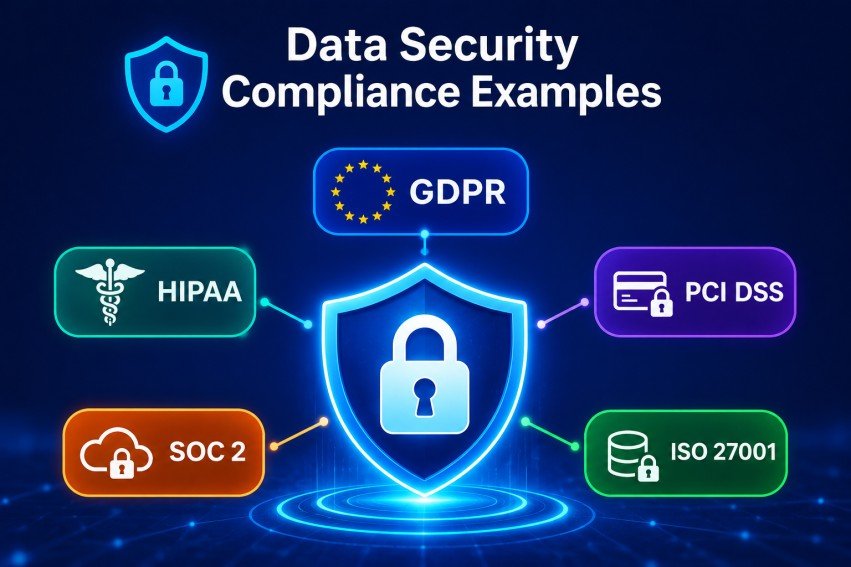
Companies that deal with sensitive information need to make sure they are complying with the relevant data security standards and regulations set by the industry. Failure to comply with these rules will result in legal difficulties and costly penalties. With the knowledge of data security compliance examples in hand, businesses will be able to determine the relevant security processes to implement.
What is data security compliance all about?
Data security compliance refers to a set of laws and regulations that protect sensitive information in a given industry. It defines the ways sensitive data must be collected, stored, and disposed of, among other things.
There are different compliance requirements for different industries as well as for different locations. For example, the healthcare industry may have its own rules for protecting patients’ information while the financial sector is responsible for ensuring data security and the safety of its customers’ information.
5 Data Security Compliance Examples
1. GDPR compliance
The General Data Protection Regulation (GDPR) kind of applies to organizations that process the personal data of people in the European Union, in the right kinds of conditions. In practice, companies have to set up suitable safeguard measures, keep the data gathering to what is truly needed, and make sure individuals can exercise their rights about their own personal information.
2. HIPAA compliance
Healthcare organizations, plus some business partners in the United States, must follow the Health Insurance Portability and Accountability Act (HIPAA) rules for protecting protected health information. Security controls here usually include things like access management, audit logs, encryption, training programs for employees, and defined procedures for handling security incidents when they pop up.
3. PCI DSS compliance
The Payment Card Industry Data Security Standard (PCI DSS) is all about guarding payment card information. If a business processes, stores, or even transmits cardholder data, it may need controls such as network protection, tighter access restrictions, vulnerability handling, and regular security testing.
For instance, a retailer can lower how much payment data sits around by using secure payment systems, so the amount of card details kept internally is reduced.
4. SOC 2 Compliance
SOC 2 is basically a framework that tech and service organizations often use to show controls around things like security, availability, and confidentiality. For instance, a SaaS company might lean on role-based access controls, continuous monitoring, employee security training, and written incident response procedures, just to back up those security controls and keep things auditable.
5. ISO 27001
ISO/IEC 27001 lays out requirements for setting up and then continually improving an information security management system, ISMS. Companies can use it to figure out information security risks in a structured way and then apply the right controls. A company aiming for ISO 27001 certification may do regular risk assessments, create security policies, manage access permissions, and keep documented procedures for dealing with security incidents, too.
Data Security Compliance Examples
| Compliance Standard | Industry / Organizations | Main Purpose | Key Data Protected | Common Security Controls | Compliance Benefit |
|---|---|---|---|---|---|
| GDPR | Organizations processing personal data of individuals in the EU under applicable conditions | Protect personal data and give individuals greater control over their information | Names, contact details, online identifiers, location data, and other personal information | Data minimization, access controls, encryption, privacy policies, data protection processes, breach response | Helps organizations meet privacy obligations and build customer trust |
| HIPAA | U.S. healthcare organizations and applicable business associates | Protect protected health information (PHI) | Patient medical records, health information, insurance information, and related identifiers | Encryption, access management, audit logs, employee training, risk assessments, incident response | Supports the protection and appropriate handling of sensitive health information |
| PCI DSS | Organizations that process, store, or transmit payment card data | Protect cardholder and payment information | Cardholder data and sensitive authentication information | Network security, restricted access, vulnerability management, encryption, security testing, monitoring | Reduces risks associated with payment-card data breaches |
| SOC 2 | Technology companies, SaaS providers, and service organizations | Demonstrate effective controls related to trust services criteria | Customer and business data handled by service providers | Role-based access, monitoring, security training, incident response, access reviews, documented controls | Provides customers and partners with evidence of security and operational controls |
| ISO/IEC 27001 | Organizations across industries that manage information assets | Establish and continually improve an Information Security Management System (ISMS) | Business information, customer data, employee information, intellectual property, and other information assets | Risk assessments, security policies, access management, incident management, supplier controls, continuous improvement | Provides a structured, risk-based approach to information security management |
Tip: Compliance requirements can vary based on an organization’s industry, location, business activities, and the type of information it processes. Organizations should verify the specific requirements that apply to their operations.
Why Data Security Compliance Matters?
Compliance is not only about dodging fines. If handled well, compliance activities can help organizations lower the odds and also the damage from data breaches. They can also boost customer trust and give you more consistent security processes, even when teams or vendors change. At the same time, businesses should note that compliance doesn’t automatically mean “fully secure.” Regulations and standards do give a structured base, but organizations still have to watch for threats and keep iterating, basically upgrading their security controls, over time.
Conclusion
These data security compliance examples, including GDPR, HIPAA, PCI DSS, SOC 2, and ISO 27001, show how organizations can guard sensitive information while still meeting regulatory or industry expectations. The best path is going to depend on your sector, your geography, the kind of data you handle, and how your business actually runs day to day. When you connect compliance obligations with solid security practices, businesses tend to end up with a more resilient and dependable data environment.
Frequently Asked Questions (FAQs)
What are examples of data security compliance?
Examples include data encryption, access controls, MFA, security audits, employee training, secure backups, incident response plans, and regular risk assessments.
What are the most common data security compliance standards?
Common standards and regulations include GDPR, HIPAA, PCI DSS, SOC 2, and ISO 27001. The appropriate requirements depend on the organization’s industry, location, and data-processing activities.
How can a company improve data security compliance?
A company can start by identifying the data it handles, assessing risks, implementing appropriate security controls, documenting policies, training employees, and regularly reviewing compliance requirements.

Read Dive is a leading technology blog focusing on different domains like Blockchain, AI, Chatbot, Fintech, Health Tech, Software Development and Testing. For guest blogging, please feel free to contact at readdive@gmail.com.